Jim Goodwin marked his return to the Dundee United dugout in emphatic fashion as his side produced a commanding 3-0 victory over St Mirren at the SMiSA Stadium. The result was shaped by a devastating first-half display, with Jesse Randall, Lyall Cameron and Kevin Ciubotaru all finding the net before the interval.
The occasion carried particular significance for Goodwin, who had recently been away from the touchline following a health scare. His return came against St Mirren, a club he previously managed, making the circumstances even more notable. Dundee United responded with an outstanding performance that gave their manager the ideal welcome back.
For St Mirren, the afternoon was considerably more difficult. The home side struggled to create clear opportunities and ultimately finished the contest without registering a shot on target. Their third consecutive league defeat added further disappointment to what had already been a challenging run of results.
The victory therefore carried significance beyond the scoreline. Dundee United demonstrated attacking efficiency, defensive discipline and the ability to take control of a match before their opponents could establish any rhythm.
Goodwin Returns to the Touchline
All eyes were naturally on Jim Goodwin before kick-off.
The Dundee United manager had recently experienced a health scare, meaning his return to the dugout was an emotional moment for the club. The circumstances made the fixture against St Mirren particularly interesting because Goodwin previously managed the Paisley side.
Rather than allowing the occasion to become a distraction, however, Goodwin’s team produced an extremely focused performance.
The players appeared determined to make the manager’s return memorable, and their intensity was evident from the opening minutes.
Dundee United did not spend the first half cautiously feeling their way into the contest. Instead, they attacked with purpose and quickly established an advantage.
Within just six minutes, the visitors were ahead.
That early goal immediately changed the atmosphere inside the stadium.
Randall Makes an Immediate Impact
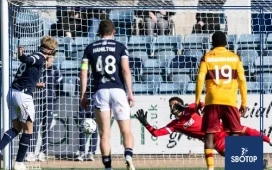
Jesse Randall opened the scoring after only six minutes. Daniel Bennie provided the pass that sent Randall into a dangerous position, and the forward took advantage of hesitation between St Mirren goalkeeper Jacob Chapman and defender Calvin Ramsay.
Randall rounded Chapman before calmly finishing into the bottom-left corner.
It was an excellent example of taking advantage of uncertainty inside the defensive line.
The goal also gave Dundee United exactly what they would have wanted from the opening stages: an early lead that allowed them to play with confidence.
St Mirren attempted to respond, but their efforts lacked the accuracy required to seriously test Jack Walton.
Instead, Dundee United continued to look dangerous whenever they moved forward.
The visitors were playing with a sense of urgency that St Mirren struggled to match.
Cameron Doubles Dundee United’s Advantage
Dundee United did not have to wait long for their second goal.
Just six minutes after Randall had opened the scoring, Lyall Cameron made it 2-0.
Idjessi Metsoko found Cameron, who cut inside from the left before producing a low finish from outside the penalty area. The shot beat Chapman and found the bottom-left corner.
The goal represented another moment of high-quality attacking play.
Cameron’s willingness to move inside created space for the shot, while his technique allowed him to keep the effort low and accurate.
At 2-0, Dundee United were suddenly in complete control.
St Mirren now had to score twice merely to draw level, yet they were struggling to create sustained attacking pressure.
The home side needed a response quickly, but Dundee United’s organisation prevented them from building momentum.
St Mirren Briefly Threaten a Response
Despite falling two goals behind, St Mirren did attempt to fight their way back into the match.
Fraser Taylor had an opportunity from outside the penalty area but sent his attempt over the target.
Eseosa Sule later produced a more dangerous effort, with his powerful shot striking the top of the crossbar before going over.
That moment briefly suggested that St Mirren might be able to change the direction of the contest.
However, Dundee United remained the more dangerous team.
The visitors were particularly effective when they transitioned from defence into attack, and their ability to exploit spaces in the St Mirren defence continued to create problems.
The home side therefore found themselves in an uncomfortable position: they needed to attack, but doing so risked leaving even more room for Dundee United’s forwards.
VAR Drama Adds Another Twist
St Mirren appeared to have been given a potential route back into the contest when they were awarded a penalty.
The decision followed a foul by Bert Esselink on Paul Nsio.
However, the situation was reviewed by VAR, and the penalty was overturned after the officials determined that there had been an offside offence earlier in the attacking sequence.
It was an important moment.
Had St Mirren been allowed to take the penalty and score, the match could have developed into a very different contest.
Instead, Dundee United retained their two-goal advantage.
The decision also added to St Mirren’s frustration, as the home side were struggling to find a way into the match.
Dundee United used the reprieve effectively.
Bennie Avoids a Red Card
There was another major VAR incident shortly afterward, this time involving Dundee United.
Daniel Bennie was initially shown a red card following a crude tackle on Ryan Carr.
The decision threatened to change the entire complexion of the match.
With Dundee United leading 2-0, playing the second half with ten men would have given St Mirren renewed hope.
However, after another VAR review, the red card was downgraded to a yellow.
Dundee United were therefore allowed to continue with a full complement of players.
It proved to be another pivotal moment.
Instead of entering half-time with St Mirren believing they could take advantage of numerical superiority, Dundee United remained in control.
And they were not finished scoring.
Ciubotaru Delivers a Third Blow
Just before the interval, Dundee United scored again.
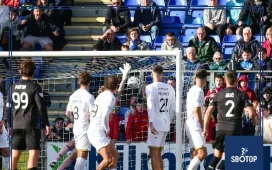
Kevin Ciubotaru added the third goal after being played through by Randall following a set-piece situation.
His left-footed finish from inside the penalty area beat Chapman and gave the visitors a 3-0 advantage at half-time.
The timing could hardly have been worse for St Mirren.
The hosts had spent parts of the first half trying to recover from the two-goal deficit, and the third goal effectively ended any immediate hope of a comeback.
For Dundee United, it was the perfect conclusion to a remarkable opening 45 minutes.
Three goals, a clean sheet and control of the match gave Goodwin an ideal platform for his return.
A Three-Goal Lead Changes the Second Half
The second half naturally developed differently.
Dundee United no longer needed to take unnecessary risks. With a three-goal advantage, the visitors could focus on managing the game while waiting for opportunities to attack.
St Mirren had to take greater risks.
The home side had more possession overall, finishing with approximately 59 percent of the ball compared with Dundee United’s 41 percent. However, possession did not translate into meaningful chances. St Mirren finished with 10 attempts but none on target.
That statistic tells much of the story.
St Mirren were able to circulate the ball, but Dundee United’s defensive structure prevented them from creating shots that genuinely threatened Walton.
The visitors, meanwhile, recorded 13 attempts, with nine on target.
The contrast demonstrated Dundee United’s efficiency.
Dundee United Continue Creating Chances
Although Dundee United were three goals ahead, they did not simply sit back.
They continued to create opportunities when St Mirren pushed forward.
Dylan Tait came close to adding a fourth, only to be denied by a strong save from Chapman.
Another Dundee United attack resulted in the ball being put into the net, but the effort was ruled out for offside.
The visitors therefore had opportunities to increase their advantage even after the interval.
That attacking intent was important.
Rather than allowing St Mirren to dominate the second half completely, Dundee United continued to remind their opponents that another goal was possible.
St Mirren Struggle to Find a Way Through
St Mirren’s biggest problem throughout the afternoon was their lack of penetration.
The home side attempted to create openings through crosses and long-range efforts, but Dundee United were able to defend their penalty area effectively.
The statistics underline the problem.
St Mirren attempted 17 crosses and completed six, while Dundee United attempted 14 and completed three. Yet the home side could not turn those deliveries into a shot on target.
Their attacking movements repeatedly ended before they could produce a decisive final action.
That allowed Dundee United to maintain their clean sheet without having to endure sustained pressure inside their penalty area.
Chapman Keeps the Scoreline from Growing
While St Mirren struggled as a team, goalkeeper Jacob Chapman deserves recognition for preventing an even heavier defeat.
He made several saves during the second half, including an important stop to deny Tait.
Chapman was also required to deal with Dundee United attacks late in the match.
Without those interventions, the final score could have been even more emphatic.
Nevertheless, the goalkeeper’s efforts could not alter the outcome.
The damage had already been done during the first half.
A Difficult Afternoon for St Mirren
For St Mirren, the result was another setback.
The club entered the match looking to respond after defeats against Rangers and Celtic, but instead suffered a third consecutive league loss.
The run meant St Mirren remained under pressure to find a positive result in their next fixture.
The most concerning aspect was the attacking performance.
A team can sometimes lose while creating numerous opportunities, but St Mirren did not manage to register a single shot on target.
That will naturally be a focus for the coaching staff.
The challenge will be finding greater creativity and accuracy in the final third.
Goodwin Gets Exactly the Response He Wanted
From Dundee United’s perspective, the match could hardly have gone better.
Goodwin returned to the dugout and immediately watched his side produce a convincing away victory.
The three goals were spread among Randall, Cameron and Ciubotaru, showing that Dundee United were not dependent on one individual for their attacking output.
Randall contributed a goal and an assist.
Cameron provided a technically impressive second.
Ciubotaru completed the scoring.
That variety will be encouraging for Goodwin as he looks to build momentum.
Randall Emerges as a Key Figure
Randall’s contribution deserves particular attention.
His opening goal came from intelligent movement and composure, while his involvement in the third goal demonstrated his ability to contribute creatively as well.
Scoring early is often important for an attacking player because it can create confidence.
Randall’s performance suggested he was comfortable in the role and capable of influencing the match beyond simply finishing chances.
His combination with teammates also helped Dundee United exploit St Mirren’s defensive weaknesses.
Cameron’s Strike Adds Another Highlight
Cameron’s goal was arguably one of the technical highlights of the contest.
Receiving the ball on the left, he moved inside and created the angle required to shoot from outside the penalty area.
The low finish gave Chapman little opportunity to intervene.
Goals from distance can be particularly valuable because they force defenders to close down attackers earlier.
For Dundee United, Cameron’s ability to contribute from that position provides another attacking dimension.
Ciubotaru Caps a Perfect First Half
Ciubotaru’s goal completed an extraordinary first-half sequence.
Dundee United had scored three times in 45 minutes and effectively decided the match before the break.
His finish also demonstrated the importance of set pieces.
Randall’s delivery created the opportunity, and Ciubotaru made no mistake when the ball reached him.
Set-piece efficiency can often be decisive in Scottish Premiership matches, particularly when games are tightly contested.
On this occasion, it helped Dundee United turn a strong performance into a commanding lead.
The Importance of Defensive Discipline
Dundee United’s attacking display understandably attracted most of the attention, but their defensive performance was equally important.
St Mirren had more possession and attempted numerous crosses, yet failed to put a single effort on target.
That indicates that Dundee United’s defenders were effective at protecting the central areas of the pitch.
Their aerial performance was also strong.
Dundee United won 73.3 percent of the aerial duels recorded in the match, compared with 26.7 percent for St Mirren.
Those numbers help explain why St Mirren struggled to turn possession and crossing opportunities into dangerous chances.
Also Read: