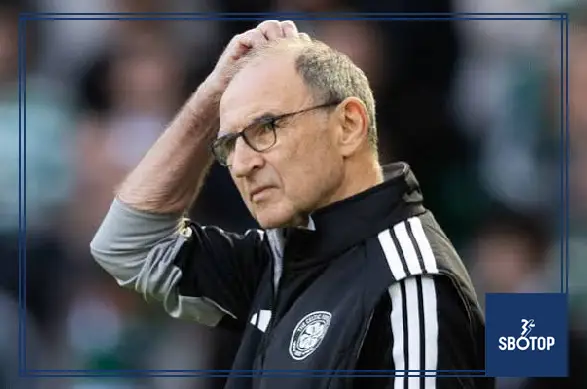
Martin O’Neill’s second spell in charge of Celtic has suddenly entered an uncertain phase after a difficult week left the Scottish champions facing serious questions about their form, performances and direction.
A 1-0 defeat to Rangers at Celtic Park on September 20 completed a sequence of three consecutive losses for O’Neill’s side. It followed a 3-0 defeat to Rangers in the League Cup at Ibrox and a 3-1 Europa League loss to Ferencvaros at home.
The latest Old Firm defeat was particularly significant because it allowed Rangers to move within two points of Celtic at the top of the Scottish Premiership while handing Derek McInnes’ team back-to-back victories over their city rivals.
For O’Neill, however, the most significant development came after the final whistle.
The experienced manager openly acknowledged that he would reflect on his position and speak to the Celtic board during the international break. His comments included a joking reference to his age and the possibility that it could be time to “wrap it up”.
Those remarks immediately intensified speculation about his future.
Yet the situation is more complicated than simply suggesting that O’Neill is about to leave Celtic. The club’s chief executive, Michael Nicholson, subsequently expressed public support for the manager and the players, indicating that the board remains behind O’Neill despite the difficult run.
The result is an intriguing situation in Glasgow: a manager questioning his own future while the club hierarchy publicly signals continued support.
Rangers Complete a Remarkable Derby Double
The latest defeat was Celtic’s first Scottish Premiership loss of the season, but the context made it particularly damaging.
Rangers had already defeated Celtic 3-0 at Ibrox in the League Cup only seven days earlier. The return fixture at Celtic Park therefore represented an opportunity for O’Neill’s side to respond immediately.
Instead, Rangers produced another disciplined performance.
Ryan Naderi scored the only goal of the match in the 33rd minute after Celtic goalkeeper Viljami Sinisalo parried a powerful effort from Kim Min-su.
Naderi reacted quickest to the rebound and converted from close range.
Celtic had opportunities, including a Kieran Tierney effort that struck the woodwork, but Rangers generally looked more threatening and better organized.
Rangers also had a second goal ruled out by VAR after Olwethu Makhanya found the net, meaning the final scoreline did not necessarily reflect the number of opportunities created by the visitors.
The victory moved Rangers to within two points of Celtic.
More importantly, it gave McInnes’ team considerable confidence after two successful meetings with the champions in the space of eight days.
Martin O’Neill Celtic Future Becomes the Central Question
Martin O’Neill’s comments after the match transformed the conversation.
The 74-year-old manager said he would reflect on whether he could still help the team before speaking with the board.
He accepted responsibility for the result and acknowledged that defeats at this level naturally raise questions.
His comments about his age attracted significant attention, particularly when he joked that he would be “110 in two years’ time” before suggesting that it might be time to end his spell in charge.
The remark was delivered with humour, but the broader message was considerably more serious.
O’Neill was not simply discussing retirement in abstract terms. He explicitly said he would assess whether he could still help Celtic and indicated that discussions with the board would follow.
That made the international break an important period for the club.
Rather than immediately announcing a decision, O’Neill appeared to want time away from the immediate pressure of the Old Firm defeat.
He also acknowledged that Celtic had lost several major matches, including European fixtures and the two games against Rangers.
The comments created uncertainty because O’Neill had only recently returned to the Celtic job on a permanent basis after helping stabilize the club during a turbulent previous season.
Three Defeats in Eight Days Change the Conversation
The timing of the results is crucial.
A single Old Firm defeat can be absorbed during a long campaign.
Two defeats to the same opponent in a week naturally attract greater attention.
Adding a European defeat between them created a sequence that was impossible for Celtic to ignore.
The 3-0 League Cup defeat at Ibrox was followed by the 3-1 loss to Ferencvaros in the Europa League.
Celtic then returned to league action against Rangers and suffered another defeat.
The three results represented three different competitions, meaning the problem could not be dismissed as a single bad performance in one tournament.
At the same time, the league position provides important context.
Celtic remained top of the Scottish Premiership after seven matches and held a two-point advantage over Rangers.
That means the title race had not suddenly been decided by the Old Firm result.
There remained a substantial amount of football to play.
Rangers manager Derek McInnes himself emphasized this point after the match, describing the victory as important while noting that there were still many points available during the season.
Therefore, the immediate issue surrounding O’Neill is less about Celtic having lost control of the league and more about the sharp deterioration in results and performances over one particular week.
Celtic’s European Setback Added to the Pressure
The Rangers defeats were not the only concern facing Celtic.
The club also suffered a disappointing European campaign at the Champions League qualifying stage.
Celtic’s Champions League play-off collapse against LASK meant the club missed out on the competition’s league phase.
O’Neill subsequently took his team into the Europa League, where the campaign began with a home defeat to Ferencvaros.
That 3-1 loss added another layer of frustration before the second meeting with Rangers.
The European situation matters because competing successfully on the continental stage is an important objective for Celtic.
Failure to reach the Champions League already represented a major setback in sporting and financial terms.
A poor start in the Europa League therefore increased scrutiny on the team.
The sequence also placed greater attention on recruitment, tactics and the ability of the squad to perform against stronger opposition.
These issues will not necessarily be solved during one international break, but the pause provides O’Neill and the club with an opportunity to assess them.
Rangers’ Tactical Approach Created Problems
The two recent Old Firm victories also demonstrated how Rangers were able to disrupt Celtic.
McInnes’ team played with energy, aggression and organization.
In the Premiership meeting, Rangers were particularly effective in central areas and prevented Celtic from developing a consistent attacking rhythm.
Celtic struggled to turn possession into clear opportunities.
According to match analysis, the home side managed only five shots on target compared with eight from Rangers, while Tierney’s effort against the woodwork was one of their clearest chances.
The visitors, meanwhile, looked comfortable defending their advantage during the second half.
That does not mean Celtic lacked attacking talent.
Instead, the problem was turning that talent into a coherent attacking structure.
O’Neill admitted that there was plenty for him to consider.
The manager had already experimented with different formations and personnel during the difficult run, but the performances against Rangers suggested that the team had not yet found a reliable solution.
The International Break Comes at a Significant Moment
Celtic now have time to step away from competitive club football.
The international break gives O’Neill an opportunity to reflect without having another immediate fixture placed in front of him.
It also gives Celtic’s hierarchy time to assess the situation.
O’Neill has indicated that he intends to speak to the board.
At the same time, the board has made clear that it continues to support him.
That combination is important.
The club does not appear to be publicly preparing for an immediate managerial change.
Instead, the situation currently depends heavily on O’Neill’s own assessment of whether he can continue to lead the team effectively.
Michael Nicholson’s subsequent comments were significant because they provided a degree of clarity following the speculation.
In Celtic’s financial reporting, Nicholson said the club would come together to support O’Neill and the players while focusing on domestic and Europa League objectives.
That does not amount to an absolute guarantee about the manager’s long-term future.
However, it does demonstrate that the club hierarchy has not publicly withdrawn its backing.
Celtic and Martin O’Neill Have a Complicated Recent History
O’Neill’s current situation cannot be separated from what happened before this season.
The Northern Irishman returned to Celtic during a period of considerable instability.
He had already served as an interim manager before eventually becoming the permanent boss again.
Last season, he helped guide Celtic to the Scottish Premiership title and Scottish Cup success after the club had experienced managerial upheaval.
That achievement gave O’Neill considerable credit with supporters.
His first Celtic spell from 2000 to 2005 was also hugely successful, producing three league titles and several major cup victories.
The 2003 UEFA Cup final against Jose Mourinho’s Porto remains one of the most memorable European nights in the club’s modern history, despite Celtic eventually losing the match.
Those achievements form an important part of the context surrounding his current position.
The latest setbacks do not erase that record.
At the same time, past success cannot remove the need for Celtic to respond to current problems.
The club has to decide how best to address the present situation while considering O’Neill’s own wishes and assessment.
The Board’s Position Provides an Important Twist
The strongest development since O’Neill’s comments has been the public backing from Nicholson.
Rather than escalating the speculation, Celtic’s chief executive has emphasized unity.
That is significant because O’Neill’s comments could otherwise have created the impression that the club was preparing for another managerial transition.
Celtic have already experienced substantial managerial disruption in recent seasons.
Another change would therefore represent another major transition.
For the moment, Nicholson’s comments suggest the club would prefer stability.
However, there is an important distinction between the board supporting a manager and the manager deciding whether he personally wants to continue.
O’Neill’s comments made clear that his own assessment matters.
He said he would consider whether he could still help the team.
That means the next stage of the story may depend less on public pressure and more on private discussions between O’Neill and the Celtic hierarchy.
Supporters Are Also Looking for a Response
The reaction from Celtic supporters has been another important part of the story.
The Old Firm defeats have inevitably generated frustration, particularly because the performances came against Rangers.
A 3-0 defeat at Ibrox followed by a 1-0 loss at Celtic Park is difficult for any Celtic manager to ignore.
The Ferencvaros defeat added further disappointment.
However, supporters also have to consider the league table.
Despite the difficult run, Celtic remained top of the Scottish Premiership and two points ahead of Rangers.
The season is therefore far from beyond recovery.
The question is how quickly O’Neill can restore consistency.
Celtic will need improved performances against domestic opponents, while the Europa League will provide further opportunities to change the mood around the club.
A strong sequence of results could significantly alter the conversation.
Equally, continued poor performances would naturally create further questions.
Also Read: