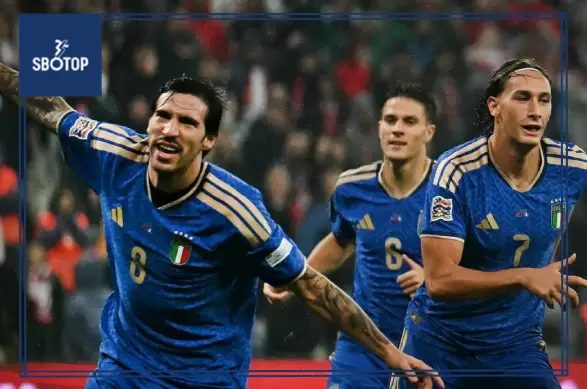
Italy struggles on the international football stage will not be solved overnight, according to former Germany international and football executive Oliver Bierhoff.
Bierhoff believes the Italian football system needs significant changes across several areas, from coaching methods and youth development to academies and infrastructure. In his view, expecting major improvements within just two or three years would be unrealistic.
The former Germany manager shared his thoughts during the Festival dello Sport in Trento on Friday, October 2, 2026, where he discussed his experiences with the German Football Association (DFB), Roberto Mancini and Paolo Maldini.
Oliver Bierhoff Calls for Patience in Italy
Bierhoff believes Italy problems are too broad to be solved through one quick adjustment.
Instead, he sees the need for a long-term restructuring of the football system.
“This is a little bit of everything. We have to realize that change will not happen in two or three years. It takes time,” Bierhoff said, as quoted by Football Italia.
His comments reflect his experience working within German football for nearly two decades.
Bierhoff spent 18 years working within the structure of the German national team. He served as team manager from 2004 to 2017 before moving into the role of technical director.
That experience gave him an inside view of how long-term football development can influence the quality of a national team.
For Bierhoff, Italy must therefore look beyond short-term results and address the foundations of its football system.
Paolo Maldini’s Short FIGC Spell
Bierhoff also discussed his relationship with Paolo Maldini, who previously worked as technical director of the Italian Football Federation (FIGC).
The two frequently communicated while Maldini was involved with the federation.
Bierhoff said he shared his own experiences with Maldini and supported his efforts to rebuild Italian football.
“I always spoke to him on the phone. I told him about my experiences and supported him. I saw how much determination he had to rebuild Italian football,” Bierhoff said.
He also believed Maldini had clear ideas about what needed to change.
However, Bierhoff pointed to an important challenge that goes beyond having the right ideas: the wider football system must be prepared to support those changes.
“He had clear ideas. But from the beginning I told him that you also have to feel that the system is willing to follow you. Maybe he did not feel that,” Bierhoff added.
Maldini’s time as FIGC technical director was brief, lasting only 17 days after his appointment.
Germany’s Reform Took Years
Bierhoff used Germany’s own football development as an example of why Italy should not expect immediate results.
Following a disappointing period around the turn of the millennium, Germany began making changes to its football development structure.
The reforms covered several areas rather than focusing exclusively on the senior national team.
“We changed training and education methods, started investing more in infrastructure, stadiums and academies. We thought it would take 10 years,” Bierhoff explained.
The results did not arrive immediately.
Germany eventually showcased the impact of that work at the 2010 World Cup in South Africa, where a younger generation demonstrated a stronger technical profile.
For Bierhoff, that experience showed why patience is essential when rebuilding an entire football system.
Areas Germany focused on included:
- Training methods
- Coaching education
- Youth development
- Football academies
- Infrastructure
- Stadium investment
- Long-term player development
The approach required time, but Bierhoff believes the commitment to structural change was essential.
“It requires patience, but also the conviction to say that we have to change,” he said.
Italy May Need to Start From the Foundations
Bierhoff believes Italy needs to confront the underlying causes of its current problems rather than searching for an immediate solution.
He acknowledged that he cannot fully assess the Italian football system from outside, but suggested that the country needs to examine the foundations of its development model.
“I cannot judge it from the outside, but you have to get to the bottom of the problem and then rise again. It seems Italy has reached that point and is starting to say, ‘enough’,” Bierhoff said.
That process could involve changes at multiple levels.
Instead of concentrating solely on the senior national team, Italy may need to examine how players are developed from a young age and whether existing structures provide them with the right environment to improve.
The objective would be to create a stronger pipeline of players capable of competing at the highest international level.
Bierhoff Questions Italy’s Current Player Quality
Another major challenge identified by Bierhoff is the quality of the current generation.
He believes Italy’s present squad cannot yet be compared with some of the country’s greatest generations.
“It is difficult to do it in the short term. At the moment there is a lack of quality, with all due respect to the players,” Bierhoff said.
He pointed to players from Italy’s past as examples of the level the country has previously produced.
Italy’s World Cup-winning teams featured iconic figures such as Francesco Totti, Alessandro Del Piero, Andrea Pirlo and Fabio Cannavaro.
Bierhoff believes producing players of that calibre is not something that can be achieved through a quick fix.
The Challenge Facing Roberto Mancini
Bierhoff also addressed the task facing Roberto Mancini as he attempts to build Italy’s national team.
The challenge extends beyond tactics and match preparation.
A national coach can only work with the players available to him, meaning improvements at youth and academy level are important for the long-term future of the senior side.
Bierhoff also compared Italy’s situation with Germany’s current generation.
He questioned whether Germany currently has enough players capable of making a major impact at the highest level of European football.
“I also look at Germany and think, who among them has a level high enough in Europe to make an impact?” he said.
He then highlighted Lothar Matthaus as an example of a player who reached an elite level after moving abroad and competing in Italy.
Italy’s Rebuild Will Take Time
Bierhoff’s message is ultimately about patience and structural change.
He believes Italy has to address the roots of its football development rather than expecting an immediate transformation at senior level.
Germany’s experience, in his view, demonstrates that meaningful reform can require a decade or more before its full impact becomes visible.
For Italy, that could mean strengthening coaching, youth development, academies and infrastructure while continuing to develop the next generation of players.
The process may take years, but Bierhoff believes fundamental change is necessary if Italy wants to return to the highest level of international football.
For now, his warning is straightforward: there is no instant solution, and rebuilding Italian football will require time, patience and a willingness to make changes from the ground up.
ALSO READ :