Scotland’s evening at Hampden Park began with the possibility of an important Nations League victory and ended with a painful reminder that taking the lead is only one part of winning an international match. Ryan Christie put the hosts ahead, but Slovenia responded through Aljoša Matko and Danijel Šturm to secure a 2–1 comeback victory on 6 October 2026.
The result left Scotland confronting a familiar footballing frustration: a promising position had slipped away before they could turn it into three points. For Slovenia, the evening demonstrated the value of staying competitive while behind, recognising opportunities, and making attacking partnerships count.
This was a contest shaped by decisive moments rather than a comfortable period of dominance from either side. Scotland produced enough to establish an advantage, yet their opponents carried a threat that the home team never fully removed. Once Slovenia found their equaliser, the match demanded a stronger Scottish response than eventually arrived.
An Opening That Required More Than Enthusiasm
Playing at home brings opportunity, but it also creates an obligation to set the tone. Scotland needed to combine attacking ambition with enough defensive security to prevent Slovenia from settling into dangerous positions.
The challenge was to make forward movement purposeful. Possession alone could not determine the outcome; the important question was whether Scotland could move the ball into areas where runners, combinations, and shooting opportunities would follow.
International football often exposes the difference between looking active and controlling a match. A team can have encouraging passages without restricting its opponent’s most effective routes forward. That distinction became important at Hampden.
From a commentary perspective, Scotland’s task was therefore twofold. They needed to offer an attacking presence that could engage the crowd, while ensuring that any misplaced pass or unsuccessful move did not leave an immediate opening behind them.
The eventual scoreline suggests why both responsibilities mattered. Scotland found a way to score, but the broader structure needed to protect that achievement proved less reliable.
Christie Gives Scotland Something to Build On
The breakthrough arrived in the 31st minute. Jack Hendry’s header struck the post, and the ensuing scramble ended with Christie backheeling the ball into the net after Oli McBurnie’s attempted follow-up. It was an improvised finish that rewarded alertness inside the penalty area.
Goals of that kind depend on players continuing their involvement after the first chance. A header against the woodwork can briefly interrupt everyone’s expectations, but the attack remains alive. Christie responded to the loose situation with the speed and inventiveness required.
For Scotland, the goal changed the practical demands of the evening. They no longer needed to force an immediate breakthrough. Instead, they had an opportunity to make Slovenia take greater risks and then exploit the spaces those risks might create.
However, a narrow lead should influence decision-making without encouraging passivity. The most effective response is usually to remain available for forward passes, maintain support around the ball, and avoid retreating into a purely reactive approach.
Christie’s contribution supplied the platform. Scotland still had to construct the rest of their performance around it.
A Half-Time Advantage With Unfinished Work
Scotland reached the interval ahead, but a one-goal margin always leaves a match open. The scoreboard offered encouragement without removing the need for improvement.
The break should be a moment for separating the result from the performance. Leading teams can ask whether their advantage reflects sustained control, a strong spell, or one successful incident. Each answer requires a different approach after the restart.
At Hampden, the sensible priority was to preserve attacking ambition while improving the reliability of possession and defensive positioning. Scotland needed a second goal, but they also needed to avoid giving Slovenia the straightforward opportunities that can turn a competitive match.
For the visitors, being behind did not require an uncontrolled chase. There was still an entire half available. Patience, combined with sharper execution, could bring them back into contention.
That balance between urgency and restraint is central to successful comebacks. A team must believe that it can recover without allowing the search for an equaliser to create an even larger deficit.
The Second Goal Scotland Could Not Find
Early in the second half, Ben Gannon-Doak drove forward and supplied Christie, whose effort was saved by Jan Oblak. Scotland had an opportunity to extend their advantage, but the Slovenian goalkeeper kept the margin at one.
The significance of such a moment grows when the match later changes direction. A second goal would have altered Slovenia’s calculations and given Scotland a greater cushion against mistakes. Instead, the visitors remained within immediate reach.
There was also a useful attacking principle in that Scottish move. Carrying the ball forward can disrupt defensive organisation, especially when another player arrives to receive a pass at the right moment. Direct movement becomes more dangerous when it produces a coordinated finish.
For Scotland, that offered a possible route toward greater attacking efficiency. The challenge was to create those situations repeatedly rather than rely on isolated openings.
A goalkeeper’s save does not automatically represent poor finishing. It does, however, leave the attacking side responsible for building the next opportunity. Scotland’s advantage required reinforcement, and it remained vulnerable while that reinforcement failed to arrive.
Matko Brings Slovenia Back Into the Match
Matko equalised in the 56th minute, cancelling Christie’s opener and resetting the contest. Slovenia’s recovery now had a tangible reward, while Scotland had to respond to the loss of their lead.
An equaliser changes more than the score. It can change how confidently the attacking team commits players forward and how cautiously the defending team approaches the next possession.
For Scotland, the immediate requirement was composure. Conceding should trigger clearer communication, secure passing options, and renewed attention to positioning. The danger is that disappointment produces rushed decisions just when a team most needs precision.
Slovenia, meanwhile, had reason to believe their approach could produce more. Having recovered from a losing position, they could pursue the winning goal without treating every attack as a desperate final attempt.
The important commentary point is that momentum must still be managed. Equalising creates an opening, but taking control requires further good decisions. Slovenia’s eventual victory came because they converted their renewed position into another decisive attacking contribution.
The Partnership That Settled the Evening
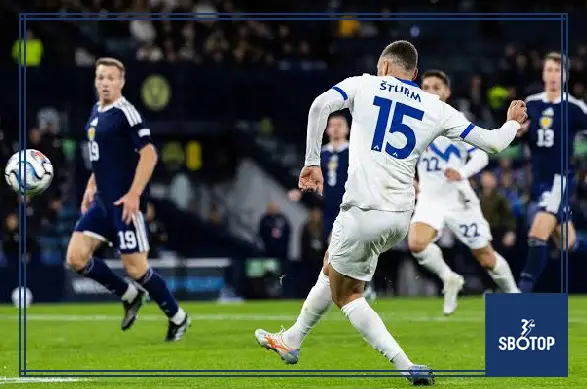
The winning goal arrived in the 71st minute. Matko advanced on the right and delivered a low ball for Šturm, who finished to put Slovenia ahead. Having scored the equaliser, Matko became the provider for the decisive strike.
It was a clear example of two attacking responsibilities working together. The player carrying or receiving the ball must recognise when to release it, while the supporting runner must reach the finishing area at the correct time.
Low deliveries can be especially difficult to defend because they demand quick adjustments from players facing their own goal. The goalkeeper must respect the ball carrier, and defenders must account for movement arriving across or behind them.
For Slovenia, the combination produced the outcome that their second-half recovery had made possible. For Scotland, it exposed the cost of allowing an opponent to turn a threatening position into a clean connection inside the box.
The match had now moved through three distinct phases: a Scottish advantage, Slovenian parity, and a visiting lead. Scotland’s final task was recovery.
Scotland’s Late Push and the Limits of Urgency
Trailing changes the nature of every remaining minute. Passes become more ambitious, attacking positions become more crowded, and the temptation to seek an immediate solution grows.
Scotland needed to bring urgency without losing the organisation required to create a genuine equalising chance. That is a demanding balance, especially when the opponent can defend its lead and threaten any spaces left behind.
The hosts had penalty appeals involving Findlay Curtis and Josh McPake dismissed as they searched for a route back into the game. The decisions left Scotland needing to find their equaliser through another opening.
Appeals can become emotionally important during a late chase, but they cannot provide a dependable attacking strategy. The next pass, the next supporting run, and the next delivery remain the actions a team can control.
A productive response to disappointment is to rebuild the attack quickly. That means keeping players available around the penalty area while retaining enough structure to recover possession.
Scotland could not reverse the scoreline before the match ended, and their earlier lead became part of the frustration.
Why the Result Was About More Than Finishing
It would be convenient to explain the defeat solely through the goals Scotland conceded or the chances they failed to convert. Both mattered, but the broader lesson concerns how a team connects its attacking and defensive work.
A side becomes vulnerable when its forwards move ahead of the ball without enough support, or when midfield pressure fails to protect the defenders behind it. Conversely, attacking play loses effectiveness when the player in possession has few useful passing options.
Those are general tactical principles, but they provide a useful framework for analysing this result. Scotland’s review should examine what happened immediately before dangerous Slovenian attacks, as well as the final defensive actions.
The same approach applies to chance creation. Counting opportunities matters less than understanding how they developed and whether the team can reproduce them.
Slovenia’s winning combination offered a practical illustration of clarity: an advance into a useful area, recognition of a teammate’s movement, and a delivery that enabled a finish.
Scotland needed that level of connection more consistently across the match.
Slovenia’s Comeback Shows the Value of Persistence
Slovenia’s achievement deserves consideration beyond Scotland’s disappointment. Recovering away from home requires a team to remain engaged when the initial scoreline works against it.
The visitors had to continue believing that their attacking opportunities were worth pursuing. They also needed to turn that belief into accurate execution rather than speculative efforts.
Their two scorers became the defining figures because their contributions changed the result directly. Matko supplied the equaliser and then helped create Šturm’s winner, giving the comeback a clear attacking centre.
There is a broader lesson here for teams facing difficult away fixtures. Falling behind does not necessarily mean the original plan has become useless. Sometimes the correct response is to improve its execution and continue identifying the same opportunities.
Persistence becomes valuable when it remains intelligent. Repeating an ineffective action is different from sustaining pressure through better movement and decision-making.
Slovenia’s recovery demonstrated the latter. They left Hampden with a victory built on turning a manageable deficit into an advantage they could retain.
What Scotland Must Take Into Their Review
Scotland’s next step should be specific analysis rather than general frustration. The defeat provides several questions that can lead to useful training work.
How effectively did players support the ball carrier? Were defensive responsibilities clear when possession changed? Did Scotland continue to offer a forward threat after taking the lead? How quickly did they regain composure after the equaliser?
Those questions connect individual incidents to repeatable team behaviour. They also avoid reducing the evening to a single player’s mistake.
Christie’s goal and the attacking move that led to his second-half chance provide material worth preserving. Improvement does not require dismissing every positive contribution because the final result was disappointing.
At the same time, good moments cannot become an excuse for ignoring the match’s decisive shortcomings. A team that leads at home must examine why its opponent remained capable of recovering.
The objective should be to produce a performance in which promising attacking passages, defensive protection, and emotional composure support one another throughout the contest.
Also Read: