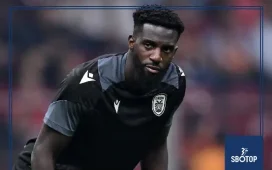
Youssoufa Moukoko’s loan move to Turkey marks another change of direction for a player once associated with extraordinary promise at Borussia Dortmund. His career now presents a more complicated story: early success, unsettled opportunities and a continuing search for a role that produces consistent senior performances.
Copenhagen confirmed on September 1, 2026, that Moukoko had joined Çorum FK on loan for the remainder of the season, with an option to buy. The Danish club explained that he wanted more playing time, something it could not guarantee.
That establishes the immediate reason for the move. It does not provide a complete explanation of his career trajectory. Understanding the broader picture requires separating confirmed events from interpretations about development, tactical suitability and the expectations attached to a teenage talent. The Turkish loan offers another opportunity, but its success remains something to demonstrate.
The Promise Was Supported by Senior Performances
Moukoko’s reputation did not depend entirely on youth football. During 2022, he scored important Bundesliga goals for Dortmund against Schalke and Bayern Munich, then struck twice against Bochum. He also earned a place in Germany’s squad for that year’s World Cup.
His subsequent search for opportunities took him to Nice on loan in 2024. He scored twice on his first Ligue 1 start, but those remained his only league goals that season. He later moved to Copenhagen before the current loan to Çorum.
By the October 8 assessment of his Turkish spell, he had made three substitute appearances. That is a dated snapshot, rather than a guarantee of his position throughout the season.
The contrast is nevertheless striking. Moukoko has already shown that he can influence senior matches, but isolated achievements have not developed into the sustained prominence once anticipated. The question concerns consistency and adaptation, rather than whether he ever possessed genuine ability.
Youth Goals and Senior Readiness Are Different Measures
A central explanation offered by Dortmund academy manager Paul Schaffran concerns the transferability of Moukoko’s youth playing style. His assessment was that many goals came from carrying the ball through opponents in ways that would be difficult to reproduce against senior teams.
This is an informed interpretation of development, not a conclusive diagnosis of every later difficulty. It identifies a potential gap between dominating youth matches and possessing a complete set of tools for professional football.
The broader principle is important. Young players can produce outstanding statistics through advantages that become less decisive at higher levels. Senior opponents may deny space earlier, respond more quickly and expose weaknesses that youth teams could not consistently punish.
Development therefore involves more than preserving what already works. It also requires identifying which habits will remain effective when opponents improve. A prolific academy scorer may still need significant preparation for the different demands of first-team football.
A Role Must Fit the Player’s Strengths
Schaffran also suggested that a different developmental role might have benefited Moukoko, potentially exposing him to midfield or supporting attacking positions rather than concentrating on a lone-striker profile.
That proposal should be understood as retrospective analysis. It does not prove that changing position would have guaranteed success, nor does it establish what Çorum’s coaches intend to do now.
The general tactical issue is one of fit. A central forward may need to receive possession under pressure, connect attacks and create space for others, alongside finishing chances. A player’s scoring record alone does not show how comfortably he performs all those tasks.
For Moukoko, finding an effective role could be as important as simply joining another club. More minutes would provide opportunity, but their developmental value would depend partly on what he is asked to do and how those responsibilities match the abilities he can consistently demonstrate.
The Search for Minutes Can Become Complicated
The confirmed explanation for Moukoko’s latest move highlights a familiar challenge: players want regular involvement, while clubs cannot always promise it. A loan can offer a route towards that involvement, but the move itself does not settle selection.
A new environment introduces fresh competition, coaching expectations and relationships with teammates. Those factors can influence whether an intended opportunity becomes a sustained place in the side.
It would be unfair to assume that limited appearances necessarily reflect a lack of effort or commitment. Public match involvement reveals the outcome of selection decisions, but not every reason behind them.
The practical assessment should focus on evidence that develops over time. Starting opportunities, responsibilities within the team and performance across several matches would provide a stronger basis than judging the entire loan through its opening weeks. A move creates possibilities; the working relationship inside the club determines how those possibilities develop.
Repeated Moves Bring Opportunity and Disruption
Changing clubs can give a player a fresh start, especially when an existing arrangement does not offer the desired involvement. It can also interrupt the continuity through which a footballer learns a system and establishes trust.
Moukoko’s route through Germany, France, Denmark and Turkey makes continuity a relevant topic for analysis. However, the sequence alone does not prove that moving has caused his difficulties. Different decisions may have reflected different circumstances.
In general terms, a player benefits from understanding how his team builds attacks, where teammates expect him to move and what the coach requires without possession. Those relationships usually need repetition.
A successful reset therefore involves more than leaving behind an unsuccessful spell. It requires an environment in which lessons can accumulate. For Moukoko, the value of the Turkish opportunity may depend on whether it provides a clear role and enough continuity to assess his progress meaningfully.
Early Expectations Can Distort Later Judgments
The label of wonderkid creates a demanding comparison. Instead of being assessed against the normal uncertainty of a developing career, a player is measured against exceptional predictions made years earlier.
That can make an ordinary setback appear like a definitive collapse. A period without goals becomes evidence that the original promise was mistaken, while one strong performance may trigger renewed expectations of immediate stardom.
Neither response offers much clarity. Football development is uneven, and early achievement does not establish a fixed destination.
This does not mean criticism of performances should disappear. It means the standard of assessment should be specific. Movement, decision-making, finishing and contribution to the team can be examined without treating every match as a referendum on childhood predictions.
For Moukoko, a more useful evaluation would concentrate on the player he is becoming through current work, rather than continually comparing him with the most ambitious version of his teenage reputation.
Confidence Should Be Discussed with Care
Confidence is often offered as an explanation when a talented player struggles, but it is difficult to assess from outside. Limited involvement or missed chances do not establish what a footballer privately feels.
Without a direct account from Moukoko, claims that he has lost belief should remain speculation. The same caution applies to assumptions about motivation, disappointment or relationships with coaches.
There are observable questions that provide a firmer basis for discussion. Does he seek possession, make useful movements and contribute within his assigned role? Does greater involvement coincide with improved effectiveness?
Those questions still require careful interpretation, but they focus on football actions rather than invented psychology. Confidence may influence performance, yet it should not become a convenient explanation for everything that has happened. An accurate account can recognise uncertainty while continuing to examine the evidence available on the pitch.
Turkey Offers a Chance to Establish a Clearer Pattern
The loan to Çorum gives Moukoko an opportunity to build a more sustained record of senior contribution. Its significance lies in what happens during the spell, rather than the idea that a geographical change automatically produces renewal.
A productive period would involve more than occasional highlights. Regular involvement, an identifiable role and contributions across different match situations would provide stronger evidence of progress.
That is an analytical measure, not a prediction that those developments will occur. The opening snapshot of substitute appearances does not establish the final outcome, but neither does the purpose of the loan guarantee it will achieve its aim.
The option to buy is also a contractual possibility rather than confirmation of a permanent move. Copenhagen’s announcement establishes that the option exists. Whether it is exercised will depend on a later decision, which should be reported separately if and when it becomes confirmed.
Also Read: