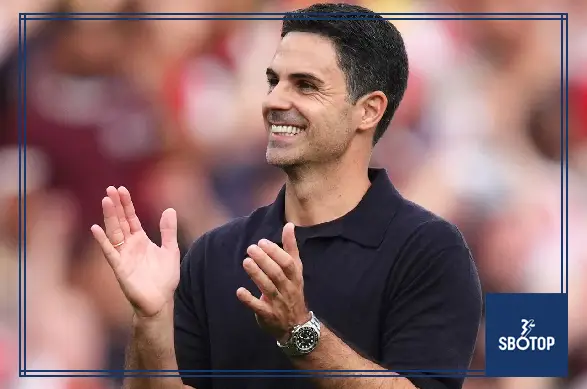
Mikel Arteta has insisted that his conscience is clear over his time at Manchester City, while declining to offer a detailed assessment of the financial rule breaches found against his former club. The Arsenal manager’s response places his personal position alongside a wider dispute that remains subject to appeal.
Speaking on October 9, Arteta faced questions about the independent commission’s verdict and the implications for a period that overlapped with his employment at the Etihad Stadium. Asked directly whether his conscience was clear, he answered: “Yes.”
Beyond that brief response, he adopted a cautious approach. He said the process remained unresolved and indicated that he would explain his feelings more fully once it had concluded. His comments were an assertion about his own conscience, rather than a detailed account of City’s financial arrangements or a challenge to specific findings.
A Former Assistant Facing Questions as Arsenal Manager
Arteta worked under Pep Guardiola at Manchester City from 2016 until his departure to take charge of Arsenal in December 2019. That connection explains why questions about the verdict have followed him, even though he now leads a competing club.
His employment overlapped with the final two seasons covered by the financial findings. However, an overlap in employment does not, by itself, establish responsibility for particular financial decisions.
An assistant manager’s involvement in coaching cannot automatically be treated as evidence of participation in commercial contracts, accounting arrangements or regulatory submissions. Any allegation concerning an individual would require evidence about that person’s actual actions and responsibilities.
Arteta’s position therefore needs careful description. He has publicly expressed confidence in his own conduct. His short answer does not provide a comprehensive explanation of what he knew, but neither does his reluctance to discuss the case establish wrongdoing.
The Financial Verdict Behind the Questions
The independent commission found serious breaches relating to Manchester City’s financial reporting during the period from 2009/10 to 2017/18. Its findings included arrangements that artificially increased reported income and reduced reported costs. The Premier League announced the verdict on September 29, 2026. City subsequently lodged an appeal and continued to deny wrongdoing. The club’s challenge means that the published findings and the eventual outcome of the proceedings must be distinguished.
An appeal does not erase the existing verdict. Equally, reporting should acknowledge that the club is contesting it through the available process. The question of sanctions also requires separate consideration; possible penalties should not be described as decisions already taken.
For Arteta, this creates a difficult public setting. He is being asked to discuss his own past while the institution that employed him challenges findings about its conduct.
What His Clear Conscience Statement Establishes
Arteta’s answer establishes that he considers his conscience clear. It should be reported with that precise meaning.
It does not amount to a formal ruling on his involvement, an independent investigation into his responsibilities or an explanation of every aspect of his former employer’s operations. Personal confidence and an adjudicated finding serve different purposes.
The same distinction applies to interpreting his guarded responses. A decision to avoid further comment may reflect several considerations, but the available remarks do not establish his private reasoning. Claims that he is protecting particular individuals, concealing information or distancing himself from Guardiola would go beyond the evidence.
The defensible interpretation is narrower: Arteta answered the question about his conscience and declined to elaborate substantially while the appeal remained outstanding. Anything more requires additional information rather than assumptions based on his tone.
Waiting for the Process to Conclude
Arteta repeatedly referred to the unfinished process when journalists pressed him for a broader reaction. He also declined to discuss whether the verdict had changed his memories of working at City.
His approach leaves important questions unanswered, particularly for supporters seeking a fuller account of how former employees view the findings. Nevertheless, postponing a detailed response is different from denying that the commission reached a verdict.
From an analytical perspective, waiting may allow him to address a more settled position later. It also limits the possibility that an incomplete answer becomes the centre of a separate controversy.
There is a cost to that restraint. Public interest does not disappear while an appeal proceeds, and a promise to speak more clearly later creates an expectation of a substantive response. Whether Arteta eventually provides one remains to be seen.
Coaching Success and Financial Compliance
The case raises a broader issue about how football evaluates sporting achievement alongside financial compliance.
Coaches prepare players, develop systems and make decisions under competitive pressure. Those contributions are real. Financial rules, however, address the conditions under which clubs assemble and sustain their teams.
A strong performance on the pitch cannot establish that the club’s accounts complied with the rules. Likewise, financial findings do not make every training session, tactical adjustment or individual effort imaginary.
The analytical task is to consider both dimensions without allowing one to settle the other automatically. Sporting excellence can coexist with questions about the resources supporting it.
For a former coach such as Arteta, that distinction is especially relevant. His professional memories concern work carried out within a football environment, while the commission’s findings concern the club’s financial conduct. Assessing their relationship requires more than a simple judgment about whether he enjoyed success.
Why His Arsenal Position Adds Complexity
Arteta now occupies a different role from the one he held at City. As Arsenal manager, he carries responsibility for his current team’s preparation, standards and public communication.
That creates an obvious tension in the questions surrounding his former club. His past gives him a personal connection to City, while his present places him in competition with them.
It would be speculative to assume that this tension determines his response. However, it helps explain why his comments attract attention beyond the normal interest in a rival manager’s opinion.
Any forceful statement could be interpreted through Arsenal’s competitive interests. Any restrained statement could be interpreted through his previous employment. Neither interpretation necessarily captures his intentions.
The fairest assessment remains anchored in what he actually said, rather than attributing a motive that cannot be verified.
Arsenal Cannot Plan Around an Unannounced Punishment
Arteta also resisted the suggestion that the proceedings might provide Arsenal with an advantage. His stated focus remained on his own team and its objectives.
That position makes practical sense. A club cannot reliably build its competitive plans around a penalty that has not been announced, especially when an appeal could affect the outcome.
Arsenal’s preparation still requires decisions about selection, fitness, tactics and performance. Those decisions have immediate consequences regardless of the timetable governing City’s case.
There may eventually be sporting implications from the proceedings. Their nature and extent depend on decisions that cannot be predicted with certainty.
Until then, treating a possible sanction as an expected advantage would introduce uncertainty into planning. Arteta’s emphasis on matters within Arsenal’s control provides a straightforward response to that problem without resolving the wider controversy.
Protecting the Competition’s Credibility
Arteta maintained his belief in the Premier League’s standing despite the questions raised by the verdict. His confidence in the competition should be understood as an opinion about its overall quality and importance.
A league’s reputation depends on several elements: the standard of football, the strength of its clubs, supporter engagement and confidence in its governance. A serious financial case can affect how those elements are perceived.
Effective enforcement may demonstrate that rules carry consequences. Lengthy proceedings can also create frustration when supporters struggle to understand what has been decided and what remains open.
Both considerations can exist together. The existence of a major case does not automatically establish that an entire competition lacks credibility, but its popularity does not remove the need for accountable regulation.
Clear explanations of findings, appeals and sanctions are therefore essential to informed public debate.
Personal Association Requires Careful Reporting
High-profile proceedings often draw attention to everyone associated with the organisation involved. Former managers, players and coaches can become subjects of scrutiny even when the reported findings concern institutional conduct.
That scrutiny can produce legitimate questions. It can also encourage guilt by association if employment is treated as proof of knowledge or participation.
Responsible reporting should identify the conduct under examination and avoid extending conclusions beyond the available evidence. A person’s job title alone cannot explain the information they received or the decisions they controlled.
The same standard applies to exoneration. A former employee’s assurance does not independently establish everything about the organisation’s behaviour.
Arteta’s case illustrates the need to hold both principles together. His statement deserves accurate reporting, while questions about the club must remain grounded in the findings and the ongoing proceedings.
Also Read: