

Ryan Gravenberch’s sending-off against Manchester City produced a familiar football argument: if the first yellow card was harsh, could the eventual red still be justified?
Liverpool’s midfielder was dismissed in the 62nd minute of the 3-0 defeat at Anfield on 11 October 2026. The match was goalless when referee Chris Kavanagh showed him a second yellow for a challenge on Jeremy Doku. City subsequently scored through Erling Haaland, Doku and Rayan Cherki.
The strongest explanation separates the two incidents. There was a credible case against the initial caution, while the later foul offered a distinct reason for a booking. That makes the dismissal understandable under the decisions already recorded, without establishing that Liverpool had been treated correctly throughout.
The First Booking Created the Controversy
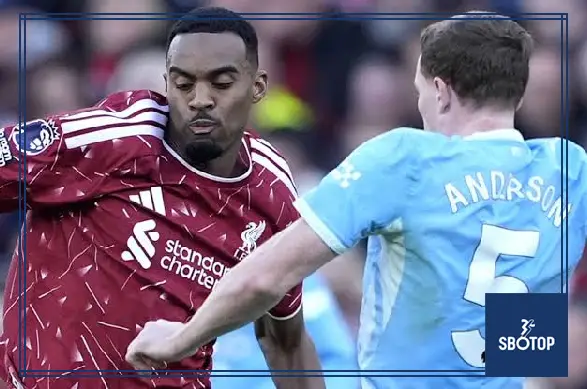
Gravenberch received his first yellow shortly after half-time following contact with City midfielder Elliot Anderson.
The severity of that incident became the principal source of disagreement. Critics considered the contact insufficient to warrant a caution, particularly because Gravenberch appeared to be withdrawing from the challenge rather than following through forcefully.
Jamie Carragher argued that the booking was unjustified and questioned whether Anderson’s apparent discomfort influenced Kavanagh’s response. That was Carragher’s interpretation of the sequence, rather than a confirmed explanation from the referee.
The distinction matters. Observers can assess the timing of a decision, but they cannot know precisely what an official saw or why he reached a conclusion without further evidence.
What is established is that the caution stood, leaving Gravenberch vulnerable to dismissal if he committed another bookable offence.
Why Limited Contact Does Not Settle Everything
A foul and a yellow-card offence are not automatically the same thing. Football allows referees to award free kicks for careless challenges without issuing cautions.
The disciplinary question concerns the nature of the action and, in some circumstances, its effect on the opponent’s attack.
That is why describing the first incident simply as contact offers an incomplete defence of the booking. Contact can establish a foul while still leaving a separate question about whether the threshold for a caution was reached.
Equally, an absence of injury would not automatically make a challenge acceptable. A dangerous or reckless action can warrant punishment even when the opponent escapes harm.
The first booking should therefore be assessed through the challenge itself: its timing, force, point of contact and surrounding circumstances.
Gallagher’s Explanation Was an Interpretation
Former Premier League referee Dermot Gallagher considered the first caution harsh. His explanation was that Kavanagh may have believed the contact was higher than replays indicated.
That was a possible account of the referee’s viewing angle, not an official admission that he had misidentified the incident.
Gallagher nevertheless supported the second booking, focusing on its effect on a promising attack rather than the force of the collision.
His assessment illustrates how two apparently similar challenges can produce different disciplinary arguments. One may lack sufficient grounds for a caution, while another becomes bookable because it stops an opponent advancing into an advantageous situation.
The useful principle is to assess each decision separately. Criticism of the first does not automatically answer the question posed by the second.
Doku’s Acceleration Changed the Situation
The second incident involved a different opponent and a different attacking context.
Doku moved the ball beyond Gravenberch’s attempted intervention, and the Liverpool midfielder brought him down. The central argument supporting the caution was that the foul interrupted a promising City attack.
That explanation does not require the challenge to have been violent or especially forceful. A comparatively modest foul can have a significant tactical effect.
Doku’s speed also helps explain the risk. A defender may initially believe the ball is reachable, only for the attacker’s next touch to move it beyond the challenge.
A genuine attempt to win possession does not guarantee that the resulting foul escapes a booking. Intention is relevant, but it does not erase the consequences of an unsuccessful intervention.
What Makes an Attack Promising?
A promising attack is not the same as an obvious goalscoring opportunity.
The latter concerns a more immediate and substantial chance to score. A promising attack can exist earlier in a move, when an opponent has useful space, forward momentum or favourable support.
Relevant considerations include the direction of play, the attacker’s control, the position of defenders and available passing options.
The presence of covering players does not automatically mean an attack lacks promise. Their distance and ability to intervene matter too.
Applied to Gravenberch’s challenge, the argument is that Doku had moved beyond him and was developing an advantageous situation. Whether that assessment is persuasive involves judgment, but it provides a clear disciplinary basis beyond the amount of contact alone.
The Laws Allow Different Routes to a Caution
Football’s disciplinary framework distinguishes careless challenges from reckless ones and also recognises offences that interfere with or stop promising attacks.
Receiving a second caution in the same match is a sending-off offence.
The important consequence is that two yellows do not have to resemble a single straight-red challenge. A player can be dismissed for two separate cautionable actions without committing serious foul play.
There is also no general exemption permitting a booked player to stop a promising attack because the resulting dismissal would alter the match.
The practical difficulty lies in the judgments preceding that outcome. The referee must decide whether each action genuinely meets a cautionable threshold. The accumulation is straightforward only after those individual decisions have been made.
A Harsh First Yellow Remains Relevant
It is reasonable to defend the second caution while continuing to question the overall sequence.
If the first booking was unwarranted, its consequences were substantial. Gravenberch would otherwise have received his first caution for the later challenge and remained available to Liverpool.
That counterfactual explains the frustration, but it does not require the referee to compensate by overlooking a subsequent bookable offence.
Two different assessments are possible. The second decision can be correct in isolation, while the dismissal as a whole still feels unfair because of the earlier caution.
Precision improves the debate. Saying that the later foul justified another yellow is narrower and more defensible than claiming that every part of the disciplinary process was beyond criticism.
Gravenberch Still Faced a Decision
Once booked, Gravenberch had to manage the remaining match with that status in mind.
That did not require him to stop competing or allow opponents to advance freely. It did increase the importance of judging whether an attempted tackle was likely to succeed.
Against a player with Doku’s acceleration, delaying the attack or directing him towards cover might sometimes offer a safer alternative.
That is a tactical possibility rather than proof that Gravenberch had an easy solution available. Decisions at Premier League speed are made with incomplete information.
Nevertheless, his existing caution formed part of the circumstances he needed to recognise. An earlier decision he considered unfair did not remove the risk associated with another mistimed challenge.
Haaland’s Reaction Does Not Prove Influence
Haaland approached Kavanagh immediately after the second challenge, prompting discussion about whether the striker added pressure to the decision.
Players frequently appeal for sanctions, but their reactions are not evidence that the referee changed his mind because of them.
Gallagher’s view was that Kavanagh had already reached his decision. Other observers questioned the effect of Haaland’s intervention.
Without confirmation of the referee’s reasoning or relevant communications, neither assumption should be presented as established fact.
The same evidential discipline applies to suggestions of bias. Disagreement with a decision, even a consequential one, does not demonstrate improper motivation.
The challenge can be debated on its merits without inventing an explanation for what happened inside the referee’s decision-making process.
The Red Card Changed the Match
The dismissal’s sporting impact was immediate.
Haaland opened the scoring less than three minutes later, and Doku quickly added another before Cherki completed City’s victory.
Liverpool had competed effectively while the numbers were level. Losing a central midfielder increased the defensive demands on the remaining players and complicated their response once they fell behind.
Those developments support describing the sending-off as a turning point. They do not establish that Liverpool would certainly have won or drawn with eleven players.
City still needed to exploit the advantage, and Liverpool still faced decisions about reorganising.
The result explains the intensity of the controversy, but it cannot retrospectively determine whether either booking was correct.
A More Precise Verdict
The most persuasive assessment is qualified rather than absolute.
Gravenberch had grounds to feel harshly treated over the first caution. The challenge on Anderson attracted credible criticism, and explanations about Kavanagh misreading the contact remain interpretations rather than confirmed facts.
The later foul on Doku presented a stronger case for a yellow because of the attack it interrupted. With one caution already recorded, another meant dismissal.
Calling the eventual red deserved therefore needs care. It can mean that the referee was justified in issuing the second yellow under the circumstances confronting him. It should not imply that the first booking was unquestionably warranted.
That distinction preserves both sides of the argument: Liverpool’s grievance about the earlier decision and Gravenberch’s responsibility for the risk he took afterwards.
Also Read: