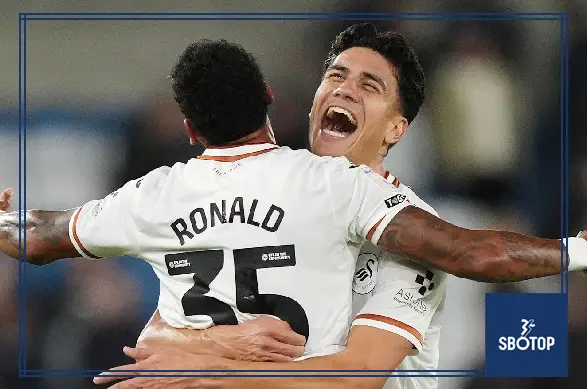
Ronald’s last-minute goal earned Swansea City a 1-0 victory at Millwall on Tuesday, 13 October 2026, keeping Vitor Matos’ side at the top of the Championship after a demanding contest at The Den. The substitute supplied the decisive touch after Swansea had survived sustained pressure and gradually developed a greater attacking threat.
Yet the result was only part of the story. The match was interrupted for almost seven minutes during the second half following a report of alleged racist chanting directed at Swansea substitute Eom Ji-sung. The South Korea international had been warming up when the incident was reported.
Both clubs condemned the alleged abuse and supported the investigation. A subsequent arrest added a significant development, although it did not establish guilt. Swansea left with three valuable points, but the circumstances surrounding the interruption ensured that discussion extended well beyond Ronald’s finish.
Millwall Make the Stronger Start
Swansea arrived with the division’s best defensive record, but Millwall immediately tested the organisation underpinning that achievement. The home side attacked with purpose, created dangerous situations around the penalty area and repeatedly forced the visitors to defend under pressure.
One early opportunity developed when Mark Sykes delivered a low cross towards Kyrell Lisbie. Filip Lissah intervened with a crucial last-ditch tackle, preventing Millwall from turning their promising approach play into an opening goal.
Jenson Metcalfe also threatened, only for Jenson Seelt to help close the opportunity. Making his first Swansea start, the defender was quickly involved in the difficult work required to keep the visitors level.
Millwall’s pressure exposed the margins separating effective defending from an early setback. Swansea were being pushed backwards, and several interventions came when the home side appeared close to finding a route through. The leaders remained competitive, but they had little reason to feel comfortable.
Vigouroux Helps Swansea Stay Level
Lawrence Vigouroux was another important figure in Swansea’s resistance. The goalkeeper denied Sykes from close range after Lyndon Dykes had helped create the chance, ensuring that Millwall’s attacking superiority did not immediately appear on the scoreboard.
There were less comfortable moments, too. Vigouroux failed to claim a Metcalfe corner, and Jordi Osei-Tutu’s subsequent header was deflected onto the roof of the net. That episode illustrated how Millwall could threaten through both open play and deliveries into a crowded penalty area.
Swansea offered relatively little attacking reward before the interval. Their only first-half attempt on target was a tame effort from Zan Vipotnik, which Filip Marschall saved.
The goalless score therefore concealed an uneven opening period. Millwall had produced the more threatening football, while Swansea’s contribution was defined largely by survival. Remaining level nevertheless gave Matos’ players an opportunity to improve without first having to recover a deficit.
The Visitors Grow Into the Contest
The second half brought a more competitive balance. Swansea began finding opportunities of their own, asking Millwall to perform the defensive interventions that had characterised the visitors’ opening period.
Josh Tymon sent a free-kick over the crossbar after Derek Mazou-Sacko fouled Moussa Yeo. Joseph Opoku subsequently saw an effort cleared off the line by Jake Cooper, while Yeo also went narrowly over.
Those incidents mattered because they changed the demands on Millwall. The home side could no longer concentrate primarily on sustaining pressure; they also had to manage Swansea’s growing threat.
Cooper made another important intervention when Vipotnik attempted to release Yeo. Mazou-Sacko later contributed a further goal-line clearance to deny Ross Stewart.
Swansea’s improvement did not amount to complete control. Instead, the match became a contest in which both teams could identify moments that might have produced the opening goal. That uncertainty remained until the closing stages.
Play Stops Following Reported Abuse
The game was halted in the 65th minute after alleged racist chanting towards Eom was reported. Referee Edward Duckworth consulted the managers, Alex Neil and Matos, alongside fourth official Ruebyn Ricardo.
The interruption lasted almost seven minutes. A stadium announcement informed spectators of the report, while police were understood to be using CCTV as part of efforts to identify anyone responsible.
The distinction between a reported incident and a proven offence remains essential. It is confirmed that the allegation prompted an interruption and an investigation. Responsibility for any criminal conduct, however, requires evidence and the appropriate legal process.
It is equally important to avoid extending an allegation against an individual to an entire crowd. The investigation concerned the reported conduct itself. The interruption placed Eom’s welfare at the centre of an evening that had previously been defined by the football, and both clubs subsequently expressed their opposition to discrimination.
Millwall Still Have Chances After the Restart
The resumption did not remove Millwall’s attacking threat. Vigouroux made a point-blank save to deny Dykes, and Tristan Crama headed over from the resulting corner.
Those opportunities complicate any simple account suggesting that the interruption alone determined the outcome. Millwall continued to create situations from which they could have scored, just as Swansea had begun threatening before the stoppage.
There is no reliable way to establish how an uninterrupted final half-hour would have unfolded. Football’s momentum can change for numerous reasons, and attributing a defeat to one delay would overlook the chances, saves and defensive decisions made throughout the match.
For Millwall, the central sporting frustration remained their inability to convert promising positions into a goal. For Swansea, the continuing requirement was to defend with enough concentration to preserve the possibility of a late breakthrough. Neither task disappeared when play resumed.
Ronald Supplies the Winning Moment
Matos introduced Ronald in the 84th minute, and the winger delivered the decisive contribution six minutes later. Opoku supplied the cross, Millwall hesitated, and Ronald finished to give Swansea the lead in the 90th minute.
The timing made the goal particularly damaging for the hosts. After spending long periods looking capable of winning, Millwall suddenly faced the prospect of taking nothing from the evening.
For Swansea, the finish rewarded their persistence and the attacking contribution of a substitute. Ronald had entered a match that remained finely balanced and needed only a brief opportunity to influence the result.
It would be excessive to describe the winner as inevitable. Millwall had created enough to make a different outcome entirely plausible. Swansea’s achievement lay in keeping themselves within reach of victory and then taking the chance that finally separated the teams. Ronald’s intervention turned defensive resilience into three points.
Different Assessments From the Dugouts
The managers’ reactions reflected their contrasting experiences. Neil believed Millwall had done enough to avoid defeat, pointing towards their stronger first-half performance and the opportunities they failed to convert.
That assessment had a clear basis in the match’s opening stages. Millwall repeatedly threatened before Swansea established a comparable attacking presence. Their disappointment was therefore about more than conceding late; it also concerned the failure to turn earlier superiority into a lead.
Matos acknowledged the intensity of the contest and Millwall’s strong start. Swansea’s ability to remain organised allowed them to grow into the game and eventually find a winning moment.
Neither perspective requires the other to be dismissed. Millwall could reasonably regret a missed opportunity, while Swansea could value the resilience and efficiency that delivered victory. The score settled the points, but it did not erase the competitive difficulties faced by the winners.
The Interruption Prompts Further Debate
Neil’s comments about the interruption subsequently drew criticism from anti-discrimination organisation Kick It Out, which emphasised that player welfare must take priority when racist abuse is reported.
His position requires context. Neil and Millwall condemned the alleged abuse, while his criticism concerned the handling and duration of the stoppage. Questions about procedure can be examined separately from whether officials should respond to an allegation.
That distinction should not diminish the seriousness of the report involving Eom. An effective response requires officials to communicate clearly, support the player concerned and allow the relevant authorities to investigate.
Swansea thanked those involved in addressing the incident and indicated their support for Eom. Matos also made clear that the winger remaining an unused substitute was unrelated to the alleged chanting. His lack of playing time should therefore not be presented as evidence of a decision caused by the incident.
Arrest Adds a Subsequent Development
Police later confirmed that a 51-year-old man had been arrested at an address in Kent on Wednesday, 14 October, on suspicion of racially aggravated intentional harassment, alarm or distress.
He was taken to a south London police station and subsequently released on bail until mid-January while enquiries continued.
An arrest is not a conviction, and the allegation should not be reported as a proven offence. The confirmed development was that police had taken investigative action; the question of criminal responsibility remained unresolved.
For Swansea, the sporting outcome was clearer. Their fourth successive league victory left them two points ahead of Middlesbrough at the top that evening. Ronald provided the decisive finish, but the win also depended on saves, blocks and sustained concentration. The allegation involving Eom required a separate, serious response beyond the final whistle.