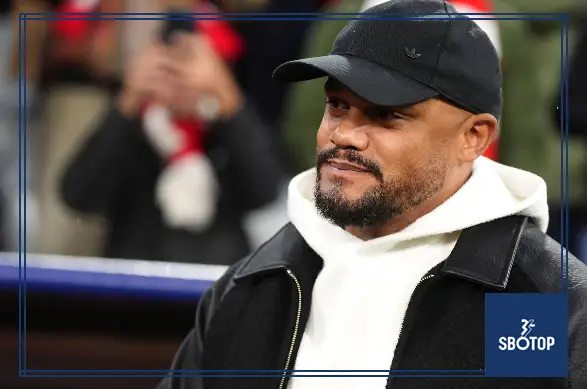
Vincent Kompany’s health has become Bayern Munich’s immediate priority after the head coach collapsed while watching a reserve-team training session and was taken to hospital. The incident on Friday, 23 October 2026, prompted the club to place its coaching staff in temporary charge of training and match preparations.
Subsequent updates brought encouraging news. Kompany was discharged from hospital on 28 October, although his recovery continued and no return date was announced. Bayern’s position remained that he would resume his responsibilities when medically ready, rather than according to the demands of the fixture schedule.
The distinction is important. Leaving hospital represented progress, but it did not mean the Belgian coach had been cleared to return to the dugout. Bayern continued to organise football operations around his absence while giving him time away from the pressures of daily management.
Collapse Occurred During Reserve-Team Training
Bayern confirmed that Kompany required medical attention after collapsing during a session involving the club’s reserve side. He had been observing the training rather than conducting a first-team match.
The club’s initial statement said he was undergoing thorough examinations in hospital and would remain under medical care. It also confirmed that his coaching staff would oversee training and match activities until further notice.
That announcement established the essential facts without offering an immediate explanation for the collapse. At that stage, the medical assessment was continuing.
Accounts of a developing health incident can change as further information becomes available. In Kompany’s case, the original hospital admission and the later discharge belong to different stages of the same event. Reporting only the initial announcement would therefore leave an incomplete picture of his subsequent condition.
Recent Illness Provided Background
Before the collapse, Kompany had been dealing with a viral illness that had affected his availability for some training and media duties. He nevertheless took his place on the touchline for Bayern’s 2-2 Champions League draw with Arsenal earlier that week.
That sequence provided relevant background, but it did not by itself establish the precise cause of the later incident. A recent illness and a subsequent collapse should not automatically be treated as a complete medical explanation.
The appropriate distinction is between what was known about his availability and what doctors subsequently assessed. Bayern initially concentrated on examinations and care, rather than announcing a diagnosis before the process was complete.
For the club, the immediate responsibility was straightforward: ensure Kompany received treatment and remove the expectation that he should continue managing the team while unwell.
Bayern Emphasise Time and Support
Bayern board member for sport Max Eberl made clear that Kompany’s health took precedence over football responsibilities. In the club’s public messaging, recovery was not presented as something that should be accelerated to meet an approaching match.
The following day, Eberl said Kompany was stable and that examinations were continuing. He also indicated that Bayern were thinking in terms of weeks rather than assuming the coach would be absent for only a few days.
Assistant Aaron Danks explained that communication with Kompany would remain friendly rather than burdening him with sporting matters. Danks and fellow coaches, including René Marić, would continue preparing the team.
Those comments outlined a practical separation of responsibilities. The medical team would oversee the coach’s care, while the football staff would handle the work required to keep Bayern functioning.
Hospital Discharge Marks Progress
The most significant subsequent development came on 28 October, when Kompany’s discharge from hospital was confirmed. Eberl identified the condition publicly as meningeal irritation and said the coach would rest and take medication.
No timetable was set for his return. Danks remained responsible for leading the team while Kompany continued recovering.
The update was encouraging, but its limits remained clear. It did not announce an immediate return to training, specify a date for his next match or confirm that the recovery process was complete.
It would therefore be inaccurate to describe the discharge as a full return to work. Equally, it would be misleading to continue presenting Kompany as hospitalised after that announcement. The confirmed position had changed: he was out of hospital, with further recovery still required.
Danks Takes Responsibility for the Team
Kompany’s absence required Bayern’s assistant coaches to move into more prominent roles. Danks took charge of match preparations and the touchline responsibilities that would ordinarily belong to the head coach.
Bayern won 3-1 at Freiburg during that period and followed it with a 6-1 victory over Magdeburg in the German Cup. Those results showed that the team’s competitive programme continued while Kompany remained away.
However, results should not be used as evidence about his medical progress. A successful performance can be positive news for the club without providing any indication of when the coach will be ready to return.
From an organisational perspective, the important feature was continuity. Bayern had staff familiar with the players and the established approach, allowing responsibilities to be redistributed without requiring an immediate permanent change.
Continuity Depends on Clear Responsibilities
An assistant assuming temporary control must manage more than the team selection. Training organisation, communication, match analysis and public duties all need attention.
In an established coaching group, much of that work is already shared. Temporary leadership therefore involves adjusting responsibilities rather than creating an entirely new operation.
Analytically, clarity becomes especially valuable when the circumstances are emotionally difficult. Players need to know who is making decisions, what the immediate priorities are and how preparations will proceed.
That does not remove concern for the absent coach. It gives the squad a practical structure within which to work. For Bayern, continuing their football responsibilities and supporting Kompany’s recovery were compatible objectives, provided the first did not place demands on the second.
The Fixture List Cannot Set the Recovery Date
Bayern’s schedule created an obvious backdrop to the incident. Domestic and European matches continued, including the high-profile meeting with Borussia Dortmund and the Champions League trip to Atlético Madrid.
Yet the prominence of those fixtures did not establish a suitable medical deadline. The club’s public position was that Kompany should return when fit, without attaching his recovery to a particular opponent.
This matters because football reporting often turns managerial absences into countdowns. In this case, no confirmed date supported such a narrative.
A reasonable sporting assessment can examine how Bayern operate without their head coach. It cannot determine when he should resume work. That decision belongs with Kompany and the medical professionals responsible for assessing his condition.
Public Information Has Clear Limits
The diagnosis disclosed by Eberl provided more information than the initial statement, but it did not make Kompany’s complete medical circumstances public.
Details about test results, treatment decisions and the expected course of recovery were not all available. Those gaps should remain gaps rather than being filled with assumptions.
The same principle applies to descriptions of seriousness. Hospital admission confirmed that medical assessment was necessary; discharge confirmed that inpatient care had ended. Neither fact alone permits a detailed prediction about his longer-term health.
A responsible account can explain the sequence and the club’s arrangements without attempting an independent diagnosis. The most useful information for supporters is what Bayern have confirmed, what has changed and which decisions remain unresolved.
Kompany’s Absence Changes the Working Environment
A head coach’s influence extends beyond matchday instructions. Daily conversations, training interventions and individual discussions all help shape the working environment.
Kompany’s absence therefore represented a genuine adjustment, even with experienced assistants available. Players had to continue performing within a familiar structure while accepting that some communication and decisions would come through different members of staff.
From an analytical perspective, this is where shared understanding becomes important. A team that depends entirely on one person for every instruction may find disruption harder to manage.
Bayern’s temporary arrangements offered a way to preserve established principles. That did not make the head coach irrelevant; it reflected the value of a coaching group capable of carrying responsibility when circumstances required it.
Sporting Focus Can Coexist with Concern
Players can remain concerned about their coach while preparing professionally for matches. Those responses are not contradictory.
Clear information from the club helps reduce uncertainty, particularly when the initial news is alarming. Confirming that Kompany was stable and later discharged gave the squad and supporters a more reliable understanding of developments.
Nevertheless, reassurance should remain proportionate. Encouraging updates did not justify promising a quick return or implying that further rest was unnecessary.
For the team, the most constructive response was to carry out the work assigned by the coaching staff. For the club’s leadership, it was to maintain support and communicate verified developments without allowing competitive pressure to determine the medical narrative.
Recovery Remains the Priority
Kompany’s collapse brought an abrupt interruption to Bayern’s season and shifted attention from tactics and results to his wellbeing. The subsequent discharge offered a welcome development, but the club continued to distinguish improvement from readiness to work.
The confirmed sequence was clear: he collapsed while observing reserve-team training, underwent hospital examinations, remained under medical care and was later discharged to continue recovering. His assistants assumed the football responsibilities during his absence.
What remained unconfirmed was a precise return date. That uncertainty did not require speculation or an artificial deadline.
Bayern’s task was to keep the team prepared while protecting the time Kompany needed. The most meaningful next step would be a medically supported return, whenever appropriate, rather than an appearance arranged around the importance of the next match.
Also Read: