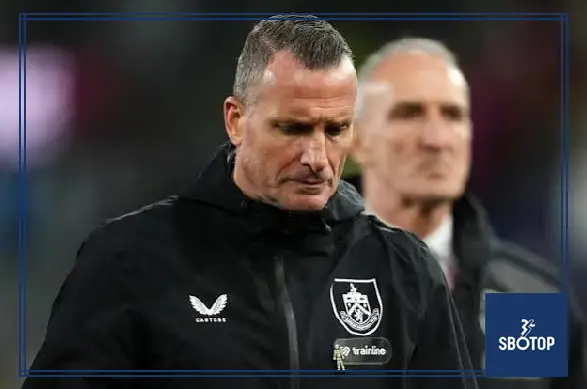
Burnley dismissed Nicky Hayen on 24 October 2026 after a 4-1 defeat at Lincoln City left the club in the Championship relegation zone. Appointed during the summer, the Belgian departed with only one victory from twelve league matches, an opening sequence far removed from expectations of an immediate return to the Premier League.
The announcement followed an afternoon that captured Burnley’s difficulties. They took the lead, conceded an equaliser before half-time, then allowed Lincoln to score three times after the interval. What began as an opportunity to secure a valuable away result became a heavy defeat. Within hours, the board confirmed a change of leadership, citing the disappointing start to the season.
A Short Statement Confirms the Decision
Burnley’s announcement was brief and unequivocal. Hayen had been dismissed with immediate effect, with the board identifying the team’s early Championship results as the reason for its decision. There was no suggestion that his departure was a resignation or a temporary arrangement.
The statement did not provide a detailed account of internal discussions. Claims about dressing-room disagreements, specific transfer disputes or individual players influencing the decision would therefore go beyond the information publicly established.
The confirmed position was serious enough without additional speculation. Burnley had reached the end of October inside the bottom three, and their latest defeat had exposed problems that a narrow scoreline might have concealed. The board decided that continuing with the existing coaching leadership was no longer the appropriate response to those results.
Twelve League Games, One Victory
Hayen’s record needs to be described carefully because league and cup totals tell slightly different stories. He oversaw fourteen competitive fixtures, including twelve Championship matches. Burnley’s only league victory during that spell was a 4-0 win at Watford on 10 October.
Their cup campaign included progress past Notts County on penalties before another shootout ended their involvement against Bradford. That distinction matters when summarising the tenure: a shootout success is not the same as another Championship win.
The central problem remained the league return. Burnley had not accumulated enough victories to support their intended direction, and the Watford result did not become the foundation for a sustained improvement. By the time they visited Lincoln, their position reflected an extended shortage of points rather than one isolated poor afternoon.
Expectations Made the Start More Difficult to Accept
Burnley entered the campaign after relegation from the Premier League, with promotion widely anticipated as a realistic objective. Their recent Championship history encouraged those expectations, but previous success could not guarantee another immediate recovery.
Relegated clubs face their own adjustments. Players must adapt to a different competitive rhythm, while coaches balance the demand for quick results with the work required to establish a coherent team. Resources and reputation can help, but neither replaces effective performances.
In Burnley’s case, the gap between ambition and results became increasingly uncomfortable. A side expected to challenge near the top instead occupied a relegation position. That contrast did not prove the squad was incapable of improving, but it created a clear need for correction. The board ultimately chose a managerial change as its response.
Lincoln Offered an Opportunity Before Becoming a Crisis
Burnley’s final match under Hayen was not a defeat in which they trailed throughout. Andreas Hountondji put them ahead in the 39th minute, providing a position from which they could have built a more controlled performance.
Ben House equalised during first-half stoppage time, removing that advantage before the interval. Lincoln then moved ahead through Mikkel Ladefoged in the 49th minute. Dom Jefferies added a third eight minutes later, and Ladefoged completed his double in the 67th minute.
The sequence explains why the result carried such weight. Burnley moved from a potentially useful lead to a three-goal deficit within a relatively short passage of the contest. Their inability to respond after the interval turned a competitive match into an emphatic setback, sharpening the focus on defensive organisation and game management.
The Defensive Problem Extended Beyond the Scoreline
Conceding four goals demanded scrutiny, but useful analysis must look beyond the total. Lincoln scored through different situations, including a long throw, deliveries into the penalty area and a strike from distance. Burnley could not consistently protect the spaces those attacks exploited.
That variety suggests several areas for review rather than one simple explanation. Defending the first contact, tracking movement, reacting to loose balls and closing shooting opportunities all contribute to preventing chances.
It would be too strong to diagnose every failure without access to the team’s instructions and a complete technical assessment. Nevertheless, the observable outcome was clear: Lincoln repeatedly turned attacking situations into goals. Burnley needed greater collective reliability, and changing the head coach did not remove the players’ responsibility to improve the execution of those defensive tasks.
Missed Opportunities Could Not Rescue Burnley
Burnley still had chances after falling well behind. Hountondji hit the outside of the post, while Marcus Edwards later had a penalty saved by George Wickens. Neither opportunity altered the final score.
Those moments deserve inclusion because the match was not entirely devoid of attacking threat from the visitors. However, they do not overturn the broader assessment. By then, Burnley had already conceded four times and were attempting to repair extensive damage.
A successful penalty might have reduced the margin, but assuming it would have produced a comeback would be speculation. The actual outcome was a missed chance and a 4-1 defeat. Burnley’s attacking openings showed that some possibilities remained, while their failure to convert them ensured there was no late change to the afternoon’s direction.
Watford’s Promise Failed to Become a Pattern
The earlier 4-0 victory at Watford demonstrated that Burnley could produce a convincing result under Hayen. It offered a plausible opportunity to rebuild confidence and establish greater consistency after a difficult opening period.
What followed did not sustain that promise. Burnley drew with Charlton Athletic and lost to Wolverhampton Wanderers before the defeat at Lincoln. The improvement suggested by the Watford scoreline therefore remained an exception rather than an established trend.
This distinction is important when assessing managerial progress. A strong individual performance can reveal potential, but it does not by itself demonstrate that underlying problems have been resolved. Burnley needed repeatable standards across successive matches. Their inability to turn one emphatic victory into a stronger sequence left the board evaluating the wider record, not simply the best afternoon of Hayen’s tenure.
Responsibility Does Not End with the Departing Coach
A dismissal places the head coach at the centre of attention, but footballing recovery requires work throughout the organisation. Players must respond to instruction, recruitment must support the intended approach, and senior decision-makers must provide a clear framework.
That is an analytical observation, not evidence of an undisclosed dispute at Burnley. The club’s public statement identified poor results; it did not assign responsibility across every department or explain the internal assessment in detail.
Even so, a replacement cannot improve performances merely by arriving. The team still needs dependable defending, effective communication and clearer decisions during difficult periods. Burnley’s leadership change created an opportunity to reassess those areas. Whether that opportunity produced lasting progress would depend on subsequent work and results, rather than the announcement itself.
Relegation Position Is a Warning, Not a Verdict
Burnley were twenty-second when Hayen departed, placing them inside the Championship’s relegation zone. That was a confirmed snapshot of their position on 24 October, not a prediction of where they would finish.
There was still substantial football remaining, making declarations of inevitable relegation premature. Equally, dismissing the table as meaningless would ignore the points already lost and the standard required to move away from danger.
The practical challenge was to replace occasional promise with a more reliable return. Improved defensive performances could provide a foundation, while converting favourable positions into victories would help change the trajectory. Those were tasks that could be addressed directly. Promotion calculations and survival forecasts remained secondary to improving what Burnley delivered from one match to the next.
A Reign Ends, but the Footballing Task Remains
Hayen’s departure marked the failure of Burnley’s initial plan for the season, rather than a final judgment on his entire coaching career. His previous achievements could explain the appeal of his appointment without cancelling the significance of results in England.
At Lincoln, the immediate evidence was damaging: an early advantage disappeared, the second half deteriorated sharply, and late opportunities went unused. The board then acted, ending his tenure after fourteen competitive matches.
Burnley’s next responsibility was to make the change meaningful. A different voice could offer new direction, but points would still have to be earned through better performances. The defeat had clarified the scale of the problem. Recovering from it required more than replacing the person on the touchline.
Also Read: