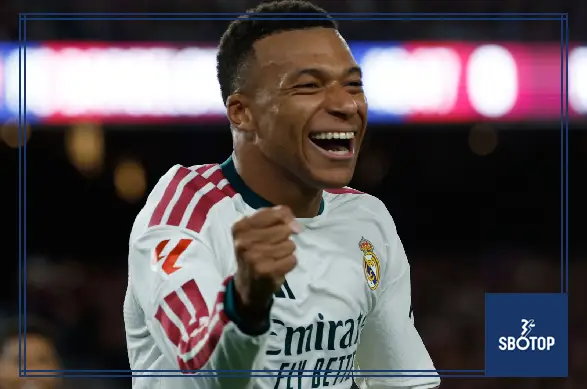
Kylian Mbappe delivered the decisive intervention in a gripping Clasico, scoring twice as Real Madrid defeated Barcelona 2-1 at Spotify Camp Nou on Sunday, 25 October 2026. His 87th-minute winner settled a match that had swung between Madrid’s threatening transitions and Barcelona’s increasingly forceful second-half response.
Mbappe opened the scoring in the 41st minute before Raphinha equalised in the 61st. Barcelona then created opportunities to complete the turnaround, but Madrid survived that pressure and produced the move that ultimately separated the teams.
The result ended Barcelona’s nine-match winning start in La Liga and reduced their advantage over Madrid from six points to three. For the visitors, it was a victory built on defensive concentration, attacking ambition and composure at the critical moment. For Barcelona, an encouraging recovery after half-time ended with the frustration of conceding when they were pursuing victory themselves.
A Contest with Immediate Consequences
Barcelona entered the fixture with a perfect league record, giving the meeting significance beyond its traditional rivalry. Another victory would have extended their advantage over Madrid to nine points. Instead, the visitors left with the gap halved.
That contrast explains the importance of the closing minutes. With the teams level, the outcome still carried substantially different consequences for the title race. Madrid’s winner transformed a possible evening of damage limitation into an opportunity to apply renewed pressure.
However, an October Clasico cannot determine a championship by itself. Barcelona remained league leaders after the defeat, with Atletico Madrid between them and their great rivals.
The appropriate conclusion was that the competition had tightened. Madrid had demonstrated they could beat the leaders away from home, while Barcelona faced the task of responding to their first league setback. Neither development established how the remainder of the season would unfold.
Madrid Find Opportunities Before the Break
Madrid’s first-half performance contained more attacking intent than a strategy based solely on containment. Arda Guler threatened early, forcing Joan Garcia into action as the visitors looked for openings around Barcelona’s defensive structure.
At the other end, Barcelona also had opportunities. Anthony Gordon tested Andriy Lunin, while Raphinha searched for space from which to threaten. The match required both sides to balance forward ambition with protection against quick attacks.
Madrid’s willingness to attack was important because it prevented Barcelona from treating possession as complete control. Whenever the visitors recovered the ball, their forward options demanded attention.
From a tactical perspective, that threat can influence a team even before a goal arrives. Defenders must decide how aggressively to support pressure, knowing that one successful escape may leave space behind them. Madrid repeatedly gave Barcelona that problem during the opening half.
Mbappe Benefits from a Fortunate Finish
The breakthrough came shortly before half-time. Madrid worked the ball towards Yan Diomande, whose delivery prompted Gerard Martin to attempt a clearance. The ball struck Mbappe and finished in the net.
The final contact involved fortune, but the attacking sequence that created the situation still mattered. Madrid had moved into a position where a hurried defensive intervention could produce an unpredictable outcome.
For Mbappe, being present in the danger area was enough to turn that uncertainty into a goal. Not every successful attacking action ends with a clean strike, and his positioning ensured the deflection benefited Madrid.
Barcelona nearly answered before the interval, while Diomande also had an opportunity to increase the visitors’ lead. Neither side scored again before the break. Madrid therefore entered half-time one goal ahead, with Barcelona needing an improved attacking performance rather than an entirely different result to restore parity.
Barcelona Increase the Pressure
Barcelona emerged with greater purpose after the interval. Their possession became more influential, and Madrid were required to defend closer to their own goal for longer periods.
The change did not immediately eliminate Madrid’s threat. Counterattacking opportunities remained available, making Barcelona’s pursuit of an equaliser a calculation involving both ambition and risk.
For the hosts, the challenge was to move the ball quickly enough to disturb Madrid’s organisation without turning attacks into avoidable losses of possession. Sustained pressure depended on support around the ball and readiness to recover it after unsuccessful moves.
This phase demonstrated why possession should be assessed through its effect rather than its duration alone. Barcelona were becoming more dangerous because they were finding better attacking positions. Madrid, meanwhile, needed concentration and an outlet whenever they regained control to avoid being trapped in a continuous defensive cycle.
Raphinha Restores Equality
Barcelona equalised in the 61st minute through Raphinha. Pedri supplied the pass, and the Brazilian’s low finish beat Lunin to bring the home side level.
The goal rewarded Barcelona’s improved second-half pressure and changed the requirements for both teams. The hosts no longer needed to chase a deficit, while Madrid had to decide how to recover attacking momentum without compromising their defensive organisation.
Pedri’s contribution underlined the importance of the pass before the finish. Breaking a compact defence often requires a delivery that gives the receiver an opportunity to act before opponents can close the space.
Raphinha supplied that immediate response. Barcelona had turned their recovery into a tangible result, but the equaliser did not settle the contest. It opened another phase in which both sides could still identify a route to victory, even as the home crowd sensed an opportunity for a complete turnaround.
Lunin Keeps Madrid in the Match
One of the crucial moments after the equaliser came when Lunin stopped Gerard Martin’s header. The intervention prevented Barcelona from converting their stronger spell into a lead.
Lunin had started in place of the unwell Thibaut Courtois, making his contribution particularly significant. Madrid needed their replacement goalkeeper to provide reliability in a demanding away fixture, and that save preserved the possibility of a winning response.
Goalkeeping can shape the interpretation of an entire match. Without a decisive intervention, defensive resistance may be remembered as insufficient. With it, the same period can become the platform for victory.
Yet Madrid’s survival was collective. Blocking shots, tracking runners and protecting central spaces also mattered. Lunin’s save was a defining individual action within a broader effort to prevent Barcelona’s momentum from producing a second goal.
Barcelona Cannot Turn Momentum into a Lead
Barcelona continued searching for the winner, with Lamine Yamal among those threatening. Their opportunities ensured Madrid could not assume that restoring some attacking presence would be enough to escape with a result.
However, a favourable spell does not guarantee the next goal. Barcelona still had to overcome the goalkeeper, defenders and the pressure attached to the final decision.
This distinction is central to understanding the defeat. The hosts had reasons to believe they could win, but those reasons remained possibilities until converted. Madrid retained the same opportunity at the other end.
It would therefore be excessive to describe Barcelona as certain winners denied by one unexpected event. Their second-half improvement was real, but Madrid’s counterattacking danger had remained part of the contest. The decisive late move exploited a threat that had never entirely disappeared.
Bellingham Begins the Winning Move
The winner arrived in the 87th minute through an attack involving Jude Bellingham, Guler, Eduardo Camavinga and Mbappe. Bellingham escaped pressure with a skilful turn, allowing Madrid to move forward before Barcelona could reorganise.
Guler helped continue the sequence, and Camavinga advanced into the decisive area before supplying the pass across goal. Mbappe completed the move with the finish that restored Madrid’s lead.
The quality lay in the connections. Bellingham’s escape would have achieved little without support, while Camavinga’s movement needed an accurate continuation from the previous action. Mbappe then had to arrive where the final ball could find him.
Although the finish was comparatively straightforward, the chance was not accidental. Madrid combined technical skill with speed and awareness, turning a moment under pressure into a clear opportunity at the opposite end.
Mbappe Reaches a Personal Milestone
Mbappe’s second goal also brought him to 100 goals for Real Madrid. Reaching that landmark through a late Clasico winner gave an already important contribution an additional personal dimension.
His two goals illustrated different aspects of attacking effectiveness. The opener came from occupying a dangerous position during an uncertain defensive moment. The winner required anticipation and timing at the end of a coordinated break.
Neither should be isolated from the team’s work. Diomande helped create the first situation, while several teammates constructed the second. Mbappe’s contribution was to ensure those sequences produced the goals Madrid needed.
A milestone also does not guarantee future performance. Its significance lies in what has already been achieved. On this occasion, the achievement coincided with a result that immediately improved Madrid’s position relative to the league leaders.
A Victory That Demands Perspective
Madrid protected their late advantage and completed a 2-1 victory, leaving Barcelona to assess both their recovery and the vulnerability exposed by the decisive transition.
For Jose Mourinho, the result demonstrated the value of remaining competitive through difficult passages while preserving an attacking route. For Hansi Flick, the task was to retain Barcelona’s improved second-half qualities while strengthening their protection when attacks broke down.
The match offered evidence of strengths and weaknesses on both sides, rather than a final verdict on either team. Barcelona remained top; Madrid had closed the distance.
What separated them at Camp Nou was execution at the decisive moment. Lunin kept Madrid alive, Bellingham helped release the winning attack, and Mbappe finished it. A Clasico that Barcelona had fought to recover ultimately belonged to the forward who struck last.
Also Read: