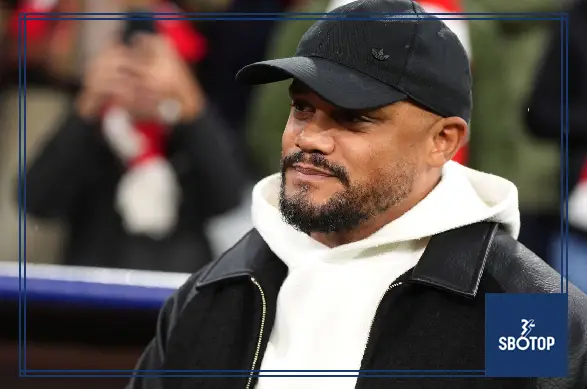
Vincent Kompany’s discharge from hospital provided welcome reassurance for Bayern Munich after their head coach collapsed while watching a reserve-team training session. The Belgian left hospital on 28 October 2026, five days after the incident, with the club making clear that his recovery would determine when he resumed his responsibilities.
Bayern’s sporting leadership described the development positively while maintaining an important distinction: leaving hospital did not mean immediately returning to full coaching duties. Kompany would continue resting and receiving treatment, with medical clearance required before he returned to work. No firm comeback date accompanied the announcement.
For a club accustomed to measuring progress through results, the immediate priority was different. Bayern needed to support their coach while ensuring that training and matches continued under his existing staff. The response placed personal wellbeing and professional continuity alongside each other, without making one dependent on the other.
The Incident That Interrupted Bayern’s Routine
Kompany required medical attention on Friday, 23 October, after collapsing during a training session involving Bayern’s reserve side. The first-team coach was observing the session when the incident occurred.
Bayern confirmed that he was undergoing examinations in hospital and would remain under medical care. His coaching staff were assigned responsibility for training and match operations until further notice.
That initial statement established the essential facts without attempting to answer questions that examinations had not yet resolved. It confirmed what happened, where responsibility would sit during his absence and the club’s commitment to supporting him.
The distinction matters because an alarming incident naturally creates demand for immediate explanations. However, the circumstances of a collapse do not independently establish a diagnosis, its severity or the expected recovery period. Those conclusions require medical assessment rather than interpretation of the setting in which someone became unwell.
Hospital Discharge Marks a Positive Development
The announcement on 28 October represented a meaningful change from the uncertainty surrounding Kompany’s admission. Max Eberl, Bayern’s board member for sport, described the discharge as particularly welcome news and said the coach was doing well in the circumstances.
The publicly reported diagnosis was meningeal irritation. Eberl also explained that Kompany would rest and take medication as his recovery continued.
Those details provided reassurance, but they did not establish that every aspect of his recovery was complete. Discharge and readiness to resume a demanding job are separate milestones.
For that reason, the announcement was best understood as progress rather than a deadline. Bayern could welcome the move out of hospital while continuing to leave decisions about work to the appropriate medical assessment. Optimism was justified by the update; certainty about an immediate return was not.
The Limits of the Medical Information
The information released publicly did not amount to a complete medical record. It would therefore be inappropriate to infer additional complications, specify an unannounced treatment programme or predict the length of recovery from the diagnosis alone.
Reports also referred to illness before the collapse. That background helps establish the chronology, but it does not justify constructing an independent explanation of exactly how the incident developed.
A responsible account should distinguish between the diagnosis communicated by Bayern’s representatives and any further interpretation. The available statements supported the conclusion that Kompany needed treatment and rest. They did not provide grounds for assessing his condition more precisely.
This restraint is particularly important when discussing a recognisable public figure. Interest in his availability does not make every medical detail public, and the absence of a detailed explanation should not be treated as evidence of a hidden development.
Bayern Give the Coaching Staff Clear Responsibility
Bayern’s initial response assigned the existing coaching team responsibility for football operations. Eberl expressed confidence in the staff and emphasised that Kompany would receive the time and support he needed.
Organisationally, that clarity served an immediate purpose. Players needed to know who would lead sessions, communicate decisions and manage match preparation. A period of uncertainty around the head coach did not have to become uncertainty about every daily task.
Analytically, established coaching structures can help a team maintain familiar standards during an absence. Assistants already understand the training methods, tactical language and expectations developed with the head coach.
That does not make the absent manager unimportant. It demonstrates why responsibilities are distributed across a staff rather than concentrated entirely in one person. Continuity allows colleagues to support recovery by keeping the professional environment functioning.
Aaron Danks Takes on the Immediate Football Duties
Assistant coach Aaron Danks led Bayern in Kompany’s absence. The team won 3–1 at Freiburg and subsequently defeated Magdeburg 6–1 in the German Cup while the head coach remained away.
At the time of the discharge announcement, Danks was also expected to take charge against Borussia Dortmund. The fixture programme continued, but it did not produce an announced return date for Kompany.
Those results established that Bayern could continue competing under the temporary arrangement. They should not, however, be used as a measure of Kompany’s health or as proof that his recovery could be accelerated.
The two issues required separate evaluation. Match performance belonged to the players and staff handling preparations. Readiness to return belonged to the recovery process. Keeping that separation reduced the temptation to make sporting importance the deciding factor in a medical matter.
Continuity Matters More Than Reinvention
From a football perspective, a temporary absence presents a different challenge from a permanent managerial change. The objective is generally to preserve an established approach while responding to the practical demands of each opponent.
That interpretation is consistent with Danks’s later explanation that Bayern had maintained their processes and drawn on the staff’s existing work with Kompany. The arrangement was presented as continuity rather than a competing coaching project.
Analytically, familiar routines can reduce the number of adjustments players must make. Training can retain recognisable objectives, while tactical discussions use language the squad already understands.
Nevertheless, assistants still face real decisions. Selection, substitutions and responses to changing match conditions cannot simply be postponed. Continuity therefore requires active leadership, not mechanical repetition. The staff’s task was to make those decisions within a shared framework while allowing the head coach to remain focused on recovery.
Encouraging Updates Do Not Establish a Deadline
A subsequent update on 6 November brought further encouragement. Danks said his conversations with Kompany had been positive and that the coach appeared to be progressing towards recovery. The international break offered an opportunity to review when he might return.
Even then, no fixed return date was announced in that update. The distinction between a positive impression and a confirmed schedule remained important.
A coach sounding upbeat in conversation is welcome, but it is not equivalent to confirmation that he can immediately resume every responsibility. Public comments can indicate direction without settling the final timing.
For supporters, that leaves an understandable degree of uncertainty. However, uncertainty about a date does not negate improvement. It simply means the information available supports cautious optimism rather than a promise tied to a particular match.
Support Does Not Require Constant Football Contact
Danks also explained that Bayern were avoiding involving Kompany in football discussions during his recovery at home. The purpose was to give him space rather than make him a remote participant in the daily workload.
That approach recognised a practical distinction between maintaining personal contact and continuing professional demands. A conversation offering support does not need to become a discussion about selection or opposition analysis.
Analytically, delegating authority only works fully when the people covering the role are allowed to exercise it. Continually referring decisions back to someone recovering could undermine the separation the arrangement was intended to provide.
There is no need to imagine private conversations to understand the principle. Bayern’s public position placed the responsibility with the available staff. The head coach’s absence was to be managed by the organisation rather than offset through an expectation that he keep working from home.
Avoiding Unsupported Explanations About Workload
The demands of elite coaching provide an obvious subject for discussion, but they should not be turned into an unverified explanation for Kompany’s collapse. Long hours, competitive pressure and extensive travel are general features of the profession; establishing a medical cause requires more specific evidence.
Likewise, the incident should not be used to diagnose burnout or another condition that was not confirmed in the medical updates considered here. Such labels can appear explanatory while adding information that has not actually been established.
The useful organisational lesson is narrower. A club benefits from having a structure capable of responding when an important member of staff becomes unavailable.
That conclusion concerns preparedness and responsibility. It does not require a claim about what caused Kompany’s illness. Bayern’s delegation of duties demonstrated one way to preserve football operations while keeping recovery separate from matchday expectations.
A Positive Step with Recovery Still Taking Priority
Kompany’s discharge was the central reassuring development after several days in hospital. It allowed the story to move from the immediate concern of the collapse towards a period of rest, treatment and assessment outside hospital.
Bayern’s response also established a clear professional arrangement: Danks and the coaching staff would manage the team while the head coach recovered. Encouraging subsequent comments supported optimism, without turning that optimism into a guaranteed return date.
The significance of the announcement therefore lay in progress rather than finality. Football continued, responsibilities were covered and Kompany had space to recover. His eventual return would be another milestone, determined by readiness rather than the urgency of the fixture list.
Also Read: