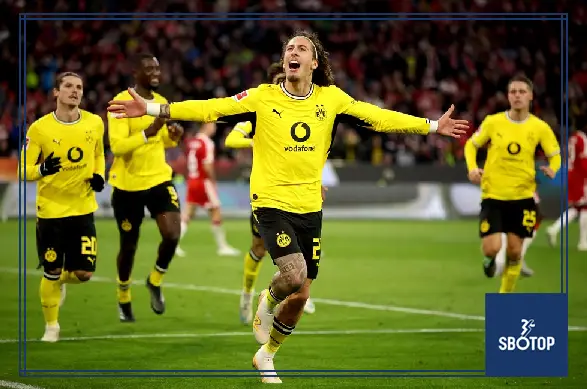
Bayern Munich twice surrendered the lead as Borussia Dortmund secured a dramatic 2-2 draw at the Allianz Arena on 31 October 2026, with substitute Fabio Silva delivering an 89th-minute equaliser.
Konrad Laimer and Dayot Upamecano scored for Bayern, while Serhou Guirassy provided Dortmund’s first response before Silva’s late intervention. The result kept the unbeaten rivals level on points after eight Bundesliga matches, with Bayern retaining first place on goal difference.
The scoreline captured the changing momentum, but only partly conveyed the drama. Bayern created opportunities to establish a more comfortable advantage, Harry Kane missed a penalty, and Dortmund repeatedly found ways to remain competitive.
For the hosts, it was an afternoon of missed opportunities. For the visitors, it demonstrated the value of staying within reach, even when the opposition appeared capable of pulling away.
A Meeting With Immediate Significance
The fixture brought together the Bundesliga’s leading two teams at an early but meaningful stage of the season.
Victory would have allowed either side to establish a points advantage over a direct rival. Instead, the draw preserved their proximity and ensured that neither could claim a decisive breakthrough.
That context added weight to every major incident.
Bayern had the responsibility of making home advantage count, while Dortmund needed to balance attacking ambition with the demands of containing a dangerous opponent.
The resulting contest resisted a simple description. There were periods when Bayern appeared more likely to settle the outcome, but Dortmund’s willingness to keep competing prevented those spells from becoming conclusive.
Ultimately, neither a lead nor a strong passage of play proved sufficient. The match remained open to another change until its closing seconds.
Laimer Converts After Dortmund’s Disallowed Goal
The first half featured an important reversal before Bayern established their advantage.
Jobe Bellingham appeared to have put Dortmund ahead, but his effort was disallowed following a review involving Carney Chukwuemeka’s offside position.
Bayern then struck in the 38th minute. Laimer advanced into a scoring position and, after Gregor Kobel stopped his initial effort, reacted quickly enough to convert the rebound.
The contrast between those moments was substantial. Dortmund went from believing they had opened the scoring to finding themselves behind.
Laimer’s finish also highlighted the importance of continuing an attack after the first attempt. Kobel had made the initial intervention, but the situation remained dangerous because Bayern’s runner stayed involved.
The goal rewarded persistence rather than a single flawless action. In a match eventually shaped by rebounds, loose balls and second opportunities, that quality became a recurring theme.
Bayern’s Advantage Remains Vulnerable
Taking the lead gave Bayern control of the score without removing the need for further precision.
A one-goal margin against an opponent with Dortmund’s attacking quality offered limited protection. It allowed the visitors to remain patient enough to seek an opening rather than immediately abandon their structure.
For Bayern, the challenge was to turn pressure into separation.
That requires more than simply maintaining possession. The team in front must continue creating worthwhile chances while avoiding the assumption that another goal will arrive automatically.
Dortmund, meanwhile, needed to prevent the deficit from growing. Even when a side cannot consistently dictate play, keeping the score close preserves the significance of its next successful attack.
The balance between those objectives gave the second half its tension. Bayern could threaten to move clear, but Dortmund never became irrelevant to the outcome.
Kane’s Penalty Miss Changes the Opportunity
Bayern received a major chance to double their lead when a handball by Felix Nmecha resulted in a penalty.
Kane stepped forward in the 57th minute, but his effort struck the crossbar. Three minutes later, Guirassy equalised for Dortmund.
The sequence transformed the match.
A successful penalty would have created a two-goal cushion, although it cannot be assumed that the remainder of the contest would then have unfolded identically.
What can be said is that Bayern failed to take a particularly valuable opportunity, and Dortmund quickly capitalised on their continued involvement.
The missed penalty therefore mattered both directly and through its place in the chronology. Instead of needing a substantial recovery, the visitors were suddenly level.
Such moments illustrate how quickly an apparently favourable position can become uncertain when a leading team leaves its advantage unprotected.
Guirassy Supplies Dortmund’s First Answer
Guirassy’s equaliser gave Dortmund a route back into the match and forced Bayern to begin again.
The striker’s ability to deliver in a decisive attacking moment was particularly valuable because the visitors did not need to dominate every phase to threaten the result.
That is an important distinction in assessing a contest between strong teams.
Sustained pressure can indicate which side is generating more danger, but the scoreboard responds to completed chances. Dortmund’s first equaliser demonstrated how one successful attack can outweigh several minutes spent defending.
For Bayern, conceding so soon after the penalty miss created an immediate test of composure.
They needed to resist allowing frustration to disrupt their attacking decisions or defensive organisation. Their response showed that the setback had not removed their capacity to produce another decisive moment.
The match still had considerable distance to run.
Upamecano Restores Bayern’s Lead
Bayern responded in the 66th minute through an aerial combination involving Joshua Kimmich, Kane and Upamecano.
Kimmich delivered the ball, Kane headed it into a dangerous area, and Upamecano finished with a close-range header to restore the home side’s advantage.
The goal offered a reminder that Kane’s contribution extended beyond his own attempts to score.
After the disappointment from the penalty spot, he remained involved and supplied the assist for a teammate. That response matters when evaluating his performance: the missed opportunity was significant, but it was not his only meaningful action.
Upamecano’s involvement also showed the value of an additional attacking presence.
A defender arriving near goal can create a different problem for opponents already occupied by recognised forwards. Bayern used that presence effectively and again placed Dortmund in the position of needing an equaliser.
Missed Chances Keep Dortmund Within Reach
Bayern continued to threaten after regaining the lead, with Kane later hitting the post.
The hosts also had to contend with first-half injury substitutions involving Ismael Saibari and Serge Gnabry, adding another complication to their afternoon.
Those circumstances provided context without changing the central requirement: Bayern still needed either another goal or sufficient defensive control to protect their advantage.
It would be excessive to attribute the final result solely to bad fortune.
Striking the woodwork shows how close an attempt came, but the outcome also depends on finishing, goalkeeping, defensive pressure and the quality of subsequent decisions.
Dortmund benefited from Bayern’s inability to extend the margin. They also had to remain organised enough to ensure that the next opportunity retained its value.
That persistence became decisive as the match approached its final minutes.
Silva Delivers the Late Equaliser
Silva’s intervention arrived in the 89th minute, when Bayern failed to resolve a dangerous situation around their penalty area.
Konstantinos Karetsas charged down Aleksandar Pavlovic’s attempted clearance, and Silva reacted to the loose ball. He turned and drove a low right-footed finish into the far corner to make it 2-2.
The goal demonstrated how an apparently defensive action can become an attacking opportunity through pressure.
A clearance is only effective if it actually removes the danger. Once Karetsas disrupted Bayern’s attempt, Silva had a brief window in which to act.
His execution supplied the decisive part.
The finish also validated Dortmund’s continued pursuit of the match. They had twice fallen behind, yet remained sufficiently engaged to exploit another opening.
For Bayern, it was a costly failure to complete the defensive sequence.
One More Escape Before Full-Time
Even Silva’s equaliser did not settle the contest immediately.
Lennart Karl struck the crossbar in stoppage time as Bayern searched for a winning goal, leaving Dortmund to survive another late scare before the final whistle.
That closing attempt reinforced the difference between the teams’ likely assessments.
Bayern could point to several opportunities that might have produced victory. Dortmund could point to their ability to respond twice and withstand the final pressure.
Both perspectives contained part of the truth.
The hosts had reasons to regret the draw, while the visitors had reasons to value it. Neither interpretation required pretending that the match had been evenly balanced in every phase.
The decisive fact was simpler: Bayern’s advantages never became secure enough, and Dortmund remained capable of changing the outcome.
A Draw Defined by Persistence and Precision
The Klassiker left the title contest unresolved and offered both teams clear lessons.
Bayern demonstrated their ability to create danger and respond after conceding, but failed to turn two leads into victory. Dortmund showed resilience and received decisive attacking contributions when the match demanded them.
Kane’s penalty miss inevitably stood out, yet reducing the entire game to that moment would overlook the goals, interventions and decisions that followed.
Laimer’s persistence, Guirassy’s equaliser, Upamecano’s header and Silva’s late finish each altered the contest.
Together, they produced a match in which superiority during a passage of play never guaranteed control of the result. Bayern came close to securing more, but Dortmund’s refusal to disappear ensured that the evening ended with the rivals still side by side.
Also Read: