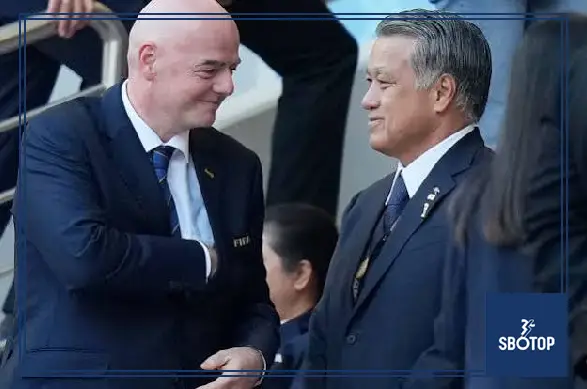
Kohzo Tashima has submitted a bid for the FIFA presidency, challenging Gianni Infantino as the incumbent seeks another four years in charge of world football. The Japan Football Association confirmed that it sent FIFA a nomination letter on 17 November 2026. Tashima, the association’s honorary president, said he had secured the backing of five national federations, the minimum required to seek a place on the ballot. The election is scheduled for 18 March 2027 at the 77th FIFA Congress in Rabat, Morocco.
The nomination makes Tashima the first Japanese figure to put himself forward for FIFA’s presidency. It also brings an experienced member of FIFA’s own governing council into a contest increasingly focused on how the organisation makes major decisions. Tashima has put governance and transparency at the centre of his bid. He has yet to publish a full manifesto or disclose the names of all the associations that supported his nomination. FIFA’s formal eligibility checks still have to take place.
An experienced FIFA insider steps forward
Tashima, 68, served as president of the Japan Football Association from 2016 to 2024. His current title is honorary president, while Tsuneyasu Miyamoto leads the association. Tashima thanked Miyamoto and the board after the nomination was submitted. The Japanese association’s public involvement gives his campaign a clear starting point, especially because the leadership of Asia’s regional confederation has already endorsed Infantino.
His path into administration began on the pitch. Tashima won seven senior caps for Japan as a forward and played for Furukawa Electric in the Japan Soccer League. After retiring from playing in 1983, he studied coaching in West Germany under Dettmar Cramer. He later led Japan at the 2001 under-17 world championship, chaired the national association’s technical committee and helped establish the JFA Academy Fukushima, where he served as headmaster from its opening in 2006 until 2012.
Tashima joined FIFA’s executive committee in 2015, a year before it became the FIFA Council and Infantino became president. He has also served on the Asian Football Confederation’s executive committee and led the East Asian Football Federation. That experience gives him a working knowledge of the bodies he wants to reform. As his campaign develops, it also gives national associations a basis for asking which decisions he would handle differently and how he would change the process.
Why Infantino’s commercial proposal matters to the race
Infantino was first elected in 2016 and was returned by acclamation in 2023 after standing unopposed. He announced that he would seek re-election in 2027, but an abandoned commercial proposal has since become a point of contention. The plan would have brought private investors into a new FIFA subsidiary holding rights linked to the World Cup and other competitions. It envisaged selling a 20 per cent stake for $4.2 billion. FIFA dropped the plan in July 2026, and Infantino later apologised to the FIFA Council over how it had been handled.
The proposal matters in an election because it raised questions about who gets consulted before FIFA considers a change affecting its biggest competitions. Tashima has said sound governance and transparency should come before individual policy initiatives. That gives his campaign a theme, though he has yet to set out how he would put it into practice. The practical questions include what information member associations would receive, when they would see it and which decisions they would have a formal role in approving.
Infantino retains considerable support. The leadership of the Asian Football Confederation backed him publicly at its extraordinary congress in Tokyo in October, after its president, Sheikh Salman bin Ibrahim Al Khalifa, had criticised the commercial proposal. Infantino has also had the support of the Confederation of African Football and South America’s CONMEBOL. The Asian confederation’s position illustrates how a dispute over a particular policy can coexist with an endorsement of the president who proposed it.
Philippe Diallo adds another option for FIFA’s voters
French Football Federation president Philippe Diallo has also entered the race. On 16 November, the European national associations represented on UEFA’s executive committee and the FIFA Council unanimously backed his bid. The scope of that announcement matters. Europe has 55 FIFA member associations, and the endorsement came from the associations represented on those two bodies. Even support from all 55 would leave a European-backed candidate needing substantial backing from elsewhere to win.
Diallo has said he wants to speak to Tashima about working together. Tashima said on 18 November that he had been in indirect contact with people around Diallo but had yet to speak to him directly about a plan. There is no announced alliance, agreement to withdraw or joint platform. For now, the two are pursuing separate bids. Their interest in speaking shows that both have to consider how their campaigns might interact if they are approved to stand.
Former Switzerland captain Ramon Vega has also declared his intention to run. His announcement adds another name to the field ahead of the nomination deadline, although the approved list will depend on whether each would-be candidate meets FIFA’s requirements. Until that list is issued, the number of names on the eventual ballot remains open. That detail matters because it determines the threshold candidates face in the first round.
How the ballot in Rabat will work
Candidates need the support of at least five FIFA member associations and must have held an active role in football for at least two of the previous five years. Those proposed for the presidency must also undergo formal eligibility and integrity checks. FIFA’s general secretariat is required to notify member associations of the proposed candidates at least one month before Congress. Tashima’s submission therefore marks the completion of an important step in the process. Confirmation of the ballot comes later.
FIFA has 211 member associations, each with one vote. In a two-candidate contest, a simple majority of valid votes cast is enough. If all 211 associations cast valid ballots, that would mean 106 votes. With more than two candidates, a first-round victory requires two-thirds of the votes of the associations present and eligible to vote. If nobody reaches that threshold, the rules provide for successive ballots and elimination of the lowest-polling candidate until two remain.
The voting structure gives national associations a direct say regardless of the size of their domestic leagues or the success of their national teams. A confederation endorsement can indicate where much of a region’s support lies, while the votes belong to the individual associations. The secret ballot also means public declarations can only offer a partial account of how Congress will vote. For Tashima, the immediate challenge is to persuade associations beyond the group that nominated him.
What Tashima still has to show
Tashima has acknowledged that he is starting from a difficult position and said he still needs to develop his manifesto and campaign strategy. Publishing that programme would allow associations to see what his call for transparency means for decisions on tournaments, commercial rights and the development of the game. The names of his nominators, when disclosed, would offer an early indication of how far his support extends beyond Japan. Neither will settle the contest, but both would make his bid easier to assess.
For now, Infantino has the advantage of incumbency and several public confederation endorsements. Tashima has Japan’s nomination, says he has met the five-association threshold and brings experience from inside the organisation he wants to lead. Diallo’s campaign gives members another option and raises the possibility of cooperation between challengers. Whether that happens remains undecided. What has changed since Infantino’s unopposed return in 2023 is that senior football officials have come forward to contest his leadership, and member associations can ask them to explain what they would do with the job.
Also Read: