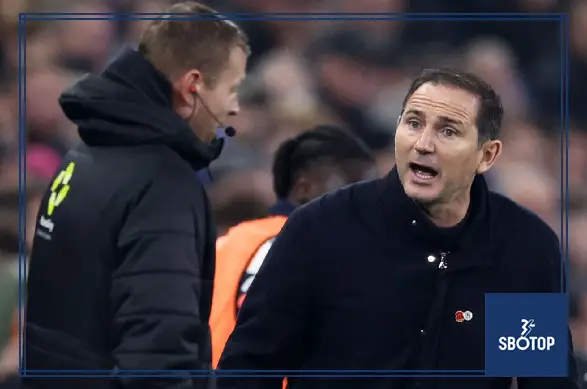
Frank Lampard said VAR “didn’t do its job” after Coventry City’s 3–1 Premier League defeat by Everton on 6 November 2026. Coventry had two penalty appeals go unanswered at Hill Dickinson Stadium, then watched Thierno Barry’s go-ahead goal survive a handball check. The Premier League’s subsequent review vindicated Lampard on one important point. Its Key Match Incidents panel unanimously found that Coventry should have received a penalty for James Tarkowski’s hair pull on Caleb Yirenkyi. The panel reached different conclusions on the other two incidents.
The football gave Lampard plenty to think about as well. Yann Gboho put Coventry ahead in the 52nd minute, but Barry scored twice in quick succession and then set up Kiernan Dewsbury-Hall to finish the game. Coventry had earned their lead in open play and lost it in a short spell when Everton repeatedly found Barry at the far post. The controversy concerned what the officials should have done at three pivotal moments. The result also reflected what Everton did when their chances came.
The hair pull that should have brought a penalty
The first flashpoint came in the 38th minute, with the score still 0–0. Tarkowski went up to challenge for a ball in Everton’s penalty area and took hold of Yirenkyi’s hair as the Coventry player tried to contest it. There was also contact involving Ethan Pinnock during the sequence. Referee Stuart Attwell allowed play to continue, and the video officials did not recommend a change to his decision. Coventry went into half-time without a penalty.
All five members of the Key Match Incidents panel later concluded that Tarkowski’s action was a punishable foul. They agreed that Coventry should have been awarded a penalty and Tarkowski should have been shown a yellow card under the season’s guidance on hair pulling. The panel was also unanimous that the decision met the threshold for VAR intervention. Its finding addressed both the original decision and the failure to send Attwell to review it.
The sanction matters because some of the immediate discussion centred on whether Tarkowski should have been sent off. The guidance distinguishes hair pulling involving excessive force or brutality, which can warrant a red card, from conduct that merits a yellow. The panel’s conclusion was specific to this incident. Coventry should have had a spot kick and Tarkowski should have been booked. With the teams level, the missed penalty would have given Coventry a chance to take the lead before the interval. Whether they would have converted it, or how the teams would have responded, remains open.
The Awoniyi challenge came down to where contact occurred
Coventry’s second penalty appeal arrived shortly after the restart. Taiwo Awoniyi broke forward and went down under a challenge from Vitalii Mykolenko near the edge of the area. The critical question was where the contact occurred. The video officials judged that it was outside the box, and the on-field decision to give no penalty stood.
The panel later supported that ruling by five votes to none. Its members agreed that Mykolenko had fouled Awoniyi and that the contact was just outside the area. For Coventry, watching a forward go down as he approached goal made the incident feel like another opportunity taken away. The panel’s remit on this point was narrower. It assessed whether the contact justified a penalty and agreed with the location identified during the match.
Coventry soon found a way through themselves. Gboho worked past challenges in the box and poked his finish beyond Jordan Pickford for his first goal for the club. Earlier, Pickford had kept out a low effort from Tatsuhiro Sakamoto after Jack Rudoni played him into the area. Gboho’s opener therefore rewarded a side that had already shown it could threaten from open play. For a few minutes, the penalty appeals receded as Coventry had the lead their attacking work had earned.
Barry’s second goal divided the panel
Everton’s response began with a Dewsbury-Hall cross. Barry met it at the back post and headed in, wiping out Coventry’s advantage within minutes. He returned to a similar position for his second in the 61st minute. This time, as the ball went in from close range, Coventry appealed that it had struck his hand immediately before crossing the line. Attwell awarded the goal, and the video review left his decision in place. Everton led 2–1.
Accidental contact can matter when the scorer’s hand or arm touches the ball immediately before the goal. Coventry’s appeal therefore hinged on establishing that contact. The league’s explanation on the night said the check had found no handball offence. The subsequent panel assessment captured the uncertainty more precisely. Three members believed the ball probably had struck Barry’s hand. The other two supported the on-field decision to award the goal. All five agreed that the available footage was inconclusive and supported VAR’s decision to leave the goal standing.
That distinction goes to the heart of Lampard’s complaint. A reviewer can consider one explanation more likely while accepting that the images fall short of the evidence needed to overturn a decision. In the Tarkowski incident, the panel found that the officials should have acted on what they could see. For Barry’s second, the panel shared some of Coventry’s doubts about what had happened but agreed that the replays could not establish it conclusively. The goal stood because the check could not resolve the question to the required standard.
Everton made the most of a short spell of vulnerability
The debate over the second goal can obscure how quickly Everton had already drawn level. Coventry knew what a delivery to Barry at the far post could do after the first header. When the ball came across again, he was in position to finish from close range. His two goals took him to ten for the season and forced Coventry to abandon the task of defending a lead. They now had to find an equaliser while Everton had an obvious route to a third.
Barry provided it in a different way. In the 81st minute, he threaded a ball through for Dewsbury-Hall, who finished from a tight angle at Carl Rushworth’s near post. Their roles had reversed since the equaliser. Dewsbury-Hall had found Barry with a cross, and Barry now supplied the pass that put the midfielder in a position to score. It was the first time Everton had led by two goals, and it took much of the tension out of the closing minutes.
That third goal also showed the limitations of reducing the match to its refereeing decisions. Coventry’s appeals concerned moments that could have changed the score, and the missed penalty was a confirmed error. Everton still had to create and convert the chances that decided the game as played. Barry’s movement made him a target for crosses, while his pass for the third showed he could hurt Coventry from outside the immediate scoring area. He had a direct involvement in all three Everton goals.
What the review established and what it leaves unanswered
Lampard’s post-match frustration was understandable given the timing of the incidents. The first came with the game goalless. The second came before Coventry scored. The third concerned the goal that took Everton from level to ahead. His argument was that decisions of that importance can alter the course of a match. The review substantiated his complaint most clearly over Tarkowski and Yirenkyi, where both the referee’s decision and VAR’s response were judged wrong.
The result itself offers no reliable way to calculate the cost of that error. A first-half penalty would have changed the next decision each manager had to make, whether it was scored or saved. Even if Coventry had converted, the remaining match would have unfolded from a different starting point. Similarly, disallowing Barry’s second would have left the teams at 1–1 in the 61st minute, with both still having time to find a winner. A missed decision can be established with more confidence than its effect on the final score.
Everton moved provisionally into fifth with the victory, while Coventry finished the night two points above the relegation zone. For Lampard’s team, the clearest grievance was the spot kick they should have had before half-time. The other two incidents explain why the match felt so contentious, while the panel’s findings show why each required a different judgement. Coventry had enough attacking purpose to take the lead at a difficult away ground. Everton had the player who took it from them. Once Barry found the far post twice, his pass for Dewsbury-Hall gave the home side the goal that finally settled the contest.
Also Read: