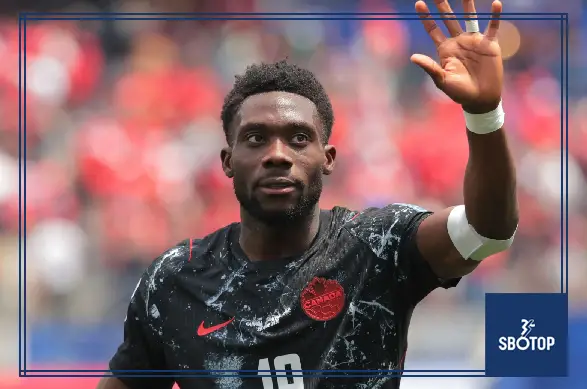
Alphonso Davies has experienced pressure before. He has played in Champions League nights, carried the expectations of Bayern Munich, and become the face of Canadian football across an era of historic growth. Yet the 2026 World Cup presented a different kind of challenge. It was not simply about tactics, opponents, or the weight of representing a host nation. It was about watching Canada’s biggest football moment unfold while knowing his body would not allow him to fully take part.
Canada’s World Cup campaign ended in a 3-0 defeat to Morocco in the round of 16, a result that brought both pride and frustration. The national team had made history by reaching the knockout rounds and recording a first-ever men’s World Cup knockout victory, but the exit also revived questions about what might have happened if Davies had been fully fit. The Bayern Munich star watched the Morocco match from the bench, unable to contribute because of the hamstring problems that limited him throughout the tournament.
For a player used to changing games with speed, aggression, and fearless forward runs, that helplessness was difficult to accept. Davies later described the tournament as one of the toughest challenges of his career, admitting that he could not perform at the level he knew he was capable of. Yet he refused to hide behind excuses. His message was clear: setbacks are part of football, and the response matters more than the disappointment.
A Statement Built on Honesty
Davies’ post-World Cup statement carried the tone of a player who was hurting but not looking for sympathy. He said representing Canada on football’s biggest stage was something he would never take for granted, and he praised his teammates for giving everything for the country. At the same time, he admitted the personal frustration of not being able to give his all when Canada needed him most.
That honesty was important. Athletes often speak in controlled phrases after major defeats, but Davies’ words felt more direct. He did not pretend the injury was a minor detail. He did not pretend he was fine. He did not shift blame toward the coaching staff, medical team, or tournament schedule. Instead, he accepted the emotional reality: he wanted to play, but he was not physically ready to be the player Canada needed.
There is maturity in that kind of response. Davies could easily have focused on misfortune. He could have leaned on the injury as a shield against criticism. Instead, he framed the experience as motivation. He said football is full of setbacks and that the way a player responds is what defines him.
That line may become the key message from his tournament. Canada lost, Davies barely played, and the dream ended earlier than the country hoped. But the response of the team’s captain showed leadership in defeat.
The Hamstring Injury That Changed Everything
Davies’ World Cup was shaped by a hamstring injury that restricted him to only a brief appearance. BuliNews reported that he was limited to just 15 minutes across the tournament and did not feel fit enough to feature against Morocco.
That number tells the story. Fifteen minutes is barely enough time for a player to find rhythm, let alone influence a World Cup. For Canada, losing Davies’ full impact was a major blow. He is not just another starter. He is the player who gives the team a unique attacking dimension, a vertical threat, and a psychological edge.
When Davies is fit, Canada can stretch opponents in a way few teams can. His speed forces defenders to retreat. His dribbling opens space for teammates. His ability to move from deep areas into the final third changes the shape of a match. Without him, Canada still showed organization and spirit, but they lacked the explosive weapon that often separates competitive performances from decisive wins.
That was visible in the Morocco defeat. As Canada chased the match, supporters waited for the moment Davies would come off the bench. It never arrived. The Guardian noted that Jesse Marsch did not bring him on, even as fans wondered when their most dynamic player would be introduced.
The Morocco Match and the Question of Risk
Canada’s 3-0 loss to Morocco was a brutal way to exit. Morocco scored through Azzedine Ounahi twice and Soufiane Rahimi deep in stoppage time, ending Canada’s run in convincing fashion.
The scoreline made Davies’ absence feel even heavier. When a team loses narrowly, supporters often point to small moments. When a team loses by three, questions become broader. Could Davies have changed the rhythm? Could his pace have disrupted Morocco? Could his leadership have lifted Canada in the second half?
Those questions are understandable, but they are also impossible to answer. What Davies made clear is that he did not believe he was ready to help at full capacity. The Guardian quoted him explaining that Canada needed players who were 100 percent ready to give everything, and he felt he was not at that level. That was why the decision was made for him to sit out.
That decision may have been painful, but it was responsible. A player can be desperate to appear in a World Cup knockout match and still know that his body is not prepared. The hardest part of professionalism is sometimes saying no to the moment everyone expects you to embrace.
Canada’s Historic Run Still Matters
The disappointment should not erase what Canada achieved. The team reached the round of 16 and secured its first-ever men’s World Cup knockout victory, a milestone that matters deeply for the country’s football development.
Bayern Munich’s official report described Canada’s win over South Africa in the round of 32 as a historic milestone, with Stephen Eustaquio scoring the decisive goal in stoppage time. Davies came on after 75 minutes in that match, making his first World Cup appearance of the tournament after missing earlier games due to injury.
That brief cameo showed what Canada had been missing. Bayern’s report noted that Davies immediately injected momentum into the game after entering as a substitute. Canada later found the winner, and the moment offered a glimpse of what a fitter Davies might have provided more consistently.
Still, the run itself deserves respect. Canada did not collapse because one player was unavailable. The team fought, advanced, and created a moment of national pride. The problem is that Davies’ limited role left a sense of unfinished business.
The Burden of Being Canada’s Defining Player
Davies carries a unique kind of pressure. For Bayern Munich, he is one elite player among many. For Canada, he is the symbol of the program’s rise. The Guardian described him as Canada’s one world-class player and noted that the national team’s hopes have often been tied to his form since his international debut in 2017.
That is not an insult to Canada’s other players. It is an acknowledgment of Davies’ impact. He helped transform expectations around the national team. He was central to Canada’s qualification for the 2022 World Cup, the country’s first appearance on the men’s football stage since 1986. He also played a major part in Canada’s wider rise, including stronger performances in regional tournaments and a fourth-place finish at the 2024 Copa América.
This is why his limited involvement in 2026 hurt so much. The World Cup was not just another tournament. It was a home-soil event for Canada, a chance to show the world how far the program had come. Davies was supposed to be at the center of that story. Instead, he became part of a different one: the heartbreak of a star player unable to fully participate in his country’s defining football moment.
The Injury Management Debate
Davies’ situation also revived a wider discussion about injury management. The Guardian traced some of the concern back to March 2025, when Davies suffered an ACL injury after playing in a Concacaf Nations League third-place match against the United States. The report noted that Bayern Munich and Davies’ agent were unhappy with how the situation had been handled, with his agent suggesting the player was not fully fit after a previous match and should not have started.
That background matters because it frames the 2026 World Cup problem as more than bad luck. Davies’ body had already been through a demanding recovery process. His hamstring issue arrived in the shadow of a longer injury story. That made every decision about his minutes more complicated.
From Canada’s perspective, the temptation to use Davies was obvious. This was the World Cup. This was a home tournament. This was the knockout stage. From Bayern’s perspective, protecting a key player’s long-term fitness was equally important. From Davies’ perspective, the emotional conflict must have been enormous.
He wanted to help Canada. He also knew he was not fully ready. That tension explains why his statement felt so heavy.
No Excuses, But Plenty of Pain
Davies’ refusal to make excuses should not be mistaken for emotional distance. He was clearly devastated. He said it hurt to know he could not give his all when his team and country needed it most.
That is the pain of elite athletes. They are trained to respond, to compete, to influence outcomes. Sitting out while teammates fight is sometimes harder than playing badly. At least on the pitch, a player can try to change the story. On the bench, he can only watch.
Davies’ statement showed that he understood the difference between explanation and excuse. The injury explained why he could not play more. It did not become something he used to avoid responsibility. That distinction is important. It showed accountability without self-punishment.
Football careers are built through setbacks as much as success. Davies has now faced another major test, and the way he processes it could shape the next stage of his career.
What This Means for Bayern Munich
Davies will now shift his focus back to Bayern Munich and the 2026/27 campaign. BuliNews reported that he will look to return to full fitness ahead of the new club season.
For Bayern, patience will be essential. Davies’ greatest strengths are based on acceleration, sharp changes of direction, recovery speed, and repeated high-intensity running. A hamstring issue can directly affect all of those qualities. Rushing him back would risk more setbacks.
Bayern will want him healthy for the full season, not simply available for the first few matches. That may mean a careful recovery plan, controlled training load, and gradual minutes. The club knows what Davies can be when fully fit. The priority will be restoring that version of him, not forcing an incomplete one onto the pitch.
This is also where Davies’ mentality matters. He has framed the World Cup disappointment as motivation. If that motivation is matched with patience, he can return stronger. If it becomes frustration, the recovery could become more difficult.
Canada’s Future After a Historic Exit
Canada must also learn from this tournament. The team made history, but the Davies situation showed the danger of relying too heavily on one player’s availability. Great national teams need stars, but they also need systems that can survive when those stars are limited.
Canada’s progress is real. The team has become more competitive, more ambitious, and more respected. But the next step is building a structure where Davies enhances the team rather than carrying its entire identity.
That does not mean lowering his importance. It means surrounding him with enough quality, tactical clarity, and depth that one injury does not define a campaign. The 2026 World Cup proved that Canada can reach knockout football. The next challenge is proving they can consistently compete there with or without their best player fully fit.
Davies’ return will be central to that future, but Canada cannot make him the entire plan.
Also Read:
- SBOTOP: UEFA Accuses FIFA of Crossing the Line After Shock Suspension of Folarin Balogun’s Red Card Ban
- SBOTOP: Vinicius Junior Reveals Penalty Decision as Bruno Guimaraes Miss Leaves Brazil Haunted Against Norway
- SBOTOP: Cristiano Ronaldo Fires Back at Retirement Talk as Portugal Icon Hints 2026 Could Be His Final World Cup Stage