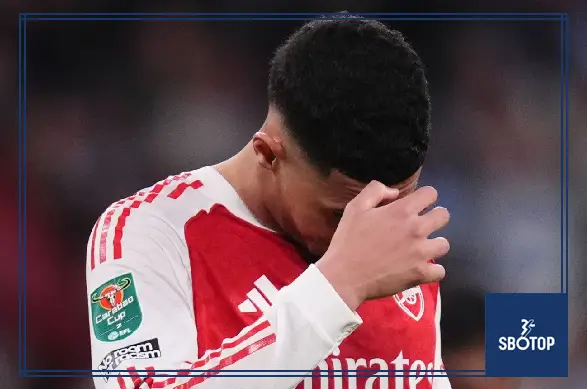
Arsenal’s preparations for the new season have suffered a serious setback after the club confirmed that William Saliba will be unavailable for an extended period because of a back injury aggravated during France’s World Cup campaign.
The influential central defender underwent specialist assessments after returning to London, with those examinations confirming that he requires a substantial period of rehabilitation. Arsenal have provided one significant piece of positive news by announcing that surgery is not currently required. Saliba will instead begin a carefully managed recovery programme under the supervision of the club’s medical team.
No precise return date has been revealed. The use of the phrase “extended period,” however, makes it clear that Arsenal expect to begin their Premier League title defence without one of the most important members of their squad.
Saliba’s injury became visibly worse during France’s World Cup semi-final defeat to Spain on July 14, 2026. The 25-year-old was substituted after approximately 30 minutes and subsequently missed France’s third-place match against England. He had already been following a modified training programme during parts of the tournament because of discomfort in his back.
For Arsenal, the timing could hardly be more difficult. The Premier League champions are approaching the start of a new domestic campaign after an exhausting season and a demanding World Cup involving many of their leading players.
The club must now decide whether the defenders already available can absorb Saliba’s absence or whether another centre-back must be added before the transfer window closes.
Arsenal Lose the Foundation of Their Defence
Saliba has developed into one of Arsenal’s most dependable and influential players.
His value cannot be measured only through tackles, interceptions or aerial duels. He gives Arsenal a rare combination of physical strength, recovery speed, composure and technical security.
When opponents attempt to play directly behind Arsenal’s defensive line, Saliba has the pace to recover. When Arsenal build possession from their own penalty area, he is comfortable receiving the ball under pressure and advancing play with accurate passes.
Those abilities allow Mikel Arteta to position the team higher up the pitch.
A slower central defender might require Arsenal to defend closer to their own goal. Saliba’s athleticism permits the back line to move forward, compress the playing area and support the team’s pressing structure.
His calmness also affects the players around him. Defenders can take more aggressive positions because they trust Saliba’s ability to cover space. Midfielders can press opponents knowing that a quick pass behind them will not automatically create a clear chance.
Removing him therefore changes more than one position.
Arsenal may have to adjust the height of their defensive line, their pressing intensity and the way they protect against transitions. Even when another defender performs well individually, reproducing Saliba’s complete tactical influence will be extremely difficult.
The Injury Developed During a Demanding Period
Arsenal’s statement confirms that Saliba returned from the World Cup with a back problem requiring rehabilitation, but reports suggest he had been managing discomfort before the tournament’s decisive stages.
During the World Cup, his training workload was adjusted as France monitored the issue. He was still able to participate in most of the campaign, but the problem worsened during the semi-final against Spain.
The decision to play through discomfort will inevitably lead to debate.
Elite players regularly manage minor injuries during important competitions. The distinction between being completely fit and being available is often blurred, particularly during title races and major international tournaments.
Saliba had contributed to Arsenal’s Premier League-winning campaign and then joined France for the World Cup with little opportunity for meaningful rest.
The desire to represent his country in the tournament is understandable. France reached the semi-finals, and Saliba was competing for one of football’s greatest honours.
However, playing with a back issue always carried the danger of aggravation.
The challenge for medical teams is determining whether discomfort can be safely managed or whether continued participation increases the chance of a longer absence.
Arsenal, France and Saliba will all have been involved in those discussions. Without access to his medical information, it would be unfair to claim that any party knowingly took an unacceptable risk.
The outcome nevertheless leaves Arsenal facing the consequences at the beginning of a new season.
Avoiding Surgery Provides Some Encouragement
The decision not to operate is an important part of Arsenal’s announcement.
Surgery can sometimes provide a clear solution, but it also introduces additional risks and normally creates a more rigid recovery schedule.
Specialists have instead recommended a managed rehabilitation programme. This suggests they believe Saliba can recover through treatment, carefully controlled loading and gradual physical progression.
That should not be interpreted as evidence that the injury is minor.
Conservative treatment can still require several months, particularly when the objective is to ensure that a player returns without recurring pain.
Arsenal will not want Saliba rushed back simply because important fixtures are approaching.
Back injuries can affect running, jumping, turning and physical contact. A central defender must repeatedly perform all of those movements, often while competing against powerful forwards.
Before returning, Saliba will need to demonstrate that he can train at full intensity, tolerate contact and recover between sessions without a negative reaction.
The medical staff will probably increase his workload in stages.
Early rehabilitation may focus on reducing pain and restoring movement. Strength work can then be introduced before running, football-specific drills, partial team training and eventually unrestricted sessions.
Every stage must be completed successfully.
Arsenal Have Not Confirmed a Return Date
Some reports have suggested Saliba could be unavailable for several months, potentially extending towards the end of the calendar year. Those estimates remain speculative.
Arsenal have deliberately avoided providing a date.
That cautious approach is sensible because recovery from a back problem can be difficult to predict. Progress is not always linear, and a player may feel comfortable during controlled exercise before experiencing discomfort under full football load.
Giving supporters an optimistic date can create unnecessary pressure if the rehabilitation takes longer.
The club’s priority should be Saliba’s complete recovery rather than meeting an artificial deadline.
Arteta is therefore likely to provide updates only when the defender reaches meaningful milestones.
Until Arsenal announce otherwise, it is safest to assume that Saliba will miss a significant portion of the opening stage of the season.
A Difficult Start to Arsenal’s Title Defence
Arsenal are preparing to defend the Premier League championship, beginning their league campaign against Coventry City on August 21. Saliba is expected to miss that fixture and a number of matches afterwards.
The opening weeks of a title defence are important.
Champions often face opponents determined to measure themselves against the best team from the previous season. Arsenal will also be expected to begin strongly because their rivals are unlikely to provide much room for early mistakes.
Saliba’s absence means Arteta must immediately reorganise his back line.
The club may also have the Community Shield and European preparation to consider, depending on the exact calendar. Arsenal’s players have had limited recovery time after a season that extended deep into domestic and continental competition.
Several members of the squad accumulated heavy workloads before representing their countries at the World Cup.
Saliba’s injury may therefore be part of a wider physical-management challenge rather than an isolated concern.
Arteta must determine which players can safely return to competitive action and which require additional recovery.
Who Can Replace Saliba
Arsenal have several defenders capable of playing centrally, but each replacement would alter the balance of the team.
Gabriel Magalhães is the established left-sided centre-back and would be expected to remain a central figure. The larger question concerns who partners him.
Cristhian Mosquera can operate in central defence and possesses many qualities suited to Arsenal’s system. He is comfortable with the ball, mobile and capable of defending in space.
However, replacing Saliba over a long sequence of high-pressure matches is a major responsibility.
Jurrien Timber also has the intelligence and versatility to play centrally. His ability to step into midfield could help Arsenal maintain their possession structure.
Timber’s own fitness must be handled carefully, though, after injury interruptions. Reports indicate he has recently been working his way back towards full training following a groin issue.
Ben White is another option. He played as a central defender earlier in his Arsenal career before becoming strongly associated with the right-back position.
Moving White inside would provide Premier League experience and distribution quality. It could also create a problem at right-back, particularly if other defenders are not fully fit.
Riccardo Calafiori may offer another solution depending on his condition and Arteta’s preferred structure.
The existence of multiple options is helpful, but none represents a simple like-for-like replacement.
Arteta May Change the Defensive Structure
Rather than asking one player to imitate Saliba, Arteta may adjust the collective system.
Arsenal could defend slightly deeper to reduce the amount of space behind the back line.
They might also use a more conservative full-back structure, ensuring an additional defender remains behind the ball when attacks develop.
A midfielder could be positioned closer to the centre-backs to offer greater protection against counterattacks.
These changes would reduce risk but might also influence Arsenal’s attacking dominance.
One of the team’s strengths has been its ability to keep opponents trapped near their own penalty area. A high defensive line helps recover possession quickly and sustain attacks.
If Arsenal become more cautious, opponents may find it easier to escape pressure.
Arteta must therefore balance defensive security with the aggressive identity that helped his team become champions.
Arsenal Could Enter the Transfer Market
Saliba’s injury may accelerate Arsenal’s interest in another central defender.
Even before the official update, the club had been linked with players capable of providing high-quality competition and cover.
Aston Villa defender Ezri Konsa has been mentioned as a possible target, although reports suggest his club would demand a substantial fee. John Stones has also been discussed in the media following his Manchester City departure.
Transfer speculation should be treated cautiously. Clubs often monitor numerous players without making formal offers.
Arsenal must also decide whether a new signing makes financial and sporting sense.
Spending a major fee on a short-term replacement could create an overcrowded position once Saliba returns.
Conversely, assuming the existing squad can cope may become costly if another defender is injured.
The best solution would be a player capable of helping immediately while retaining a long-term role.
Versatility would be valuable. A defender who can play centrally and at full-back could strengthen the squad without becoming redundant after Saliba recovers.
Experience in a high defensive line, comfort under pressure and recovery speed are likely to be key requirements.
Saliba and Gabriel’s Partnership Will Be Missed
The relationship between Saliba and Gabriel has become one of the foundations of Arsenal’s success.
Their qualities complement each other.
Gabriel brings aggression, aerial strength and front-foot defending. Saliba offers composure, pace and the ability to cover large spaces.
Both players are comfortable in possession and understand when the other is likely to step forward.
Central-defensive partnerships depend on repetition. Defenders develop an instinctive understanding of positioning, communication and responsibility through hundreds of shared situations.
A new combination may need time to reach that level.
Even a talented replacement could initially hesitate over whether to challenge an attacker or hold position. Small delays at Premier League level can create significant openings.
Gabriel may also have to take on additional leadership duties while Saliba is absent.
Lessons from the 2022–23 Season
Arsenal supporters will remember the impact of Saliba’s back injury during the closing months of the 2022–23 campaign.
He suffered a problem during a Europa League match against Sporting Lisbon and missed the remainder of the season.
Arsenal had been leading the Premier League but struggled defensively during the final run of fixtures, eventually finishing behind Manchester City.
It would be simplistic to say Saliba’s absence alone cost Arsenal the title. Several factors contributed, including injuries elsewhere, difficult fixtures and a decline in collective performance.
Nevertheless, the episode demonstrated how important he had become.
The current Arsenal squad is deeper and more experienced than it was three years ago. Arteta should have more alternatives available.
Even so, the historical comparison will increase anxiety among supporters.
The club must show that it has learned from that experience by responding with tactical flexibility and sufficient squad depth.
The World Cup Workload Raises Wider Questions
Saliba’s injury is likely to add to concerns about the football calendar.
The 2026 World Cup ended only weeks before the start of the European club season. Players representing teams that reached the latter stages had almost no traditional summer break.
Arsenal’s internationals accumulated thousands of minutes during the tournament, with France, England and other countries progressing deep into the knockout rounds.
A player normally requires time to recover physically and mentally after a demanding club campaign.
The World Cup instead extended the competitive period into July. Those players must now transition almost immediately into pre-season preparation.
Clubs benefit from having players perform on the international stage, but they also carry much of the risk when players return injured or exhausted.
National teams face their own pressure to select the strongest available squad.
The solution cannot simply be asking players to decline major tournaments.
Football authorities may eventually have to reconsider rest periods, fixture density and the timing of domestic competitions.
For Arsenal, that broader debate offers little immediate help. They must manage the squad available.
Saliba’s Mental Recovery Will Matter Too
Long-term rehabilitation is not only a physical process.
Saliba has become accustomed to playing almost every important match. Being removed from the team for an uncertain period can be emotionally difficult.
The early stages of recovery may feel especially frustrating because progress is less visible than during football training.
The player must remain patient and avoid comparing every day with an expected return date.
Arsenal’s medical, coaching and psychological staff will have an important role in keeping him engaged.
He can still participate in tactical discussions, attend matches and remain connected with teammates.
That involvement may help him return with a strong understanding of how the team has evolved during his absence.
Also Read: