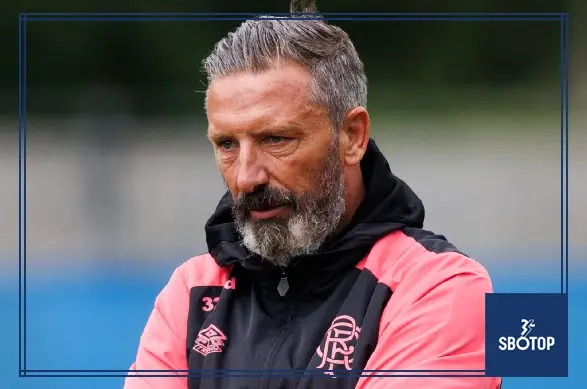
Rangers manager Derek McInnes has been handed a four-match touchline suspension by the Scottish Football Association following comments he made about match officials while still in charge of Hearts.
Three matches of the punishment are scheduled to take immediate effect, while the fourth has been suspended until the end of the 2026–27 season. That additional game will apply only if McInnes commits another breach of the same disciplinary rule during the relevant period.
The ruling means the recently appointed Rangers manager could be absent from the technical area for the opening domestic fixtures of his tenure at Ibrox. However, Rangers have announced plans to appeal, arguing that the decision raises legitimate questions about consistency, precedent and the right of managers to criticise individual refereeing decisions without being accused of attacking an official’s integrity.
The case originates from remarks McInnes made near the end of the previous Scottish Premiership campaign, when he was managing Hearts and competing with Celtic in a dramatic title race.
His frustration followed a controversial stoppage-time penalty awarded to Celtic during their 3–2 victory away to Motherwell. McInnes described the decision as “disgusting” and expressed anger over its potential effect on the championship.
Celtic’s victory left them within one point of Hearts heading into the final round, and they eventually overtook McInnes’ team to secure the title.
The Scottish FA determined that his comments breached Disciplinary Rule 72, which concerns public statements that indicate bias or incompetence by match officials or otherwise attack their character.
McInnes has maintained that his criticism was directed at the decision rather than the officials personally. Rangers have supported that distinction and are preparing to challenge the punishment through the association’s appeal process.
A Ban Carried from Hearts to Rangers
The unusual feature of the case is that McInnes made the comments as Hearts manager but must serve the immediate punishment after moving to Rangers. He left Tynecastle during the summer and was subsequently appointed to lead the Ibrox club after Danny Rohl departed for RB Salzburg.
His arrival was intended to begin a fresh chapter for Rangers, who are attempting to strengthen their domestic challenge and make progress in European competition. Instead, one of the first major issues of McInnes’ tenure concerns remarks made during his previous employment.
Disciplinary suspensions generally follow the individual rather than remaining attached to the club at which the offence occurred. As a result, the change of employer does not remove the consequences of the ruling.
Rangers are therefore facing disruption even though the alleged breach did not involve the club.
That detail has added to the frustration at Ibrox. Rangers believe they are now being placed at a sporting disadvantage because of a case arising from McInnes’ battle for the championship with Hearts.
At the same time, the governing body must apply disciplinary rules consistently regardless of whether the manager has changed jobs.
The central issue is not which club McInnes currently represents, but whether his public remarks crossed the line between legitimate criticism and an accusation that officials were biased or incompetent.
The Controversial Motherwell-Celtic Penalty
The incident occurred during one of the most important weekends of the Scottish Premiership season.
Celtic were drawing 2–2 away to Motherwell when they were awarded a late penalty. The decision allowed them to score the winning goal and remain firmly involved in the championship race.
McInnes, whose Hearts side were leading the table at that stage, reacted strongly because the result had direct consequences for his team.
He believed the penalty was incorrect and was particularly angered by the timing and significance of the call. His post-match comments conveyed not only disappointment with the decision but a wider sense that Hearts had been negatively affected during the title race.
The disciplinary issue was not simply his use of the word “disgusting.” Football managers frequently use forceful language when discussing controversial decisions.
The Scottish FA’s concern centred on whether the full comments implied that match officials were biased, incompetent or acting in a manner designed to influence the championship.
Rule 72 exists to protect officials from public allegations that go beyond an assessment of an individual mistake.
Managers are generally permitted to say that a referee made the wrong decision. They may also explain why they believe video evidence supports their view.
Problems arise when criticism questions honesty, impartiality or professional competence.
The line between those two forms of commentary can be difficult to define, particularly immediately after a match when emotions are high.
What McInnes Said in His Defence
McInnes appeared personally at the disciplinary hearing and argued that he had not intended to make his criticism personal.
His position was that he had condemned the penalty decision rather than attacked the referee or video assistant referee as individuals.
He has also emphasised that managers are routinely required to provide immediate reactions during television interviews. Those interviews often take place only minutes after emotionally significant matches, leaving little time for reflection.
McInnes believes coaches must be allowed to express honest opinions about major decisions, especially when those decisions influence championships, promotion contests or relegation battles.
He has reportedly referred to previous disciplinary examples in an attempt to show that similar comments did not always produce comparable sanctions.
That argument is central to Rangers’ planned appeal.
The club does not appear to be claiming that managers should have unlimited freedom to insult officials. Instead, it is questioning whether criticism of a decision should automatically be interpreted as criticism of the referee’s integrity.
Rangers have argued that public confidence in officiating also depends on transparency and a willingness to allow reasonable scrutiny.
Their appeal will likely focus on the wording of McInnes’ remarks, the context in which they were delivered and the consistency of the punishment compared with previous cases.
Rangers Challenge the Decision
Rangers responded firmly to the ruling and confirmed that they would appeal.
The club believes the punishment raises important questions about disciplinary consistency within Scottish football. It also argues that McInnes’ comments reflected a widespread public reaction to the penalty rather than an attempt to accuse officials of corruption or dishonesty.
From the club’s perspective, there is a meaningful difference between saying that a decision was unacceptable and claiming that a referee deliberately favoured one team.
Rangers are concerned that managers could become reluctant to answer legitimate questions if strong criticism is treated as a disciplinary offence.
Post-match interviews are a major part of football coverage. Broadcasters, journalists and supporters expect coaches to explain how decisive incidents affected the contest.
If managers believe every strongly worded response may lead to a ban, they may produce cautious and uninformative answers.
The opposing argument is that managers hold influential positions and must use that platform responsibly.
Comments suggesting officials are biased can increase hostility, undermine trust and contribute to abusive behaviour directed at referees.
The appeal will therefore involve a balance between freedom of sporting expression and the need to protect officials from damaging allegations.
Three Games Immediate, One Suspended
Although the punishment has been widely described as a four-game ban, McInnes is currently required to serve only three matches immediately.
The fourth fixture is suspended until the end of the season and will be activated only if he commits another breach of Rule 72.
A suspended sanction acts as both a warning and a deterrent. It allows the disciplinary body to recognise the seriousness of the original offence while giving the individual an opportunity to avoid the full punishment.
If McInnes comments on refereeing decisions again during the season, he will need to choose his words carefully.
Another proven breach could lead to the suspended game being added to any new punishment.
The immediate suspension is expected to affect Rangers’ early Scottish Premiership and domestic cup matches. Reports indicate he is set to miss the league games against Dundee United and Hibernian, as well as a Scottish League Cup tie, unless the appeal changes the ruling.
European competition is treated separately under UEFA jurisdiction, meaning McInnes remains available to occupy the technical area for Rangers’ Europa League qualifying fixtures.
That creates an unusual situation in which he may lead the team from the touchline in Europe but be required to watch domestic matches from elsewhere in the stadium.
How a Touchline Ban Affects a Manager
A touchline suspension does not always prevent a manager from carrying out every part of his job.
McInnes can usually continue preparing the team during the week, leading training sessions, selecting the squad and participating in tactical meetings.
The restriction primarily affects his position during the match and, depending on the specific terms, his ability to communicate directly with the dugout.
His assistants will have to take greater responsibility for in-game management.
They may need to deliver tactical instructions, organise substitutions and communicate with players during stoppages.
Modern technology can reduce some of the disruption. Analysts can identify patterns from the stands, while coaching staff can prepare detailed contingency plans before kick-off.
However, the physical presence of the manager remains important.
Players often look towards the technical area for reassurance, adjustments and emotional leadership. A manager can also respond immediately to changes in the opposition’s shape or intensity.
McInnes is an experienced and vocal coach. Removing him from the touchline could therefore affect Rangers more than it would affect a manager with a quieter matchday role.
The club will need a clear communication structure to minimise that impact.
An Unwanted Start to His Rangers Career
McInnes was appointed with major expectations.
Rangers supporters want a manager capable of challenging Celtic domestically, improving consistency and restoring a stronger identity to the team.
His familiarity with Scottish football was one of the main attractions. He understands the league, the pressure surrounding the Old Firm and the demands of working for a club expected to win almost every domestic fixture.
Yet the ban has immediately complicated the beginning of his tenure.
Instead of concentrating entirely on recruitment, tactics and pre-season preparation, McInnes and the club must manage a disciplinary appeal.
The situation also risks dominating early media coverage.
Every press conference may include questions about referees, the SFA and the boundaries of acceptable criticism.
McInnes will need to avoid allowing the dispute to distract the squad. Players must focus on performances rather than becoming involved in a wider argument with the governing body.
A strong start to the season would reduce the significance of the ban. Poor results during the affected fixtures would inevitably lead to questions about whether his absence made a difference.
The Importance of His Backroom Staff
Rangers’ coaching team will become particularly important if the appeal is unsuccessful.
McInnes has assembled staff members he trusts and who understand his methods. Their ability to reproduce his instructions from the technical area will be tested immediately.
The assistant responsible for leading the dugout must have the authority to make decisions without constantly seeking approval.
Football matches change quickly. Injuries, tactical switches, red cards or unexpected performances can make pre-arranged plans obsolete.
The stand-in touchline leader must be able to react independently while remaining faithful to McInnes’ overall strategy.
Players also need clarity about the chain of command. Confusion over who delivers instructions can weaken decision-making during key moments.
McInnes may spend the days before each suspended match preparing several scenarios.
These could include changes to the formation, pressing intensity, set-piece roles and substitution timings.
The more detailed the preparation, the less disruptive his absence should become.
The Wider Debate Over Referee Criticism
The case has reopened a familiar debate in Scottish football.
Managers, players and supporters frequently complain about inconsistent decision-making. The introduction of VAR has not removed controversy and has occasionally increased frustration because incidents are examined for longer without always producing agreement.
Coaches want the right to discuss those decisions honestly.
They argue that officials influence matches and should therefore be open to professional criticism, just like managers and players.
Referees are assessed privately, but those evaluations are rarely visible to the public. That can create a perception that officials are protected while coaches face immediate questioning.
Referee organisations respond that public accusations can create an unsafe and hostile environment.
Officials receive abuse online and at stadiums, while grassroots football continues to struggle with shortages partly linked to poor treatment.
Comments from prominent managers can influence supporter behaviour even when the coach does not intend to encourage abuse.
The challenge is creating a system that permits meaningful analysis without allowing personal attacks.
Also Read: