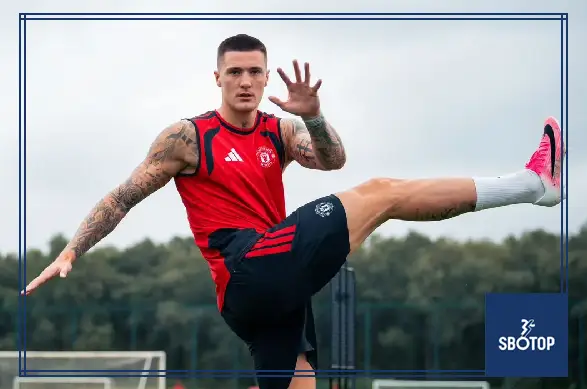
Benjamin Šeško has returned to Manchester United’s preseason preparations with a noticeably stronger physique, increasing excitement among supporters who believe the Slovenian striker could become an even more intimidating opponent during the 2026/27 campaign.
Images from United’s training base showed the 23-year-old looking significantly more muscular than he did during his first season at Old Trafford. His broader upper body and stronger frame quickly attracted attention online, with supporters predicting that Premier League defenders could find him increasingly difficult to contain.
The physical development comes at an important stage of Šeško’s Manchester United career.
He experienced a challenging beginning after arriving from RB Leipzig in the summer of 2025, but his performances improved dramatically during the second half of the season. Šeško finished his debut campaign with 12 goals in all competitions and became United’s leading scorer, despite missing the final matches because of a calf injury.
His progress under Michael Carrick provided evidence that he was beginning to adapt to English football. The sight of a stronger and apparently more powerful Šeško has now encouraged hopes that the striker can turn encouraging flashes into consistent dominance.
Physical transformation alone will not guarantee a successful season. Goals will still depend on movement, service, finishing and tactical understanding. Nevertheless, Šeško’s development suggests that he has used the offseason to prepare seriously for the demands ahead.
A Striking Return to Carrington
Šeško’s changed appearance became one of the major talking points when he returned to Carrington.
The Slovenian had already possessed an unusual physical profile for a striker. He combined considerable height with excellent acceleration, allowing him to threaten defenders both in the air and through runs behind the back line.
His latest development appears to have added greater muscle to that foundation.
Reports described teammates and supporters as being surprised by the change, while images circulated widely across social media. Fans claimed he looked more capable of competing physically with powerful Premier League centre-backs and suggested that defenders might struggle to move him away from dangerous areas.
That reaction reflects the anticipation surrounding Šeško.
Manchester United supporters saw enough during his first season to recognise his potential. He produced powerful finishes, intelligent runs and several important late goals. However, there were also matches in which he struggled to establish himself against experienced defenders.
A stronger body could help him become more influential during those difficult periods.
When a striker cannot immediately run behind the defence, he must sometimes receive the ball with his back to goal, protect possession and wait for teammates to advance. Increased strength could make Šeško more effective in those situations.
It could also help him remain balanced when shooting under pressure.
The Work Continued During Injury Recovery
Šeško’s physical transformation reportedly occurred while he was recovering from the calf injury that ended his first Premier League season earlier than expected.
He missed United’s final three matches and had not appeared in the club’s early summer friendlies at the time his training photographs generated attention. Reports nevertheless indicated that he was expected to be available for the beginning of the competitive campaign.
An injury layoff can be frustrating for any player, particularly one who had been enjoying strong goalscoring form.
However, rehabilitation also provides an opportunity to focus on areas of physical conditioning that may receive less attention during a congested season. Players recovering from lower-body problems can sometimes work extensively on upper-body strength, core stability and controlled movement under the supervision of medical and conditioning specialists.
Šeško appears to have taken that process seriously.
The result does not simply look cosmetic. Additional functional strength could support his balance, jumping, shielding and resistance to contact.
United will still need to manage his return carefully.
A larger physique does not automatically mean that the calf is ready for maximum competitive intensity. The medical staff must ensure that Šeško can sprint, change direction and repeat explosive movements without creating another problem.
His long-term availability matters more than rushing him into a preseason match.
A Difficult Start Followed by a Major Improvement
Šeško’s first season at Manchester United contained two very different periods.
He initially struggled to find a consistent rhythm under Ruben Amorim. The striker scored only twice in his first 16 appearances during the early part of the campaign, when United’s collective performances were also disappointing.
Several factors contributed to those difficulties.
Šeško was adapting to a new league, a new country and the pressure associated with representing Manchester United. He was also attempting to understand an attacking system that did not always provide regular service to the central striker.
Premier League centre-backs gave him little time to settle. They challenged him early, disrupted his first touch and attempted to prevent him from turning toward goal.
The situation improved after Amorim’s departure.
Darren Fletcher briefly took charge before Carrick became head coach, and Šeško began scoring more regularly. Reports credit him with 10 goals in 15 matches under Fletcher and Carrick, including a run of seven goals across nine Premier League appearances.
That improvement showed that his early struggles were not evidence of a lack of quality.
Once United’s structure became more suitable and his confidence increased, Šeško looked capable of becoming the team’s long-term number nine.
Carrick’s Influence on the Striker
Michael Carrick appears to have played an important role in Šeško’s improvement.
Carrick’s United have placed a greater emphasis on controlled possession, structured buildup and creating clearer relationships between midfielders and forwards. During the 2026 preseason, the team continued developing a style based on patient circulation and intelligent positioning rather than relying only on rapid counterattacks.
That approach can help Šeško.
A central striker needs predictable support. He must know when a midfielder is likely to play forward, where the wide players will position themselves and whether someone will move close enough to collect a layoff.
During United’s less organised periods, Šeško could become isolated between two centre-backs.
Carrick’s structure gave him more connections.
The striker could receive passes with teammates nearby, make runs behind defenders after coordinated movements and attack deliveries from more favourable positions.
His goalscoring form after the managerial change suggests that tactical clarity increased his confidence.
The next challenge is building on that relationship from the beginning of a full season.
Carrick now has an entire preseason to design attacking patterns around Šeško’s strengths. The striker, meanwhile, has time to understand exactly what the coach expects in possession and during pressing.
Why Added Strength Could Transform His Game
Šeško’s combination of size and speed already makes him an unusual forward.
Standing well above six feet, he has the frame of a traditional target striker. Unlike many players of similar height, however, he can accelerate quickly and reach high speeds over open ground.
His style has previously drawn comparisons with powerful forwards who combine athleticism with technical ability. Career profiles have highlighted his pace, finishing and aerial potential as central elements of his game.
Additional strength could help him connect those qualities more effectively.
When receiving with his back to goal, Šeško needs to resist contact long enough to control the ball. Premier League defenders often attempt to step in front of strikers or force them away from central areas before the pass arrives.
A stronger core and upper body can help him maintain position.
In the penalty area, added power may improve his ability to attack crosses. Defenders will find it harder to block his movement or prevent him from reaching the ideal jumping position.
He may also become more effective during transitions.
If Šeško receives a forward pass and a defender makes shoulder-to-shoulder contact, greater strength could allow him to continue running rather than losing balance.
These small improvements can create additional shots across an entire season.
Strength Must Not Reduce His Mobility
Although the physical change has generated excitement, United must ensure that Šeško retains the speed and agility that make him special.
Adding too much weight can occasionally affect a footballer’s acceleration, endurance or ability to change direction. Muscle is valuable only when it supports the movements required by the player’s position.
Šeško is dangerous partly because defenders cannot treat him as a stationary target man.
He can move into the channels, sprint behind a high defensive line and attack space from different angles. If added size reduced that mobility, the transformation would become less useful.
Modern strength programmes are designed to avoid that problem.
Elite conditioning staff focus on power relative to body weight rather than simply increasing muscle mass. Exercises are selected to support acceleration, jumping, balance and injury prevention.
The early images cannot prove how Šeško’s movement has changed.
That will become clearer when he returns to match action.
The ideal outcome is a striker who remains explosive but becomes significantly harder to push away from the ball.
Supporters Expect a Breakout Campaign
Manchester United supporters have responded enthusiastically to Šeško’s new appearance.
Comments shared across social media described him as looking like a “monster,” while others suggested that Premier League defenders were not prepared for the stronger version of the Slovenian.
Fan excitement is understandable.
United have spent several years searching for a reliable long-term centre-forward. Different strikers have produced promising periods, but injuries, inconsistency and tactical changes prevented the position from becoming fully settled.
Šeško has the potential to provide stability.
He joined the club at a young age, remains under a long-term contract and has already demonstrated that he can score regularly once placed in a suitable structure.
His late-season form gave supporters something tangible to believe in.
The physical transformation has added another layer to that optimism. Fans imagine a striker who combines the finishing seen during the second half of last season with greater power and confidence.
However, expectations must remain realistic.
A changed physique will not automatically produce 25 or 30 goals. Šeško is still developing and will experience difficult periods.
The key will be how he responds when goals do not arrive immediately.
A More Demanding Second Season
A player’s second Premier League season can be more difficult than the first in certain ways.
During Šeško’s debut campaign, defenders were still learning his habits. They were discovering which runs he preferred, how he controlled the ball and where he wanted to shoot.
Opposition analysts now have an entire season of footage.
Defenders may position themselves differently, deny his stronger side or attempt to prevent United from delivering passes into the areas where he is most effective.
Šeško must therefore continue evolving.
Greater physical strength provides one solution, but he will also need improved movement and decision-making.
He must vary his runs rather than always attacking the same space. Sometimes he should move toward the ball to create room for a teammate. In other moments, he should remain patient and wait for the defender to lose sight of him.
His first touch will also be important.
The strongest striker can still lose possession if his control sends the ball into an opponent’s path. Šeško must receive cleanly and decide quickly whether to pass, turn or shoot.
The Importance of Better Service
Šeško’s success will depend on Manchester United’s ability to create chances.
Strikers are often judged entirely by their goal totals, but those numbers are influenced by the quality and frequency of service they receive.
United must provide crosses, through passes and cutbacks that match Šeško’s movement.
A high delivery toward the penalty spot can take advantage of his height. A low pass behind the defence can use his acceleration. A cutback from the byline may allow him to finish first time without wrestling with centre-backs.
Carrick’s midfield structure will be crucial.
The arrivals of Youri Tielemans and Andrey Santos have added players capable of progressing possession and connecting with the attack. United are also expected to continue strengthening the squad as they prepare for Champions League football.
Wide players must develop an understanding with Šeško as well.
They need to recognise whether he is moving toward the near post, delaying his run or attacking the far side. Good attacking relationships are created through repetition rather than improvisation alone.
Also Read: