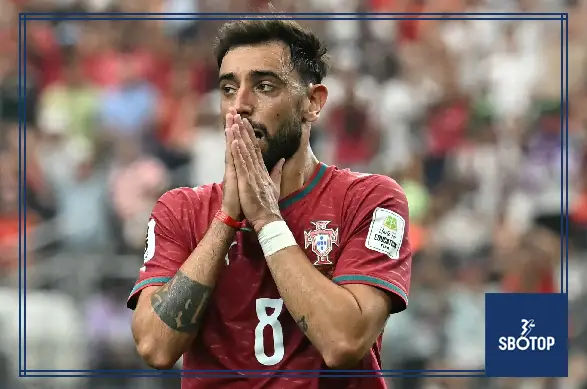
Bruno Fernandes has admitted that Portugal’s premature departure from the 2026 World Cup left him “sad, frustrated and disillusioned,” as one of the most talented squads in the country’s history failed to progress beyond the round of 16.
Portugal’s campaign ended in the cruellest possible fashion against Spain. After resisting the reigning European champions for 90 minutes, Roberto Martínez’s side conceded in stoppage time when substitute Mikel Merino scored the only goal of a tense Iberian derby.
The 1-0 defeat brought Portugal’s hopes of winning a first World Cup to an abrupt conclusion. It also ended Cristiano Ronaldo’s final appearance at the tournament and closed Martínez’s three-and-a-half-year spell as national-team coach.
For Fernandes, the pain came from believing Portugal possessed everything required to challenge for the trophy.
The Manchester United captain thanked his teammates, coaches, staff and supporters in an emotional message after the elimination. He acknowledged that the group had fallen short of its objective, but stressed that its commitment and ambition could not be questioned.
His disappointment reflected more than the result of one match.
Portugal arrived in North America with proven winners, elite-level creators and considerable depth across almost every position. They had recently won another Nations League title and travelled to the World Cup expecting to compete with France, Argentina, Spain, England and the other leading contenders.
Instead, their tournament became a story of inconsistency, tactical hesitation and a missed opportunity that may never return in the same form.
Fernandes Struggles to Accept the Ending
Fernandes is one of football’s most emotionally expressive players. His frustration can be obvious when a pass goes astray, a teammate fails to make a run or a referee rejects an appeal. That intensity has occasionally been used against him, but it also explains why Portugal’s elimination affected him so deeply.
The midfielder does not treat international football as a pleasant interruption to his club career. Representing Portugal carries enormous personal importance, and every major tournament is approached as an opportunity to deliver something historic.
His post-tournament message captured the conflict he was experiencing.
Fernandes was proud of the group and grateful for the support Portugal received, yet he could not hide his belief that the team should have achieved far more. He described the exit as a painful missed opportunity because the squad had enough quality to challenge for the title.
There is a difference between losing to a clearly superior opponent and leaving a competition while believing the decisive match was available to win.
Spain controlled important periods, particularly after half-time, but Portugal defended well and reached the final moments with the score level. The possibility of extra time was only seconds away when Merino arrived to score the winner.
That timing made the defeat especially difficult to process.
Portugal were not eliminated by a heavy scoreline or an obvious collapse. They were eliminated by one late action after allowing the match to drift away from them.
Portugal’s Second-Half Retreat Proved Costly
Fernandes identified Portugal’s change of approach after the interval as one of the central reasons for the defeat. He believed his team competed strongly during the first half, showing enough courage and control to trouble Spain. Portugal pressed with greater purpose, attempted to progress possession and prevented their opponents from establishing complete dominance.
The balance changed in the second half.
Portugal dropped deeper, surrendered possession and increasingly focused on surviving rather than threatening. That invited Spain closer to Diogo Costa’s penalty area and placed greater pressure on the defensive line.
Fernandes suggested Portugal had repeated a familiar mistake by retreating instead of continuing to play with the aggression shown earlier in the game.
The decision may have been understandable in the moment.
Spain are among the world’s strongest possession teams. Their midfielders are comfortable circulating the ball for long periods, while their wide players can stretch defensive structures and create openings through repeated attacks.
Portugal may have believed that remaining compact and waiting for extra time represented the safest option.
The problem was that this strategy gradually removed their attacking threat.
Cristiano Ronaldo became isolated, Fernandes received possession farther away from goal and Portugal’s wide players were forced to spend more time helping their full-backs than attacking Spain’s defence.
Without a reliable outlet, every clearance returned quickly.
Spain did not need to create a large number of clear chances. They only needed to maintain the pressure until Portugal made one positional mistake.
Merino eventually punished them.
A Tournament That Never Fully Came Together
Portugal’s struggles against Spain did not emerge without warning.
The team finished second in Group K behind Colombia after recording one victory and two draws. A squad regarded as one of the tournament favourites progressed, but rarely looked completely comfortable or tactically settled.
Their performances generated questions about the balance of midfield, the movement of the attack and the continuing influence of Ronaldo at the age of 41. Fernandes and Vitinha also faced criticism for failing to control matches as effectively as expected.
Portugal eventually defeated Croatia 2-1 in the round of 32, with Ronaldo scoring his first World Cup knockout-stage goal from the penalty spot.
The victory provided relief but did not remove concerns.
Portugal remained vulnerable when opponents increased the intensity, and their talented attacking players often appeared to be operating as individuals rather than as parts of one coordinated structure.
That was particularly surprising because the squad contained footballers accustomed to sophisticated tactical systems at Europe’s largest clubs.
Fernandes, Vitinha, João Neves, Bernardo Silva, Rafael Leão and Pedro Neto offered different creative qualities. João Cancelo and Nuno Mendes could provide attacking width, while Rúben Dias gave the defence experience and authority.
On paper, Portugal possessed solutions for almost every match situation.
The difficulty was combining those qualities consistently.
Fernandes Could Not Control the Match Alone
As one of Portugal’s principal creators, Fernandes inevitably became a focus of the post-tournament analysis.
His critics argued that he did not exert enough control over the team’s biggest match. He struggled to dictate the second half against Spain and could not create the decisive chance Portugal required.
That assessment contains some truth, but it also oversimplifies his responsibilities.
Fernandes is most dangerous when he receives the ball in advanced spaces and has runners attacking the defence. His passing is ambitious, direct and designed to create opportunities rather than simply preserve possession.
Against Spain, Portugal’s retreat moved him farther away from the areas where he could hurt the opposition.
When the team regained possession, Fernandes frequently had limited options ahead of him. Ronaldo remained central, while the wide forwards were often positioned too deep after completing their defensive work.
Attempting a difficult forward pass risked returning possession to Spain. Playing safely allowed the opponents to reset and press again.
The tactical situation reduced Fernandes’ influence.
A creative midfielder can change a match, but he cannot simultaneously recover the ball, progress it through midfield, stretch the defence and finish the move.
Portugal needed a stronger collective structure around him.
The Weight of Another Missed Opportunity
Fernandes has now experienced several painful tournament exits with his country.
Portugal were eliminated by Uruguay in the round of 16 at the 2018 World Cup. Belgium ended their European Championship campaign at the same stage in 2021, while Morocco defeated them in the 2022 World Cup quarter-finals.
France then eliminated Portugal on penalties in the Euro 2024 quarter-finals before the latest defeat against Spain.
The repeated pattern explains why Fernandes used language stronger than ordinary disappointment.
Portugal have consistently possessed enough talent to reach the latter stages, yet their tournament runs have repeatedly ended before the semi-finals.
Each elimination produces the same painful question: how many opportunities can one generation waste before its window closes?
Fernandes was 31 during the 2026 World Cup. Unlike some older members of the squad, he could still remain an important international player for another major tournament.
However, there are no guarantees.
Football careers can change quickly through injuries, form and coaching decisions. Even when an individual remains available, the surrounding squad may no longer possess the same balance.
Fernandes understood that Portugal had allowed a valuable opportunity to disappear.
Ronaldo’s Final World Cup Adds to the Emotion
The elimination was also historic because it brought Ronaldo’s World Cup journey to an end.
Before facing Spain, the Portuguese captain confirmed that the 2026 tournament would be his last. At 41, he was competing in a record sixth World Cup and attempting to add the one major trophy missing from his international career.
Ronaldo had already won the European Championship and two Nations League titles with Portugal, transforming expectations around the national team.
However, the World Cup repeatedly remained beyond his reach.
Portugal never advanced beyond the quarter-finals during his six appearances, and the defeat to Spain ensured his final campaign would end without another opportunity to compete for the trophy.
His departure creates an emotional and tactical turning point.
For more than two decades, Portugal’s identity has been connected to Ronaldo. Coaches changed, teammates retired and new generations emerged, but the team continued to be built around its captain and record scorer.
Fernandes has spent much of his international career operating beside him.
The next Portugal side may need the Manchester United midfielder and other senior figures to carry greater leadership responsibility.
A Difficult Relationship With Expectations
Portugal’s footballing growth has created enormous expectations.
There was a time when qualifying for major tournaments represented a meaningful achievement. That standard changed as the country developed a steady supply of elite players and established itself among Europe’s strongest national teams.
Winning Euro 2016 accelerated the transformation.
Portugal were no longer viewed merely as dangerous outsiders. They became a country expected to compete for trophies.
The 2019 and 2025 Nations League successes strengthened that belief, making their 2026 World Cup squad appear capable of adding the greatest prize of all.
Those expectations influenced the reaction to the elimination.
Losing narrowly to Spain is not inherently embarrassing. Spain entered the knockout stage as reigning European champion and one of the tournament favourites.
Yet Portugal’s disappointment was measured against their own talent rather than the reputation of the opponent.
They believed they were good enough to defeat Spain.
Fernandes’ frustration came from knowing the team had not fully demonstrated that quality when it mattered.
Also Read: