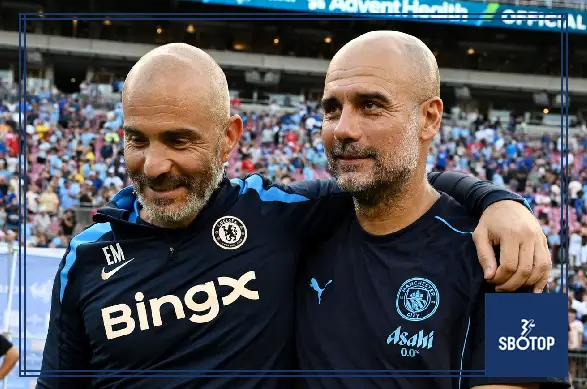
Enzo Maresca has stepped into one of the most demanding jobs in world football. Taking charge of Manchester City is already a major responsibility, but taking charge immediately after Pep Guardiola makes the challenge even bigger. This is not simply a managerial appointment. It is a test of continuity, identity, expectation, and pressure at a club that has become conditioned to winning.
Manchester City have appointed Maresca as their new manager on a three-year contract, with reports stating the club paid Chelsea around £17 million in compensation to secure him. The move brings the Italian coach back to the Etihad, where he previously worked under Guardiola during City’s treble-winning 2022/23 season.
That connection to Guardiola is one of the reasons City’s decision makes sense. Maresca understands the club, the culture, the tactical language, and the standards. But familiarity will not protect him from scrutiny. If anything, it may increase it. Supporters will expect him to understand immediately what Manchester City are supposed to look like.
This is why Gary Neville described Maresca’s task as the “ultimate test,” stressing that City will accept nothing less than winning from their new manager. For Maresca, the message is clear: he is not being hired to rebuild slowly. He is being hired to keep a winning machine moving.
Why Replacing Guardiola Is So Difficult
Replacing Pep Guardiola is not like replacing a normal successful manager. Pep Guardiola did not merely win trophies at Manchester City. He reshaped the club’s football identity, turned dominance into routine, and made tactical control part of the club’s public image. Under him, City became associated with positional play, technical superiority, relentless pressing, and an almost ruthless ability to win over long seasons.
Guardiola’s decade at City produced a historic trophy haul, including six Premier League titles and a Champions League triumph. The Guardian reported that he left after a 10-year era marked by 20 major trophies. That kind of legacy can be inspiring, but it can also be suffocating for the next manager.
Every Maresca decision will be measured against Guardiola’s shadow. Every team selection will be compared. Every tactical adjustment will be analysed. Every dropped point will invite the same question: has City lost something since Pep left?
That is the true difficulty. Maresca is not walking into a broken club. He is walking into a club that has been operating at an extraordinary level. Improving a struggling side can sometimes be easier because progress is visible. Maintaining greatness is harder because the margin for praise is smaller.
Maresca Knows the City Way
One of Maresca’s biggest advantages is that he knows Manchester City from the inside. He has already worked within the club’s football structure, first in the academy and later alongside Guardiola. That matters because City are not likely to abandon their principles overnight.
Maresca’s coaching education has been heavily influenced by possession-based football, positional structure, and tactical detail. His time around Guardiola gave him direct exposure to the standards City expect at first-team level. The Guardian noted that City chairman Khaldoon al-Mubarak praised Maresca’s intelligence, style of play, and alignment with the club’s footballing vision.
That alignment is important. Manchester City did not choose a manager who would tear everything down. They chose someone who could preserve the core ideas while adding his own interpretation. Maresca’s task is not to become a copy of Guardiola. It is to protect the principles that made City successful while proving he can lead in his own voice.
This is where the job becomes delicate. If Maresca changes too much, critics will say he is damaging Guardiola’s work. If he changes too little, critics will say he lacks originality. The best path is somewhere between continuity and evolution.
Winning Is Not Optional at Manchester City
At some clubs, a new manager can ask for patience. At Manchester City, patience exists only if results remain strong. The club’s modern standards are extreme. A good season is not simply qualification for Europe. A good season is competing for major trophies.
That is what makes Neville’s warning so relevant. City have become a club where the expectation is not to challenge eventually, but to win immediately. Maresca inherits world-class infrastructure, elite players, vast resources, and a winning culture. Those things help him, but they also remove excuses.
The pressure will be different from anything he has experienced before. At Leicester City, promotion was the target. At Chelsea, he dealt with pressure, instability, and high expectations. At Manchester City, the scale changes again. The club expects to be judged alongside the best teams in Europe every season.
That creates a brutal reality. If City win, people may say the squad was already strong. If City fall short, the blame will land heavily on the new manager. That is the cost of succeeding a legend.
Lessons from Leicester and Chelsea
Maresca’s managerial journey gives City reasons to believe he is ready, but it also shows why this appointment remains a gamble. He gained major attention after leading Leicester City to Premier League promotion in 2023/24, proving he could build a controlled, possession-heavy side capable of handling the demands of a long campaign. Reuters highlighted that Leicester promotion as a key point in his rise.
His time at Chelsea added another layer to his reputation. Reports credited him with leading Chelsea to a fourth-place Premier League finish, as well as success in the UEFA Conference League and Club World Cup, before his eventual departure created controversy.
Those experiences matter because Maresca has already dealt with expectation, large squads, media attention, and the challenge of imposing a clear style. But Manchester City are still a different level. At City, success is measured not by improvement alone, but by silverware.
The Leicester job showed he could build. The Chelsea job showed he could handle a bigger platform. The City job will show whether he can sustain elite winning standards at a club where almost every opponent treats the match like a final.
The Guardiola Comparison Will Be Constant
Maresca will hear Guardiola’s name all season. That is unavoidable. Every new manager following a legendary figure must live with comparisons, especially in the early months. Manchester United struggled for years after Sir Alex Ferguson. Arsenal needed time after Arsene Wenger. City will hope they have planned better, but history shows that replacing a defining manager is never simple.
The danger is that Maresca becomes judged against an impossible version of Guardiola. Pep’s best City teams were among the most dominant in English football history. They were not built overnight. They developed through years of coaching, recruitment, adjustment, and shared understanding.
Maresca may inherit a strong squad, but he will still need time to form his own relationships. Players who were deeply connected to Guardiola must adapt to a different voice. Even if the football principles remain similar, the emotional dynamic changes. Training sessions feel different. Team talks feel different. Tactical details are delivered differently.
The first months will be about trust. Maresca must convince the squad that he is not simply Pep’s successor in title, but a leader they can believe in.
The Squad Must Accept a New Voice
Manchester City’s players are used to elite demands. Many of them have won everything under Guardiola. That experience is valuable, but it can also create a challenge for Maresca. Players who have known one dominant managerial voice for so long may need time to adjust.
Maresca’s authority will come partly from his knowledge, partly from his communication, and partly from results. Winning early would help enormously. A strong start would make players buy in faster and reduce outside noise. A difficult start, however, could create doubt.
This is why man-management will be just as important as tactics. Maresca must respect what the squad has achieved while making it clear that a new era requires new energy. He cannot simply tell champions what they already know. He must give them fresh motivation.
That may be one of the hardest parts of the job. City’s players are not hungry because they have never won. They must be made hungry despite already winning so much.
City’s Identity Needs Evolution Not Revolution
Manchester City are unlikely to change dramatically under Maresca. The club’s recruitment, academy work, and tactical planning have all been shaped around a possession-based model. Maresca fits that world naturally. But even within continuity, evolution is necessary.
Opponents have spent years studying City. They know the passing patterns, the positional rotations, and the dangers of being pulled out of shape. Guardiola constantly evolved to stay ahead. Maresca must do the same.
He may adjust pressing structures, midfield roles, full-back positioning, or attacking movements. The challenge is to add fresh ideas without breaking the rhythm that made City so effective. Small changes can matter. A different build-up angle, a new midfield balance, or a more direct option in transition could help City remain unpredictable.
The danger for Maresca is becoming too safe. If he simply tries to preserve Guardiola’s system without adding anything, City may become easier to read. If he overcorrects, he risks destabilising the team. His intelligence will be tested in those details.
The First Season Will Define the Mood
First seasons after legendary eras are often emotionally complicated. Supporters want to be optimistic, but they also fear decline. Players want clarity, but they also feel change. The media looks for signs of weakness. Rivals smell opportunity.
Maresca’s opening season will therefore be about more than league position. It will define the mood of the post-Guardiola era. If City remain competitive and win silverware, the transition will feel controlled. If they fall away, the debate will become much louder.
The early market view already reflects uncertainty. One report, citing Betfair Predicts via The Sun, placed Maresca’s chance of winning the Premier League in his first City season at 21%, with Arsenal rated higher at 38%. Those numbers are not destiny, but they show how the outside world sees the transition: City are still powerful, but the post-Pep risk is real.
That risk is what Maresca must manage. He is not only competing against Arsenal, Liverpool, Manchester United, Chelsea, and the rest. He is competing against the fear that City’s greatest era may be impossible to extend.
The Pressure of the Premier League
The Premier League is unforgiving. Even a small drop in consistency can change a title race. Under Guardiola, City often turned winning runs into a weapon. They could move from strong form to relentless form, collecting points until rivals cracked. Maresca must prove he can produce the same machine-like rhythm.
This is not only about tactical quality. It is about squad rotation, injury management, emotional control, and standards in training. Winning the Premier League requires concentration every week. Teams that lose focus in January or February often pay for it in May.
Maresca’s first test will be maintaining City’s hunger in domestic competition. Opponents will see the new era as a chance to attack. Some teams may press City more aggressively. Others may sit deeper and test Maresca’s ability to solve compact defensive blocks.
The Premier League will quickly reveal whether City are still the same force or whether the Guardiola transition has created vulnerability.
Also Read:
- SBOTOP: Rangers Secure Ben Godfrey on Season-Long Loan from Atalanta as Former Everton Defender Makes Scottish Move
- SBOTOP: Jude Bellingham Earns Tuchel’s Praise as England Star Embraces World Cup Role with Back-to-Back MOTM Displays
- SBOTOP : Harry Kane Heroics Send England Into World Cup 2026 Last 16 After DR Congo Thriller