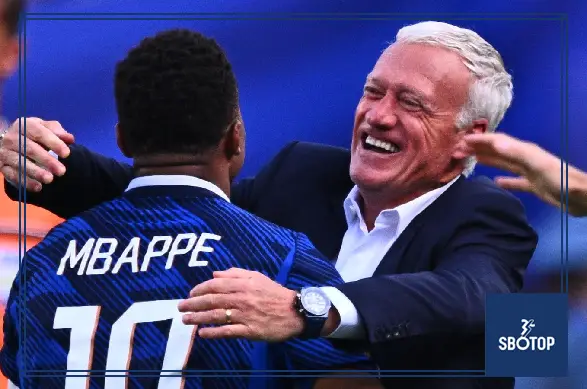
Gary Neville did not need many words to describe what the rest of the World Cup has already started to feel. After France swept Sweden aside 3-0 in the round of 32, the former England defender and Sky Sports pundit placed Les Bleus above everyone else in the tournament conversation. His verdict was clear: France look like a team operating on a different level, and Kylian Mbappe is moving toward the kind of greatness that defines World Cups, not just seasons.
That kind of praise can sometimes arrive too early in a tournament. Knockout football is dangerous because every round resets the pressure. But in France’s case, the evidence is becoming difficult to ignore. Didier Deschamps’ side have won all four of their matches, scored 13 goals, and conceded only two, entering their last-16 tie against Paraguay as the most feared attacking force left in the competition.
The Sweden win was not simply a result. It was a statement of control. Mbappe scored twice, Bradley Barcola added the other goal, and Michael Olise again looked like one of the tournament’s most intelligent creators. France did not just rely on individual brilliance; they moved with rhythm, speed, and purpose. Neville’s praise landed so heavily because it matched the feeling of the performance. This was not a team scraping through. This was a team accelerating.
Neville’s Verdict Reflects the Mood Around Les Bleus
Neville described France’s win over Sweden as a statement performance and said their attacking players would create nightmares for defenders across the tournament. He also argued that France now look so far ahead that failure to win the World Cup would feel like letting themselves down.
That is a bold judgement, but it captures the scale of expectation surrounding this France team. Some World Cup favourites carry pressure because of reputation. France are carrying pressure because of performance. There is a difference. Reputation can fade when the games become harder. Performance builds belief every time the evidence repeats itself.
Against Sweden, the evidence repeated itself again. Mbappe was devastating from the left, Olise found spaces between the lines, Ousmane Dembele helped stretch the defence, and Barcola offered another direct threat. France looked like a side with several ways to hurt opponents. If defenders tracked Mbappe, space opened elsewhere. If they tried to compress central areas, France attacked wide. If they sat deeper, Olise had time to dictate. If they stepped out, Mbappe could run beyond.
Neville’s words matter because they did not sound like simple post-match hype. They sounded like a defender recognising a nightmare. France’s forward line is not just talented. It is difficult to prepare for because the danger keeps changing shape.
Mbappe Is Entering Legacy Territory
The centre of the story remains Kylian Mbappe. He has been one of the biggest names in world football for years, but World Cups offer a different kind of stage. At club level, greatness can be accumulated over a season. At the World Cup, it is compressed into moments that nations remember for decades.
Against Sweden, Mbappe added two more of those moments. Reuters reported that his brace took him to six goals in the current tournament and 18 career World Cup goals, just one behind Lionel Messi’s all-time total. Sky Sports also noted that his Sweden double moved him level with Messi in the Golden Boot race.
Neville’s phrase about Mbappe being on the verge of greatness is powerful because Mbappe already has the numbers of a giant. What he is chasing now is not recognition as an elite player. That has long been settled. He is chasing historical separation. The kind of separation that places a player not only among the best of his generation, but among the defining figures of the sport.
World Cups are central to that. Mbappe has made the tournament feel like his natural environment. He does not appear overwhelmed by the pressure of knockout football. He seems sharpened by it. Against Sweden, he scored at the end of the first half to break resistance, then scored again in the second half to remove all doubt. That is the mark of a player who understands timing.
The Ronaldo Nazario Comparison Makes Sense
Neville also compared Mbappe’s first-half performance against Sweden to Brazilian Ronaldo, praising the way his movement and body shape terrified defenders. That comparison is not made lightly. Ronaldo Nazario remains one of the great World Cup forwards, a player whose acceleration, power, and finishing created panic before he even touched the ball.
Mbappe creates a similar kind of fear. Defenders know what he wants to do, yet that knowledge often does not help. He can slow down and then explode. He can drift wide and still arrive centrally. He can score from angles that appear half-closed. He can make a defensive line retreat without France even playing the ball forward.
The Sweden match showed that psychological damage in real time. Swedish defenders were not simply beaten by passes or shots. They were dragged into uncertainty. Step toward Mbappe and he can burst beyond. Drop off and he can shoot. Shift cover toward him and Barcola or Dembele can attack the opposite space. That is what separates France’s attack from ordinary star-heavy forward lines. Mbappe is the headline, but the system around him multiplies his threat.
Great forwards make defenders uncomfortable. Historic forwards make entire defensive plans feel unstable. Mbappe is moving rapidly toward the second category.
Olise Has Changed France’s Attack
One of the reasons France look so complete is the emergence of Michael Olise as the creative brain of the attack. Mbappe provides the devastating final action, but Olise gives France control between those moments. He sees the pass early, waits when the game needs patience, and accelerates attacks with disguised touches.
Reuters reported that France’s attacking quartet has produced extraordinary numbers, with Mbappe, Dembele, and Olise combining for 11 goals and nine assists in four matches, while Barcola has added two goals and an assist. Olise alone has five assists, just one short of Pele’s 1970 World Cup record.
That is why France look different from a team built purely around Mbappe. They do not need him to create every chance himself. Olise can receive under pressure, turn in tight spaces, and find the run before defenders have adjusted. His pass for Barcola against Sweden showed the value of timing, not just technique. His connection with Mbappe has also become one of the most productive partnerships of the tournament.
Neville’s praise focused heavily on France’s devastating attacking unit, and Olise is a major reason that unit feels so balanced. He brings craft to the chaos. He allows France to be more than fast. He allows them to be precise.
France’s Front Four Are Becoming a Tournament Story
Every World Cup eventually develops a central attacking story. In 2002, Brazil had Ronaldo, Rivaldo, and Ronaldinho. In other eras, teams were defined by a great No. 10, a lethal striker, or a brilliant winger. At this tournament, France’s front four are forcing themselves into that conversation.
Reuters has already framed France’s attacking line as one entering the debate over the World Cup’s greatest forward units, noting how Mbappe, Dembele, Olise, and Barcola have combined speed, imagination, finishing, and depth. That debate is still premature if judged by trophies, because France have not finished the job. But if judged by the level of performance so far, it is easy to understand why the comparison has started.
What makes this group special is variation. Mbappe is the explosive finisher. Dembele is unpredictable and dangerous in one-on-one situations. Olise is the connector. Barcola provides direct running and composure in the final third. Behind them, Deschamps still has players such as Rayan Cherki and others who can change the rhythm from the bench. Reuters noted that Deschamps’ squad depth gives France late creative options, especially against teams expected to defend deep.
That is the nightmare for opponents. Surviving the first wave does not guarantee relief. France can bring another wave.
Deschamps Keeps the Hype Under Control
The challenge for Deschamps is not creating belief. France already have plenty of that. His job now is controlling it. Tournament favourites often fail not because they lack quality, but because they become too comfortable with praise.
Deschamps has been careful. Reuters reported that even after France reached the last 16 in dominant style, the coach insisted there was still room for improvement and emphasised that stronger tests lie ahead. That message is important because France’s current aura could become dangerous if the players start believing the tournament is already bending toward them.
Mbappe has echoed that caution. Reuters reported that both he and Deschamps have warned against overconfidence before the Paraguay clash, despite France’s excellent record of four wins, 13 goals, and only two conceded.
That balance may be the most impressive part of France’s campaign. They are playing with swagger, but speaking with restraint. They attack like a team that knows it is superior, but prepare like a team that knows one bad night can end everything.
That is how champions behave before they become champions.
Paraguay Are the First Test of France’s Patience
France’s next match against Paraguay will ask a different question from the Sweden game. Sweden tried to play, tired under pressure, and were eventually torn open. Paraguay are likely to be more stubborn, more physical, and more comfortable defending deep.
Reuters reported that France expect Paraguay to bring resilience, defensive organisation, and emotional motivation, especially given the history between the two nations. Paraguay were eliminated by France in the 1998 World Cup last 16 through Laurent Blanc’s golden goal, with Deschamps captaining France that day.
That history gives the tie an old emotional edge, but the tactical problem is more immediate. Paraguay just eliminated Germany on penalties and will not fear suffering without the ball. They have already shown they can frustrate a European heavyweight, absorb pressure, and survive long enough to change the match through penalties or isolated moments.
For France, this is where greatness must become patience. Mbappe may not have the same open grass he enjoyed against Sweden. Olise may need to create in tighter spaces. Barcola and Dembele may have fewer chances to run behind. France will need to avoid frustration, keep circulating the ball, and trust that their quality will eventually create openings.
Why Neville’s Praise Can Help and Hurt
Neville’s comments will be welcomed by French supporters because they confirm what they already believe: France look like the team to beat. But praise can also add pressure. When a respected analyst says a side is a level above everyone else, the tournament narrative changes. Winning becomes expected. Anything less becomes failure.
That is the dangerous side of being elite. Underdogs can survive on momentum. Favourites must carry judgement. France are no longer being asked whether they can win the World Cup. They are being asked whether anyone can stop them.
That pressure will grow with every round. If they beat Paraguay, the hype will intensify. If Mbappe scores again, his record chase will become even louder. If Olise adds another assist, the Pele comparison will grow. If France’s forward line continues to dominate, the debate about historical attacking units will become a major theme of the tournament.
Deschamps’ experience matters here. He has lived through World Cup pressure as a player and coach. He knows that outside noise can become a trap. The best teams use praise as fuel without allowing it to soften their edge.
France must do exactly that.
Also Read: