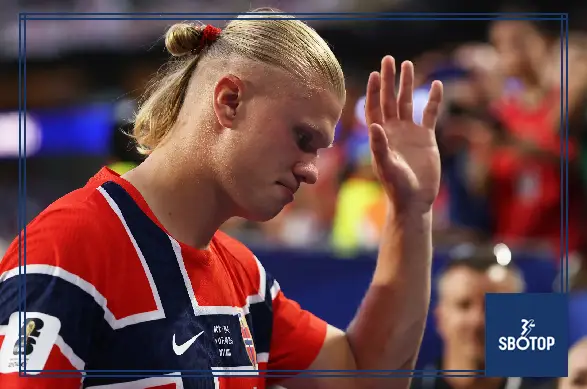
Why remove the player most capable of changing the match with one finish? Why take off a forward who had carried Norway through a historic campaign when England were preparing to defend deeper, creating the kind of penalty-area battle in which Haaland usually thrives?
The explanation after the final whistle was less dramatic than the reaction suggested. Norway coach Ståle Solbakken said Haaland had suffered a dead leg during the second half and was physically exhausted. According to the manager, the striker had reached the point where continuing was no longer helping the team. Jørgen Strand Larsen was therefore introduced to provide fresh movement and energy.
That explanation does not remove the frustration of Norway’s elimination, but it changes the meaning of the substitution. Haaland was not withdrawn because Solbakken had stopped believing in him. He was taken off because his body could no longer produce the explosive actions that make him so dangerous.
A Substitution Nobody Expected
The decision looked shocking because of the circumstances. Norway were behind in a World Cup quarter-final, the match had entered its decisive phase, and Haaland remained the player England feared most. Even when he is quiet, his presence changes how defenders behave and how aggressively they can attack.
Haaland had also arrived as one of the stars of the tournament. He had scored seven goals in five appearances and played a central role in Norway’s remarkable progress, including their knockout victory over Brazil. His combination of power, speed and ruthless finishing had given Norway a weapon few international teams could match. t record made the change difficult to accept. Yet coaches must judge what a player can still contribute in that moment, not what his name normally promises.
Solbakken’s assessment was that Haaland was physically finished.
What Happened to Haaland
The Norwegian coach explained that Erling Haaland had received a dead leg in the second half. A dead leg usually follows a forceful impact to the thigh, causing pain, stiffness and reduced mobility. For a striker whose game depends on sudden acceleration, powerful contact and repeated explosive runs, even a seemingly minor blow can have a major effect.
The problem was compounded by fatigue. Haaland had carried a huge physical and tactical burden throughout Norway’s campaign. He was not simply waiting in the penalty area. He was battling centre-backs, attacking long passes, pressing England’s build-up, making decoy runs and repeatedly trying to stretch the defensive line.
By extra time, the accumulated workload was visible. Solbakken later suggested the striker may even have needed to come off earlier, such was the level of exhaustion.
The conditions increased the strain. The quarter-final was played in Miami Gardens in temperatures reported at around 92 degrees Fahrenheit, or 33 degrees Celsius. England’s players also spoke about the difficulty of performing in the heat, and the contest became increasingly demanding as it continued beyond 90 minutes. that environment, carrying a painful thigh while wrestling with defenders can quickly reduce a striker’s effectiveness. Haaland may still have possessed the instinct to score, but reaching the right position at the right speed had become much harder.
Why Leaving Him On Was Not Automatically Safer
The instinctive argument is simple: an exhausted Haaland is still more dangerous than most fully fit forwards. There is truth in that. He can score from one cross, rebound or defensive mistake.
However, keeping a visibly limited player also creates problems. A striker who cannot press or sprint behind the defence allows the opposition to play more comfortably and defend higher.
There was also the risk of worsening the injury without guaranteeing a decisive chance.
Solbakken faced an uncomfortable choice. He could retain the tournament’s leading figure in the hope that one moment would justify the risk, or introduce a fresher striker who could run, press and attack crosses with full commitment. He chose the second option.
The decision failed to produce an equaliser, but failure does not automatically make the reasoning wrong.
England Had Already Made Haaland Work
England’s defensive plan contributed to the striker’s fatigue. Before the quarter-final, stopping Haaland was identified as the central challenge. The objective was not merely to mark him inside the box but to reduce the quality and frequency of the service reaching him. long periods, England’s defenders remained compact and physical. They challenged Haaland early, crowded central areas and forced Norway to build attacks around rather than directly through him. Even when he did not receive the ball, he was constantly making runs to create space for teammates.
Many of those efforts are invisible in the statistics: unrewarded sprints, physical duels and repeated pressing runs.
Haaland also saw a potential Norway goal ruled out after VAR identified a foul by him during the move. The incident reinforced how closely England were competing with him in the penalty area and how little margin existed in such an intense match. Norway’s Dream Start Slipped Away
The substitution became more painful because Norway had previously been in control.
Andreas Schjelderup gave Norway the lead during the first half, rewarding a confident performance from a team that refused to treat England as overwhelming favourites. Norway attacked with purpose and showed why their run to the last eight was more than a story built around one superstar.
England responded through Jude Bellingham shortly before half-time. The equaliser arrived amid controversy after Norway’s players and staff argued that the ball had struck an overhead camera cable during the sequence. FIFA later stated that sensor data from the match ball showed no contact or abnormal movement, and the goal stood. match remained level through the second half, despite Norway believing they had regained the lead before the VAR intervention involving Haaland. Once the contest entered extra time, England struck quickly. Bellingham scored his second goal in the 93rd minute, turning a tense quarter-final into a desperate chase for Norway. was in that context that Haaland’s removal felt so startling. Norway needed a goal, England were protecting a narrow advantage, and the clock was becoming their greatest opponent.
What Strand Larsen Was Asked to Provide
Jørgen Strand Larsen did not enter with the expectation of replacing Haaland’s reputation. He was asked to replace his physical output.
The fresh striker could press defenders, compete for direct balls and attack the box without managing an injury. Norway’s late strategy required energy as much as finishing. They needed someone capable of forcing England backwards, challenging for crosses and reacting quickly when possession changed.
Substitutions are not always a judgment that the incoming player is better, only that he is better equipped for the next phase.
A fully fit Strand Larsen could make repeated runs that an exhausted Haaland could no longer guarantee. He could also defend from the front, helping Norway regain possession before England settled into controlled passing.
The plan did not deliver the required goal. England survived, completing a 2-1 extra-time victory and advancing to a semi-final against Argentina. The Difference Between Explanation and Excuse
Some supporters will still believe Haaland should have remained on the pitch regardless of his condition. That reaction is understandable. Great goalscorers build their reputations by deciding matches when they appear tired, isolated or ineffective.
Yet the available information makes it difficult to portray the substitution as a reckless experiment. Solbakken did not remove Haaland to protect him for a future fixture. Norway had no future fixture if they lost. Nor was the manager attempting to defend the score. His team was already behind.
The change was made because Haaland had taken a painful blow and no longer had the physical capacity to perform at the required level. That is an explanation, not an excuse.
Solbakken’s responsibility was to evaluate the player in front of him, not the version represented by Haaland’s statistics.
Had Haaland stayed on and failed to move freely, the same critics might have asked why Norway did not introduce fresh legs sooner.
A Difficult Ending to a Historic Tournament
The quarter-final defeat should not erase what Haaland and Norway achieved.
Norway entered the tournament carrying enormous expectations because of a talented generation led by Haaland and Martin Ødegaard. They turned that promise into a historic run, reaching the country’s first World Cup quarter-final and eliminating Brazil along the way. Haaland’s seven goals placed him among the leading scorers and confirmed that his club-level dominance could translate to football’s biggest international stage. inst England, the margins finally turned against them. They led, conceded a disputed equaliser, had a goal ruled out, entered extra time and then fell behind to another Bellingham finish. Their most dangerous player was left bruised and exhausted at the moment they needed him most.
That sequence made the defeat feel especially cruel. Norway were close enough to imagine a semi-final, yet every disputed moment and missed opportunity became magnified.
Solbakken nevertheless described his players’ campaign with pride. His team had competed with elite opponents, survived difficult knockout matches and given Norwegian supporters a tournament they will remember beyond the controversy of one substitution.
Also Read: