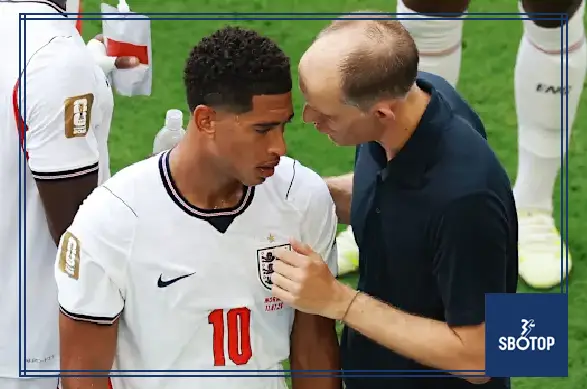
England had just reached a World Cup semi-final. Jude Bellingham had scored twice, the supporters were singing his name, and another difficult knockout match had ended with the Three Lions still standing.
Thomas Tuchel was not satisfied.
Instead of allowing the emotion of England’s 2-1 extra-time victory over Norway to dominate his post-match assessment, the head coach focused on the technical errors, slow circulation and lack of control that had made the quarter-final far more dangerous than he believed necessary.
When Bellingham was informed of Tuchel’s criticism, the midfielder offered a dismissive response. His message was clear: England had faced difficult conditions, a dangerous opponent and the enormous pressure of a World Cup quarter-final. The performance might not have been beautiful, but the team had found a way to survive.
The brief exchange created an unexpected debate around a team preparing for a semi-final against Argentina.
Was Tuchel right to demand more after England’s latest escape? Or was Bellingham right to prioritise resilience over style at the most unforgiving stage of international football?
The answer may be that both men were describing different truths.
Bellingham Rescues England Again
England’s quarter-final began badly. Despite enjoying possession, Tuchel’s side struggled to turn control of the ball into clear opportunities. Harry Kane was isolated, England’s passing lacked speed and Norway remained comfortable enough to wait for moments when the game opened.
Andreas Schjelderup punished England in the 36th minute, giving Norway the lead with a shot that struck the post before crossing the line. The goal immediately changed the atmosphere and placed England in the familiar position of chasing a knockout match.
Bellingham responded before half-time.
He recognised space inside the penalty area, accelerated beyond Norway’s midfield and converted Anthony Gordon’s delivery from a difficult angle. The equaliser arrived during first-half stoppage time and prevented England from entering the interval behind.
His second goal arrived in the third minute of extra time. Morgan Rogers forced a save from Norway goalkeeper Ørjan Nyland, and Bellingham reacted faster than the defenders around him to finish the rebound.
The brace took him to six goals at the tournament, level with Kane and behind only the leading scorers. England had reached the semi-finals for the first time since 2018, and Bellingham had once again provided the decisive intervention.
Tuchel Refuses to Celebrate the Performance
Tuchel acknowledged the importance of the result, but he refused to describe the overall display as acceptable. He believed England had made the match unnecessarily difficult through technical mistakes, slow passing and an inability to repeat attacking movements with sufficient intensity. Although he praised the players’ commitment, he said the team had been fortunate to survive.
The criticism appeared unusually severe after a World Cup quarter-final victory.
Managers commonly protect players after difficult wins, particularly during major tournaments. They may acknowledge weaknesses privately while presenting a united and positive message publicly.
Tuchel chose a different approach.
He did not want qualification to hide the problems England would need to correct before facing Argentina. Reaching the last four was an achievement, but the coach’s attention had already moved towards the next challenge.
From his perspective, congratulating the team without demanding improvement would have wasted an important opportunity.
Bellingham Defends the Players
Bellingham’s response was instinctive.
He appeared surprised when told how strongly Tuchel had criticised the performance and initially brushed the comments aside. He then defended his teammates, emphasising the physical effort required to play in the South Florida heat and humidity against a Norway team containing Erling Haaland, Martin Ødegaard, Antonio Nusa and Alexander Sørloth.
Temperatures had reached approximately 33 degrees Celsius before kick-off, and the match eventually lasted 120 minutes. Several players visibly tired as the contest continued, while Norway’s physical style demanded constant defensive concentration.
Bellingham’s argument was not that England had produced perfect football.
It was that knockout matches cannot always be judged by the standards of a controlled league performance. England had fallen behind, recovered, defended against one of the tournament’s most dangerous strikers and found a winner in extra time.
For Bellingham, those qualities deserved recognition.
He viewed the match primarily through its psychological challenge. England had experienced another setback and responded without losing belief. That resilience, he suggested, was more important than whether every passing sequence had been clean.
Two Different Ways of Seeing the Same Match
The disagreement between Bellingham and Tuchel was not necessarily evidence of a serious breakdown.
Tuchel was assessing the match as a coach responsible for preparing England to win the tournament. Bellingham was speaking as a player who had just completed an exhausting contest and watched his teammates push through physical and emotional pressure.
Both perspectives were valid.
The coach saw misplaced passes, poor decisions and a lack of rhythm.
The player saw sacrifice, recovery and courage.
Tuchel’s job required him to identify why England had struggled. Bellingham’s instinct was to protect the people who had suffered through those struggles alongside him.
The difference became dramatic because both expressed their views publicly, within minutes of the final whistle.
England Were Far From Comfortable
Tuchel’s concern was supported by several dangerous moments.
Norway created opportunities after taking the lead and believed they had scored again when Torbjørn Heggem converted a rebound following a corner. The goal was disallowed after a video review identified a foul by Haaland inside the penalty area.
Haaland also forced Jordan Pickford into an important save with a close-range header. Although England ultimately prevented the Manchester City striker from scoring for the first time at the tournament, his movement and physical presence continually disrupted the defensive line.
England were also fortunate that Norway failed to punish several technical errors in midfield.
Passes were played behind teammates, attacking moves slowed near the penalty area and the team often struggled to connect Kane with the supporting players around him.
Against Argentina, similar errors could carry a greater cost.
That was the point Tuchel wanted to establish.
The Controversy Around England’s Equaliser
Bellingham’s first goal also arrived after a disputed moment.
Immediately before England’s equalising attack, a Norway goal kick appeared on television replays to pass close to an overhead camera cable. Had the ball touched the cable, play should have been stopped and restarted with a dropped ball.
Norway coach Ståle Solbakken believed the contact was visible. FIFA later said data from the sensor inside the match ball showed no evidence that it had struck the cable, allowing the goal to stand.
The incident strengthened Tuchel’s argument that England had benefited from fortune.
However, England still had to build the attack and Bellingham still had to convert the chance. The controversy did not erase the quality of his run or finish.
Knockout football often turns on narrow decisions, rebounds and moments that remain disputed long after the match ends.
England took advantage of theirs.
Bellingham’s Tournament Is Becoming Extraordinary
The quarter-final added another major chapter to Bellingham’s World Cup.
He had already scored twice in England’s 3-2 round-of-16 victory over Mexico. Against Norway, he repeated the achievement and moved level with Kane on six tournament goals.
That scoring record is particularly remarkable because Bellingham is not operating as a traditional centre-forward.
His greatest weapon has been timing.
He senses when defenders become occupied by Kane, when a rebound may fall loose or when space is opening between midfield and defence. Instead of remaining outside the penalty area, he attacks the decisive zone before opponents recognise the danger.
Both goals against Norway demonstrated that instinct.
For the equaliser, he accelerated into space and demanded the ball. For the winner, he anticipated the rebound and arrived before his marker.
These are not accidental goals. They are the product of awareness, athleticism and confidence.
England’s New Centre of Gravity
Kane remains captain and one of England’s greatest goalscorers, but Bellingham increasingly appears to be the emotional centre of the team.
When England need intensity, he provides it. When a match becomes chaotic, he seems more comfortable rather than less. His body language encourages teammates to believe that the decisive moment is still coming.
Reuters described the 23-year-old as a player capable of changing not only matches but also the mood surrounding them. In Miami, his energy helped pull England back into a contest that had begun slipping away.
His post-match defence of the players reflected that influence.
Bellingham was not only explaining his own performance. He was speaking for a group he believed had earned praise for its effort.
That willingness to challenge the manager publicly may create headlines, but it also reveals how much responsibility he feels inside the squad.
Tuchel’s Standards Could Help England
Harry Kane offered a more diplomatic interpretation of the manager’s reaction.
The captain acknowledged that Tuchel had congratulated the players but still believed another level was available. Kane suggested that reaching a World Cup semi-final while knowing the team could improve should be viewed positively.
That may be the healthiest way to understand Tuchel’s criticism.
England are not preparing for an ordinary match. They are two victories away from becoming world champions. Satisfaction can quickly become dangerous.
Tuchel has won major club trophies by demanding tactical discipline and refusing to allow results to conceal weaknesses. His public comments after Norway were consistent with that personality.
He was not saying the players lacked courage.
He was saying courage alone might not be enough against Argentina.
The Risk of Public Criticism
Even when the analysis is accurate, the timing of Tuchel’s comments carried risk.
Players had just completed a draining match and achieved a major objective. A manager who immediately describes the performance as lucky may unintentionally reduce the emotional value of the victory.
Bellingham’s reaction suggested that at least one leading player believed the criticism failed to reflect the difficulty of the assignment.
Public disagreements can also become distractions. Instead of discussing England’s progression, the debate quickly shifted towards whether Tuchel and Bellingham were divided.
Tuchel later rejected that interpretation, insisting there was no disconnect and expressing his admiration for the players. He remained proud of their resilience while maintaining that the football had to improve.
The challenge for the manager is to preserve high standards without making players feel their effort is being dismissed.
“Winning Dirty” Is a Tournament Skill
Bellingham’s central point deserves serious consideration.
World Cup winners rarely produce perfect football in every match.
Tournament success requires teams to survive different types of contests: matches dominated through possession, matches decided by counterattacks, matches won through set pieces and matches in which exhaustion replaces tactical control.
England’s victory over Norway belonged to the final category.
The conditions were difficult, the opponent was physically powerful and several players had already accumulated significant minutes during the tournament. England were unable to impose a smooth rhythm, but they continued competing.
That capacity to win without playing well can be a strength.
It becomes a problem only when the team repeatedly depends on recovery rather than addressing the reasons it keeps falling into danger.
Norway Deserved Respect
Bellingham was also correct to reject any suggestion that Norway represented an easy opponent.
Haaland entered the quarter-final after scoring seven times at the tournament, including twice against Brazil in the previous round. Ødegaard offered creativity in midfield, while Schjelderup and Nusa provided speed and direct running.
Norway had already shown that it could eliminate an established football nation.
Their physical approach tested England in every area. Defenders had to manage Haaland’s movement, midfielders competed against Ødegaard and Sander Berge, and the full-backs were repeatedly challenged by quick wide players.
England were favourites, but the match was never supposed to be comfortable.
Recognising that does not excuse England’s technical mistakes. It provides the context Bellingham believed Tuchel’s immediate criticism lacked.
Also Read: