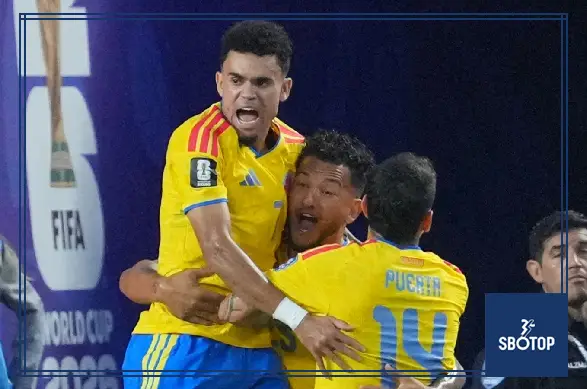
Colombia did not need chaos, penalties, or late drama to reach the last 16 of the 2026 World Cup. They needed one sharp attacking moment, a disciplined defensive performance, and the calmness to manage a knockout match without letting emotion take over. Their 1-0 win over Ghana in Kansas City may not go down as the wildest game of the round of 32, but it was one of the clearest examples of tournament control.
Jhon Arias scored the decisive goal in the 14th minute, turning in a cross from substitute Luis Suárez after Colombia had already been forced into an early change. That single goal was enough to send Néstor Lorenzo’s side through and set up a last-16 meeting with Switzerland in Vancouver. Colombia’s victory also extended their unbeaten World Cup run after topping Group K against Portugal, Uzbekistan, and DR Congo.
It was not a performance built on spectacle. It was built on authority. Colombia created the better chances, controlled the emotional temperature of the match, and kept Ghana from finding any real rhythm. In a tournament where bigger names have stumbled, Colombia continue to move forward with the confidence of a team that knows exactly what it is.
Arias Arrives at the Perfect Moment
The match turned on Arias’ movement. Colombia had already suffered an early blow when Jhon Córdoba was forced off with an apparent groin problem in the eighth minute. Suárez came on unexpectedly, and within minutes he had changed the match. His delivery from the right found Arias drifting into space at the back post, and the Palmeiras midfielder guided his finish into the bottom corner.
It was a simple goal, but simple goals often reveal excellent details. Arias read the play quicker than Ghana’s defenders. He attacked the blind side, stayed composed, and finished with the calmness of a player who understood the importance of the moment. In knockout football, that kind of timing is priceless.
Arias’ story also adds depth to the moment. After a difficult spell at Wolves, he moved to Palmeiras and has now become one of Colombia’s key tournament figures. The Guardian reported that he believes Colombia have enough quality to dream big in this World Cup, and his goal against Ghana gave that belief another layer of credibility.
Suárez Becomes Ghana’s Unwanted Reminder
There was a strange historical echo in the name of Colombia’s assist-maker. For Ghana supporters, the surname Suárez still carries World Cup pain because of Uruguay’s Luis Suárez and the infamous 2010 quarter-final incident that denied the Black Stars a historic path toward the semi-finals. This Colombian Luis Suárez had no connection to that moment beyond the name, but his assist still felt like a cruel twist of football history.
He had barely entered the match when he helped decide it. The Guardian noted the uncomfortable coincidence, with Ghana’s first knockout game since that painful 2010 chapter again involving a Suárez figure in a decisive moment.
But beyond the narrative, the football was clear. Suárez reacted well to being thrown into the game early. He gave Colombia a direct option, found space on the right, and delivered the kind of cross that turned pressure into a goal. It was not the role he expected to play at kick-off, but it became the role that shaped Colombia’s night.
Ghana Start Brightly Then Fade
Ghana did not begin like a team ready to disappear. Thomas Partey almost opened the scoring inside the first two minutes with a long-range effort that went narrowly wide. For a brief spell, Ghana had energy, aggression, and enough confidence to make Colombia uncomfortable.
But the match changed quickly. The injury to Marvin Senaya forced Ghana into an early defensive reshuffle, and Colombia’s goal arrived before the Black Stars had properly reorganised. Carlos Queiroz later admitted the early substitution disrupted his team’s shape and that Colombia struck while Ghana were still trying to settle again.
After that, Ghana struggled to create. They had effort, but not enough imagination. They had physicality, but not enough precision. The absence of Mohammed Kudus was felt heavily, with The Guardian noting that Ghana failed to register a shot on target.
For a team chasing a knockout match, that statistic was fatal.
Colombia’s Defence Wins the Night
Arias scored the goal, but Colombia’s defence protected the result. This was not a desperate backs-to-the-wall effort. It was disciplined, calm, and organised. Ghana’s Antoine Semenyo looked like their most dangerous attacking player, but Colombia denied him the clear sight of goal he needed.
That defensive control is one of the reasons Colombia look increasingly dangerous. They are not only a team of flair, rhythm, and attacking confidence. They can also manage space. They can absorb pressure without panicking. They can close passing lanes and make opponents feel as though every attack has to be perfect to cause damage.
Against Ghana, that structure was decisive. Colombia did not need to score three or four. They trusted the 1-0. They trusted their midfield. They trusted their centre-backs. They trusted their ability to reduce the match to a handful of controllable moments.
This is how strong tournament sides often progress. Not every knockout match is a showpiece. Sometimes the most important victories are the ones that look routine because the winning team made them feel that way.
Luis Díaz Keeps Knocking
Luis Díaz did not get his goal, but he remained one of Colombia’s most dangerous outlets. He had chances to make the match more comfortable, including a second-half finish that was ruled out for offside. Reuters reported that Díaz continued to threaten throughout, while Ghana goalkeeper Lawrence Ati-Zigi made several important saves to keep the scoreline at 1-0.
That was one of the few frustrations for Colombia. They were the better team by a clear margin, but they never found the second goal that would have killed the match emotionally. Díaz’s disallowed effort briefly looked like the moment of relief, only for the offside flag to keep Ghana alive.
Still, Díaz’s influence mattered. He stretched Ghana, forced defenders backward, and created the sense that Colombia could break through again at any time. Even without the goal, his movement helped prevent Ghana from fully committing forward.
If Colombia are to go deep, Díaz will almost certainly need to deliver decisive moments. Against Ghana, Arias took the headline. But Díaz remains one of the players opponents will fear most.
James Rodríguez and a Changing Colombia
James Rodríguez started the match and earned another major tournament appearance, but he was withdrawn at half-time. The Guardian described him as disappointed to come off and noted that his best days, including Colombia’s memorable 2014 quarter-final run, are now behind him.
That substitution felt symbolic. Colombia still respect James’ history and creativity, but this is no longer a team built entirely around his magic. Arias, Díaz, Richard Ríos, Daniel Muñoz, and others are now carrying the rhythm of a new version of Colombia. The side has evolved from relying on individual inspiration into a more balanced, collective unit.
That may be a strength. The best Colombia teams of the past were often loved for their flair, but sometimes vulnerable when the game became tense. This version looks more pragmatic. It can still play with imagination, but it also knows when to slow the tempo, protect a lead, and let the opponent run out of ideas.
That maturity could be vital in the next round.
Queiroz Points to Ghana’s Lack of Maturity
After the match, Carlos Queiroz did not hide from the problem. He said Ghana lacked experience and calmness when pressure arrived, describing the team as young and still in need of maturity. He also accepted that Colombia were the better side and deserved to go through.
That assessment was fair. Ghana had enthusiasm and athletic ability, but they did not have enough composure once the match turned against them. After conceding early, they needed patience, cleaner passing, and better final-third decisions. Instead, they became predictable.
Queiroz also said Ghana’s final pass and final service lacked the necessary quality. Reuters reported that he credited Colombia’s control, movement, and passing for damaging Ghana’s ability to recover the ball and build attacks.
The Black Stars can leave with some pride. They reached the knockout stage in an expanded World Cup and competed hard. But the Colombia match exposed the gap between competing and controlling.
A Painful Exit for Ghana
Ghana’s exit hurts because the match was close enough on the scoreboard to feel reachable. A single goal separated the teams. One moment of quality might have changed everything. Yet the deeper truth is that Ghana never truly forced Colombia into crisis.
Their World Cup story carries history and emotion. Their previous knockout heartbreak against Uruguay in 2010 remains one of the most painful African football memories. The chance to write a new knockout chapter was there, but Ghana lacked the creativity to take it.
The absence of Kudus clearly limited their attacking spark. Partey and Jordan Ayew brought experience, while Semenyo offered energy, but Ghana never found the combination that could unlock Colombia’s defence. They left the tournament not because of one mistake alone, but because they could not produce enough danger across the full match.
That will be the regret. Not that they were destroyed, but that they were contained.
Colombia’s Fans Turn Kansas City Yellow
One of the night’s most striking features was the atmosphere. Reuters described Kansas City Stadium as feeling more like Barranquilla than Missouri, with Colombia supporters filling the stands in yellow shirts, scarves, and sombrero vueltiao hats.
That support mattered. Colombia played with the confidence of a team surrounded by belief. Every attack had noise behind it. Every defensive action was celebrated. Every pass late in the game was cheered as if the crowd were helping carry the ball away from danger.
In a World Cup spread across huge distances and different climates, support can become a major factor. Colombia’s players looked energised by the atmosphere, and Ghana looked increasingly isolated as the match went on.
The Colombian diaspora has made its presence felt throughout this tournament. In Kansas City, it helped turn a neutral venue into a home match.
Heat, Travel, and Tournament Survival
Lorenzo has been careful not to get carried away. The Colombia coach spoke about the difficulty of the tournament, including travel, temperatures, and logistics. Reuters reported that the match was played in 30°C heat, adding another physical challenge to the pressure of knockout football.
That matters because the 2026 World Cup is not only a test of football quality. It is a test of recovery, rotation, and adaptability. Teams are moving across large distances, adjusting to different conditions, and dealing with short turnarounds between high-stakes matches.
Colombia’s ability to manage the match against Ghana without extra time or penalties could prove important. They preserved energy compared with teams that survived 120-minute battles. They will need that freshness against Switzerland, a side built on discipline and tactical control.
The Ghana win was not just a ticket to the next round. It was a physically efficient passage.
Also Read: