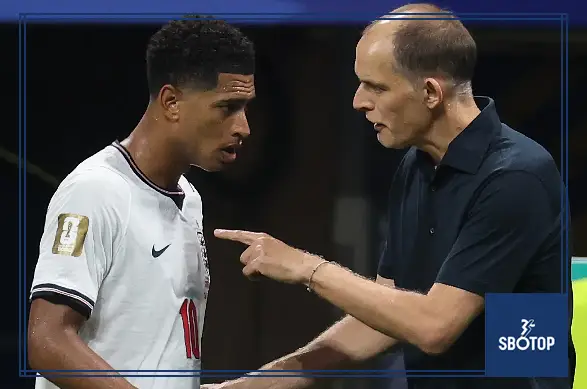
Joe Hart has defended Jude Bellingham after the England midfielder’s sharp reaction to Thomas Tuchel’s criticism threatened to overshadow a remarkable individual performance in the World Cup quarter-final victory over Norway.
Bellingham scored both of England’s goals in a dramatic 2-1 extra-time win on July 11, carrying the Three Lions into the semi-finals after they had fallen behind in difficult conditions in Miami. Yet much of the immediate discussion focused not on his decisive contribution, but on the apparent disagreement that developed between the Real Madrid star and his national-team coach during their post-match interviews.
Tuchel praised England’s resilience and celebrated qualification, but he also described the team’s performance as technically careless and fortunate. When a visibly exhausted Bellingham was presented primarily with the negative part of that assessment, he responded dismissively before defending the physical effort made by his teammates.
Hart believes that reaction was understandable.
The former England goalkeeper argued that the questioning gave Bellingham the impression that he was being criticised immediately after producing a match-winning performance. In Hart’s view, the midfielder was not responding to the full balance of Tuchel’s comments. He was reacting to a condensed version that made the manager’s verdict sound far more hostile than it actually was.
The episode raised wider questions about player emotions, media framing and the relationship between a demanding coach and one of his most important stars.
Bellingham Delivers When England Need Him Most
England’s quarter-final against Norway was never comfortable.
Norway possessed major attacking quality through Erling Haaland, Martin Ødegaard, Antonio Nusa and Alexander Sørloth. They took the lead and forced England to chase the match during an exhausting evening shaped by intense heat, tactical pressure and the knowledge that one mistake could end either country’s World Cup campaign.
Bellingham responded as elite players are expected to respond.
He scored England’s equaliser before striking again early in extra time, capitalising on a Norwegian error and securing the victory. His two goals took his tournament total to six and reinforced his position as one of England’s most decisive performers. Reuters noted that he had also scored twice against Mexico earlier in the knockout stage, demonstrating a repeated ability to influence matches when England’s wider performance became unstable.
The midfielder had therefore earned the right to feel proud.
He had completed a physically demanding match, scored both goals and helped his country reach the last four. In the minutes after the final whistle, his body would still have been carrying the effects of extra time, emotional tension and the demanding Florida conditions.
That context is essential when judging what happened next.
Tuchel Refuses to Ignore England’s Problems
Tuchel approached the result from a different perspective. The England head coach was delighted to reach the semi-finals, but he believed the team’s performance had exposed weaknesses that could prove costly against stronger opposition.
England had misplaced passes, struggled to move the ball quickly and allowed Norway opportunities that might have ended their campaign. Tuchel’s concern was not that his players lacked commitment. He repeatedly praised their mentality and their ability to overcome adversity.
His dissatisfaction centred on the quality of England’s football.
The German said the team had made the contest unnecessarily difficult through technical mistakes and slow decision-making. He considered England fortunate to progress and felt that the performance required significant improvement before the semi-final.
From a coaching perspective, the analysis was reasonable.
Managers cannot allow a positive result to erase obvious problems. A World Cup knockout victory deserves celebration, but the purpose of post-match analysis is also to identify what must improve before the next challenge.
Tuchel was attempting to hold both ideas at once: England had shown outstanding character, yet they had not played at the required technical level.
The controversy developed because Bellingham was initially presented with only one side of that message.
The Interview Question Changed the Meaning
Post-match interviews take place in an unusual emotional environment.
Players have very little time to recover before microphones are placed in front of them. They may not have spoken to their coach, watched any replays or even fully processed the result.
Bellingham was told that Tuchel had been unhappy and believed England were lucky. That framing removed much of the praise that surrounded the criticism.
The midfielder’s immediate response—“Yeah, well, whatever”—was blunt. He then emphasised the difficulty of the conditions, the quality of Norway’s players and the effort required from every member of the England team.
His answer sounded like a direct challenge to Tuchel.
However, Hart argued that the question encouraged precisely that type of reaction. The former goalkeeper described the approach as slightly mischievous because it highlighted the negative part of Tuchel’s verdict without giving Bellingham the full context.
Hart suggested that Bellingham felt he was being attacked after doing something exceptional. From that perspective, his defensive response was not necessarily evidence of a major disagreement with the manager. It was the natural reaction of an emotional player who believed his achievement and his teammates’ sacrifice were being dismissed.
Hart Understands the Emotion of the Moment
Hart’s defence carried weight because he spent many years dealing with the demands of playing for England.
He understands how quickly the atmosphere around the national team can change. A player can move from hero to controversy within one interview, particularly during a major tournament when every sentence is analysed across television, newspapers and social media.
Hart acknowledged that journalists had every right to ask Bellingham about Tuchel’s comments. His criticism concerned the way the question was framed rather than the existence of the question itself.
He argued that a player leaving the pitch after reaching a World Cup semi-final would naturally be emotional. Had he been in Bellingham’s position and been offered only the most critical section of his manager’s comments, Hart said he might have responded in a similar manner.
He also believed that the issue would appear much less serious inside the England camp.
Once Bellingham heard Tuchel’s complete assessment—including the praise for his performance and the team’s mentality—Hart expected the player and manager to understand each other. He suggested that the disagreement was probably resolved away from the cameras without becoming a genuine dressing-room problem.
Bellingham Was Defending More Than Himself
One important part of Bellingham’s response was that he did not focus entirely on his own performance.
He had scored both goals and could easily have answered by reminding everyone that he had decided the match. Instead, he repeatedly referred to the work of the wider team.
Bellingham felt that England’s effort deserved greater recognition. The players had competed through difficult weather, faced one of the strongest attacking teams in the tournament and found a way to win when their football was not flowing.
His defence was therefore collective.
He was protecting teammates who had run, tackled and suffered through extra time. He appeared frustrated by the idea that their achievement could immediately be reduced to poor passing and good fortune.
This quality helps explain Bellingham’s influence within the England squad. His emotional intensity can sometimes create controversy, but it also reflects a strong sense of responsibility.
He does not treat major matches as ordinary professional assignments. He becomes personally invested in the team’s success, and that investment can produce both extraordinary performances and highly charged reactions.
Tuchel’s Standards Are Part of His Management Style
Tuchel has built his coaching career around detailed analysis and demanding expectations.
He is rarely satisfied simply because a team wins. He studies positioning, passing speed, pressing distances and decision-making, often identifying problems even after positive results.
That mindset can improve elite teams because it prevents complacency.
England had reached a World Cup semi-final, but Tuchel did not want the players to believe that the Norway performance would be sufficient against the strongest remaining opponents. He wanted greater control, fewer unforced errors and more clinical attacking play.
His message was not that England had achieved nothing. It was that achievement and improvement could exist together.
Tuchel later insisted there was no separation between himself and his players. He said his analytical dissatisfaction did not reduce his admiration for their commitment, and he made clear that he remained emotionally connected to the squad. He also offered the strongest possible praise for Bellingham, describing the midfielder as world class and highlighting his ability to deliver repeatedly.
The full comments present a more balanced picture than the version initially given to Bellingham.
A Previous Controversy Increased the Sensitivity
The quarter-final exchange attracted additional attention because Tuchel and Bellingham already had a complicated public history.
In 2025, the England coach created controversy when discussing Bellingham’s emotional behaviour on the pitch. Tuchel used language suggesting that some of the midfielder’s mannerisms could be viewed negatively, including a term that was widely interpreted as excessively harsh.
The coach later apologised and said he had not intended to attack the player. Nevertheless, the incident remained part of the public conversation surrounding their relationship.
That history influenced how the Norway interviews were interpreted.
Had another player responded dismissively to another manager, the moment might have been treated as temporary frustration. Because Tuchel and Bellingham had previously been linked to reports of tension, the new exchange immediately became evidence for a possible conflict.
This demonstrates how football narratives develop.
Once a relationship is described as difficult, every disagreement is placed inside that existing story. Ordinary tension becomes a rift, criticism becomes hostility and emotional body language is treated as proof of deeper problems.
Hart’s intervention challenged that interpretation.
He argued that the interview context, not a damaged relationship, was the most important explanation for Bellingham’s reaction.
Successful Teams Do Not Require Perfect Agreement
Managers and players do not need to share the same interpretation of every performance.
Tuchel saw technical errors and tactical risks. Bellingham saw sacrifice, resilience and a difficult opponent. Both perspectives contained truth.
England were not at their best against Norway. They also deserved credit for recovering from a losing position and surviving a demanding knockout match.
The disagreement became controversial because it happened publicly, not because disagreement itself is unusual.
In elite football, coaches are expected to demand improvement. Players are equally entitled to defend the work they perform on the pitch.
The healthiest teams create an environment in which both can happen without damaging trust.
A player should be able to question an assessment, while a manager should be able to criticise a performance without being accused of losing the dressing room.
The important question is what happens afterwards.
Do the player and coach communicate privately? Do they understand each other’s intentions? Can they focus on the next match without carrying personal resentment?
Hart believed the answer in this case was yes.
Bellingham’s Personality Is Central to His Greatness
Bellingham’s emotional nature is not separate from his footballing ability.
The confidence that allows him to score decisive goals in World Cup knockout matches is connected to the same personality that produces forceful celebrations and confrontational interviews.
Trying to remove every emotional edge from his character could also reduce part of what makes him exceptional.
He demands the ball under pressure. He expects to influence major matches and does not hide when the team is struggling. Those qualities require unusual self-belief.
However, emotional intensity must still be managed.
England need Bellingham available, focused and connected to the collective. Public arguments, unnecessary disciplinary incidents or repeated confrontations can become distractions.
The challenge for Tuchel is not to transform him into a quiet, emotionless player. It is to help him channel his intensity towards the match rather than the surrounding noise.
Bellingham must also recognise that criticism from an elite coach is not always personal. Tuchel’s standards apply precisely because the manager believes the squad is capable of winning major honours.
The Media’s Role Deserves Examination
The episode also illustrates the power of selective quotation.
A manager may deliver a two-minute answer containing celebration, praise, criticism and tactical analysis. A player may then be presented with a single negative sentence and asked to react immediately.
The resulting confrontation creates compelling television.
Yet it may not accurately represent what either person intended.
This does not mean interviewers should avoid difficult questions. Public figures must expect scrutiny, and Bellingham’s response was his own responsibility.
However, context matters.
Telling the midfielder that Tuchel had praised his mentality before questioning the performance might have produced a more considered answer. Presenting only the description of England as lucky made the comments sound closer to a personal rejection of everything the players had achieved.
Hart’s criticism was therefore about fairness rather than protection from accountability.
Players should answer challenging questions, but they should be told accurately what they are being asked to address.
Also Read: