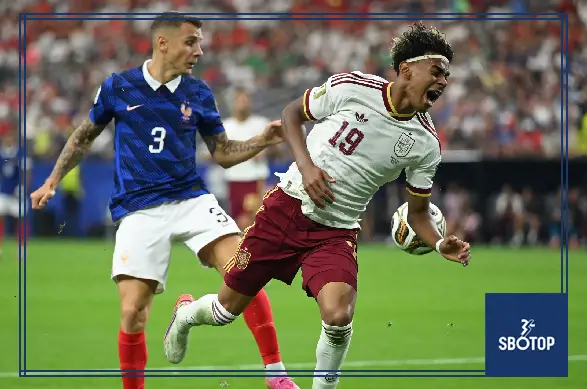
Lucas Digne has experienced enough of elite football to understand how quickly one decision can reshape an entire match. During France’s World Cup semi-final against Spain, the left-back had only a fraction of a second to react as Lamine Yamal moved into the penalty area. Digne attempted to clear the danger, made contact with the Spanish winger and watched the referee point to the penalty spot.
Mikel Oyarzabal converted the resulting kick in the 22nd minute. Pedro Porro later doubled Spain’s advantage as the European champions completed a commanding 2-0 victory and advanced to the World Cup final. Digne played 72 minutes before being substituted, leaving the pitch with France’s hopes already slipping away.
The defender subsequently broke his silence with an emotional message in which he accepted personal responsibility for the incident.
“First of all, I am disappointed in myself,” Digne wrote while reflecting on the end of France’s campaign. He also expressed his regret for his teammates, staff members and the supporters who had followed Les Bleus throughout the tournament.
His reaction was honest, but France’s elimination cannot be reduced to a single challenge.
The penalty gave Spain the opening they needed, yet the semi-final was decided by a wider difference in control, energy and technical authority. Spain dominated possession, dictated the rhythm and restricted France to only two shots on target. Didier Deschamps later acknowledged that his team had been technically inferior on the night.
Digne’s foul became the defining image of the defeat because it created the first goal. It was not, however, the only reason France’s World Cup dream ended.
A Moment That Changed the Semi-Final
The incident developed rapidly. Yamal received the ball on Spain’s right and moved towards the penalty area, forcing Digne to retreat while attempting to judge whether the winger would shoot, pass or continue carrying possession.
Yamal’s movement placed the defender in an uncomfortable position. Digne tried to reach the ball as the Spanish attacker entered the box, but the challenge resulted in contact. The referee immediately awarded a penalty.
Oyarzabal stepped forward and converted, giving Spain an advantage that suited their preferred style perfectly. With the lead secured, they could control possession, force France to chase and wait for spaces to appear.
The official match data records Oyarzabal’s penalty in the 22nd minute and Porro’s second goal in the 58th. The final score sent Spain into their first World Cup final since winning the competition in 2010.
For Digne, the emotional consequences were immediate.
Players often understand the importance of a mistake before the scoreboard confirms it. The expression on the defender’s face suggested he knew that Spain had been handed a major opportunity in a match where clear chances were expected to be limited.
The penalty did not make France’s defeat inevitable. More than an hour of football remained. Yet it transformed the tactical conditions of the contest.
Spain no longer needed to force the game. France did.
Digne Refuses to Hide
One of the most difficult responsibilities for an elite player is addressing the public after a painful mistake. It would have been easy for Digne to remain silent, focus on the controversy surrounding the decision or allow his manager to defend him. Instead, he chose to acknowledge his disappointment openly.
His message centred on personal regret, the collective effort of the squad and the supporters whose backing had carried France through the competition. He described the elimination as the end of a childhood dream and made clear that he felt responsible for his contribution to the result.
That response revealed character.
Taking responsibility does not mean accepting that an entire defeat belonged to him. It means recognising that his action had consequences and refusing to pretend otherwise.
Football supporters often demand accountability from players but can be unforgiving when they receive it. An honest admission may be treated as proof of guilt rather than evidence of maturity.
Digne’s statement should be viewed in a broader context. He did not accuse the referee, criticise Yamal or attempt to redirect attention towards teammates. He acknowledged his own disappointment while showing respect for the group.
That distinction matters.
Was the Penalty Decision Correct?
The decision immediately generated debate.
Some observers believed the contact was sufficient and that Digne’s attempt to play the ball arrived too late. Others argued that Yamal moved into the challenge and that the defender had little opportunity to avoid contact while attempting a natural clearance.
Deschamps questioned the standard of officiating after the match and expressed frustration with the decision, although he stopped short of blaming the referee entirely for France’s elimination. He also admitted that Spain had been superior in possession and game intelligence.
Both ideas can be true.
France may have felt the penalty was harsh while also recognising that their overall performance was not good enough.
Debates surrounding penalty decisions often become overly absolute. Supporters search for evidence that a referee was completely correct or entirely wrong, even when slow-motion replays reveal a complicated sequence involving movement from both players.
Digne was attempting to clear the ball. Yamal was attempting to reach a dangerous position. Their paths collided inside the area, and the referee interpreted the contact as a foul.
Once the decision was made and confirmed, France still had time to respond.
They did not.
Yamal’s Movement Created the Problem
The incident also demonstrated why Yamal is so difficult to defend.
The Spanish winger does not rely solely on speed. His greatest strength may be his ability to change direction at exactly the moment a defender commits.
Against Digne, Yamal recognised the space between the defender and the ball. He attacked that area, ensuring that any attempted clearance carried significant risk.
The movement was intelligent because it forced a decision.
Had Digne remained passive, Yamal could have continued into a dangerous position. By attempting to intervene, the Frenchman risked making contact.
This is the dilemma elite attackers create. Defenders are criticised for challenging unsuccessfully, yet they are also criticised when they allow a player to advance without resistance.
Yamal had entered the semi-final immediately after his 19th birthday and was already one of Spain’s central attacking figures. Despite scoring only once earlier in the tournament, his presence consistently opened spaces and forced opponents to adjust their defensive structures.
He did not score against France, but his movement produced the opening goal.
That contribution was decisive.
Spain’s Control Made Recovery Difficult
The most important consequence of the penalty was not simply the score. It was the way the goal strengthened Spain’s tactical position.
Luis de la Fuente’s side were already comfortable controlling possession. Once ahead, they could circulate the ball patiently and force France’s forwards to spend energy chasing.
Rodri controlled the central areas, Spain’s defenders passed through pressure and the full-backs advanced whenever France’s shape became stretched.
France entered the semi-final with one of the tournament’s most dangerous collections of attackers. Kylian Mbappé, Ousmane Dembélé and Michael Olise had the talent to punish any opponent.
Spain prevented them from establishing momentum.
Their pressing denied France clean progression from defence, while their possession reduced the number of transitions available to Mbappé and Dembélé. Reuters described Spain’s control as suffocating, noting that the 2-0 scoreline did not fully reflect the authority of their performance.
Digne’s foul opened the door. Spain’s collective quality ensured France never closed it.
Porro Delivers the Second Blow
France needed a strong start to the second half. Instead, Porro scored Spain’s second goal in the 58th minute.
The right-back had already performed his defensive duties effectively, helping Spain contain Mbappé and France’s left-sided attacks. His goal completed a display that established him as one of the semi-final’s outstanding performers.
For France, the second goal was particularly damaging because it removed any possibility of patiently rebuilding the match.
A one-goal deficit allows a team to remain measured. At 2-0, France had to take greater risks against an opponent that thrives when spaces appear.
Digne was still on the pitch when the goal arrived. He and Désiré Doué faced criticism for their defensive involvement in the move, although the breakdown again reflected a wider collective failure rather than one player’s mistake.
Spain moved the ball more quickly, recognised the weakness and finished the opportunity.
By the time Digne was substituted in the 72nd minute, France required a comeback that never appeared likely.
France’s Biggest Stars Fail to Respond
The semi-final was supposed to be an opportunity for France’s attacking stars to demonstrate their superiority.
Instead, Spain prevented them from influencing the contest.
Mbappé struggled to receive the ball in areas where he could accelerate towards goal. Dembélé’s movement produced little reward, while Olise was unable to dictate play between Spain’s midfield and defence.
Former France international Patrick Vieira criticised the leading players for failing to rise to the occasion. His argument was that a World Cup semi-final must be decided by a team’s most influential figures, yet France’s biggest names were unable to provide a response.
That criticism places Digne’s error in a more balanced perspective.
The defender conceded the penalty, but France still possessed enough attacking talent to recover. No major player produced the goal, assist or sustained period of pressure required to change the match.
Digne’s mistake was visible. The attacking failures were quieter but equally damaging.
When a defender concedes a penalty, responsibility is easy to identify. When forwards fail to create, the blame becomes more widely distributed.
France suffered from both problems.
Deschamps Confronts a Painful Ending
The defeat also carried major significance for Deschamps.
France had been attempting to reach a third consecutive World Cup final after winning the trophy in 2018 and finishing as runners-up in 2022. Their elimination ended that possibility and was widely expected to close Deschamps’ long period in charge.
His team had progressed deep into another major tournament, but the performance against Spain lacked the authority associated with France’s strongest sides.
Deschamps admitted that Spain were technically better and that France failed to perform at the level required. While he questioned aspects of the officiating, he did not claim the penalty alone had decided the match.
That assessment was fair.
France were not eliminated by a random moment in an otherwise dominant display. They were beaten by a team that controlled the ball more effectively, pressed with greater organisation and made better decisions in both penalty areas.
Digne’s foul was crucial because it created the first goal. Spain’s superiority made that goal feel increasingly decisive as the match continued.
The Burden Carried by Defenders
Defenders frequently experience football differently from attacking players.
A forward can miss several chances and still become the hero by scoring once. A defender can perform well for most of the match and be remembered for a single mistimed intervention.
Digne’s semi-final followed that pattern.
The challenge on Yamal became the moment replayed repeatedly after the final whistle. His positioning, timing and decision were examined from multiple angles, while much of his other work disappeared from the discussion.
This does not mean criticism is unfair. Elite defenders are judged by decisive actions, especially inside their own penalty area.
It does mean the emotional burden can be severe.
Digne knew his challenge had contributed directly to Spain’s opener. He also knew the incident would follow him into the post-match analysis, regardless of everything that happened afterwards.
His public statement suggested he was already carrying that weight.
The challenge now is to prevent one mistake from defining his view of the entire tournament.
Digne’s World Cup Was Bigger Than One Foul
France reached the last four, and Digne played his part in that journey.
The semi-final was his most difficult evening, but it should not erase the performances that helped the team advance through earlier rounds.
International tournaments are often remembered through final moments rather than complete campaigns. A missed penalty, a defensive error or a red card can become more famous than weeks of consistent work.
Digne will understand that reality.
At the same time, experienced professionals know that careers are not judged by one match alone. His response—both publicly and on the pitch in future fixtures—will matter more than attempts to rewrite what happened.
Accepting responsibility is the first stage. Recovering confidence is the next.
France Still Have One Match Remaining
France’s campaign did not end entirely with the semi-final.
Les Bleus were scheduled to face England in the third-place play-off, offering both beaten semi-finalists an opportunity to finish the tournament with a victory.
The match may lack the emotional importance of a final, but it remains significant for players attempting to respond after disappointment.
For Digne, selection would offer a chance to return quickly rather than spend months waiting for another international appearance.
Whether Deschamps chooses him may depend on his physical condition, emotional readiness and the manager’s desire to rotate the squad.
France must also decide whether the play-off should be treated as a final competitive objective or the beginning of a transition towards a new era.
The answer could influence Digne’s role.
Spain’s Victory Was About More Than the Penalty
Reducing the semi-final to Digne’s challenge would also underestimate Spain.
The European champions produced a mature and highly organised performance. They controlled possession, pressed effectively and protected their defence against one of the most talented attacking lines at the tournament.
Oyarzabal converted the penalty with composure. Porro chose the biggest match of his international career to score an important goal. Rodri controlled midfield, while Yamal contributed through movement even without scoring.
Spain earned their place in the final.
France may regret how the opening goal arrived, but they cannot claim that one refereeing decision completely distorted the contest.
The better team won.
That truth is painful, but it also offers a clearer foundation for improvement than placing the entire defeat on one defender.
Responsibility Without Isolation
Digne was right to acknowledge his role. He should not carry the defeat alone.
A World Cup semi-final is shaped by dozens of actions: missed passes, lost duels, failed presses, poor clearances and chances that never become shots.
The penalty was one of those actions, although it was more consequential than most.
France had 68 minutes after Oyarzabal scored to respond. Their forwards could not break through, their midfield could not disrupt Spain’s rhythm and their collective pressure never became sustained enough to create a comeback.
Digne’s responsibility is real.
So is the responsibility shared by the entire team.
Also Read: