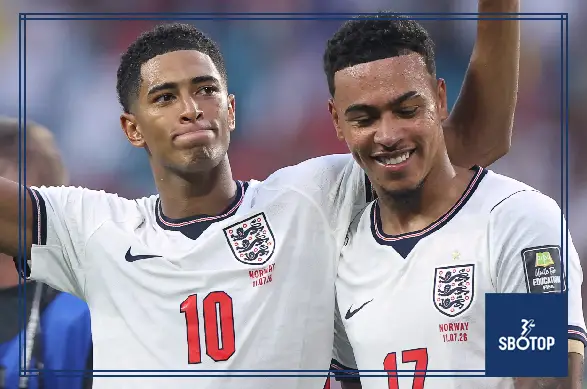
Morgan Rogers has dismissed the suggestion that Jude Bellingham should ever have been considered anything other than a central figure in England’s 2026 World Cup campaign.
Before the tournament, debate surrounded Thomas Tuchel’s preferred option in the No.10 role. Rogers had produced outstanding club form for Aston Villa, while Bellingham’s position in the starting side was questioned by some observers following an uneven period with the national team.
Those arguments now appear increasingly difficult to defend.
Bellingham has responded with six World Cup goals, a series of decisive performances and two match-winning braces in the knockout rounds. His latest intervention came in England’s 2-1 extra-time quarter-final victory over Norway, when he scored both goals to overturn a deficit and send Tuchel’s team into the semi-finals.
Rogers, rather than expressing frustration about his own opportunities, praised his teammate and described the earlier discussion about Bellingham’s involvement as “ridiculous.” He argued that the Real Madrid midfielder has repeatedly demonstrated his quality on the biggest stage and deserves recognition not only for his goals but also for the energy and sacrifice he gives to England.
The response offered a revealing insight into England’s dressing room. What had often been presented publicly as a personal battle between two gifted attacking midfielders appears to have been viewed very differently by the players themselves.
For Rogers, the question is not whether he can remove Bellingham from the side. It is how both players can contribute to England’s attempt to win the World Cup.
A Debate That Grew Before the Tournament
The competition for England’s attacking midfield position became one of the dominant selection stories before the World Cup.
Rogers had earned significant attention through his performances for Aston Villa. His direct running, physical strength and ability to carry the ball through pressure made him an attractive option for an England side searching for greater attacking power.
By December 2025, Rogers had already been discussed as a possible starter ahead of Bellingham, Phil Foden, Cole Palmer and Eberechi Eze. Former England defender Phil Jones publicly argued that Rogers should occupy the No.10 role, praising his pace, strength, two-footed finishing and influence at club level.
Rogers himself avoided encouraging the comparison.
He repeatedly stated that he was focused on improving his own football rather than worrying about who might start. He recognised the quality within England’s attacking department and treated selection as a consequence of performance rather than a personal campaign against another player.
That measured response did little to stop the discussion.
Bellingham’s enormous reputation ensured that every England performance was examined closely. When the team lacked fluency, critics questioned whether he was occupying the correct position. Some preferred him deeper in midfield, while others suggested that Rogers offered a more natural blend of physicality and directness behind Harry Kane.
Tuchel’s refusal to guarantee places for major stars gave the conversation additional momentum. Bellingham’s importance was no longer being treated as automatic, at least publicly, and the No.10 role became one of the manager’s most closely watched decisions.
The World Cup has now provided a forceful answer.
Bellingham Has Settled the Argument Through Goals
The most obvious reason the debate has faded is Bellingham’s scoring record. The midfielder entered the semi-final stage with six goals, level with England captain Kane. Together, the pair had scored 12 of the team’s first 13 goals at the tournament.
Those numbers would be remarkable for a centre-forward. For a midfielder operating between the lines, they demonstrate an exceptional ability to recognise decisive moments.
Bellingham’s movement into the penalty area has become one of England’s most reliable attacking weapons. He does not remain close to Kane throughout every phase. Instead, he waits for defenders to become occupied before accelerating into spaces that open around the striker.
His first goal against Norway was an example of that timing. England had struggled to threaten consistently, but Bellingham found room, demanded the pass and finished from a difficult angle to equalise before half-time.
The winner showed another part of his game.
Rogers produced the original shot, forcing a save from goalkeeper Ørjan Nyland. Bellingham reacted faster than the surrounding defenders and converted the rebound in extra time. The goal took him to six for the tournament and levelled him with Gary Lineker’s record for non-penalty goals by an England player at a single major competition.
The sequence also demonstrated why the public presentation of Rogers against Bellingham has always been too simplistic.
Rogers helped create the decisive moment. Bellingham completed it.
England benefited from both.
Rogers’ Reaction Reveals Genuine Respect
After the Norway victory, Rogers was asked about Bellingham’s influence and the earlier discussion surrounding his place in the team.
His response was emphatic.
He suggested Bellingham could be considered among the leading candidates for player of the tournament and rejected the idea that the midfielder should not have been heavily involved in England’s campaign. Rogers also praised the effort Bellingham gives away from the headline moments, noting how physically exhausted he appears after matches because of the amount of work he performs for the team.
That praise matters because it came from the player most frequently presented as Bellingham’s rival.
Rogers could have used the moment to emphasise his own quality or express disappointment about limited starting opportunities. Instead, he focused on Bellingham’s contribution and described him as both an outstanding player and a valued teammate.
The comments suggest that England’s internal culture is healthier than the public debate implied.
Competition exists. Every elite player wants to start important matches, and Rogers will naturally believe he can influence the team. However, competition does not require resentment.
Rogers appears capable of separating personal ambition from collective responsibility. He can want a larger role while still recognising that Bellingham’s performances have justified Tuchel’s decisions.
That maturity could become important in the closing stages of the tournament.
Bellingham Offers More Than a Traditional No.10
Part of the earlier confusion came from attempting to define Bellingham through a single position.
He wears England’s No.10 shirt and frequently operates behind Kane, but his role is broader than that of a traditional playmaker.
Bellingham can drop into midfield to help progression, carry the ball through pressure and contribute defensively. He can also press centre-backs, compete physically and arrive in the penalty area as a secondary striker.
Against Norway, Reuters described him as England’s driving force, highlighting not only the goals but also the way he continued pressing, demanding more from teammates and finding additional energy despite the difficult conditions.
That versatility makes him difficult to replace directly.
Rogers may offer more explosive ball carrying in certain situations. Palmer provides creativity and control in tight spaces. Eze can drift between midfield and attack, while Foden possesses exceptional technical quality.
Bellingham combines parts of all those roles with an instinct for decisive moments.
He is not always England’s most elegant passer, nor does every attacking phase run through him. His greatest value is his ability to recognise when the match requires a tackle, a forward run, a press or a finish.
That adaptability is particularly useful in tournament football, where games rarely follow one predictable pattern.
Rogers Still Has an Important Role
Bellingham’s success does not make Rogers unnecessary.
The Aston Villa midfielder offers qualities that England may still require against different opponents. His physical strength allows him to protect possession, drive through challenges and attack defenders directly.
He can play centrally, operate from the left or enter as an advanced midfielder when England need greater running power.
His shot against Norway helped create Bellingham’s winning goal, providing a reminder that substitutes can decide knockout matches even without receiving the final headline.
Tuchel has also praised Rogers’ contribution during the tournament, particularly in matches where England needed fresh energy and greater aggression in attacking areas. After the quarter-final, the manager included him among the players whose performances helped change the contest.
The challenge for Rogers is therefore not to wait for Bellingham to fail.
It is to remain prepared for the tactical situation in which his own strengths become essential.
He may be introduced when England need to carry the ball out of pressure. He could play alongside Bellingham if Tuchel wants additional attacking power, or operate wider while the Real Madrid midfielder remains central.
Squad depth is often discussed abstractly before tournaments. In the final stages, it becomes decisive.
Rogers’ acceptance of his current role increases the likelihood that he can make an impact when called upon.
England’s Attack Remains Too Dependent on Two Players
Although Bellingham’s form has settled the No.10 discussion, it has also highlighted a wider concern.
England have relied heavily on him and Kane for goals. Tuchel has acknowledged that the pair are decisive players who accept responsibility, but he also wants the team’s attacking structure to create more opportunities for others.
That is where Rogers could become increasingly important.
England cannot assume that Bellingham will continue scoring in every knockout game. Argentina will prepare specifically to restrict his runs into the box, while Kane will receive close attention from the central defenders.
If both are controlled, another attacker must be ready to contribute.
Rogers has the ability to shoot from distance, carry the ball through midfield and arrive late around the penalty area. His willingness to attack defenders can also create disruption that opens space for Bellingham.
The quarter-final winner offered a small example. Rogers’ effort forced the goalkeeper into a save, and Bellingham capitalised.
England need more of those shared attacking sequences.
The objective should not be to replace their six-goal midfielder. It should be to build an attack in which his threat becomes even more difficult to contain.
The Norway Performance Elevated Bellingham’s Tournament
Bellingham’s two goals against Norway continued an extraordinary knockout run.
He had already scored twice against Mexico in the round of 16, meaning he registered braces in consecutive World Cup knockout matches. Reports compared the achievement with a feat associated with Diego Maradona during Argentina’s 1986 campaign.
The comparison does not suggest that the players are identical.
It reflects the rarity of a midfielder repeatedly taking control of major knockout fixtures through goals and personality.
Against Norway, England’s overall performance was far from convincing. Tuchel described the team as technically poor and too error-prone, even while praising the mentality required to progress.
Bellingham’s contribution was therefore even more valuable.
He did not simply add goals to a dominant team display. He provided solutions when England’s system was struggling to generate them.
That distinction separates good tournament performances from iconic ones.
Elite international competitions are often decided by players capable of intervening when tactics, rhythm and collective control have broken down. England have found that player in Bellingham.
Tuchel’s Relationship with Bellingham Remains Demanding
Bellingham’s status within the team does not mean his relationship with Tuchel is uncomplicated.
The pair briefly disagreed after the Norway match. Bellingham defended the effort of his teammates and pointed to the heat and quality of the opposition, while Tuchel remained dissatisfied with England’s football.
Earlier tensions had also surrounded Tuchel’s comments about Bellingham’s temperament and his refusal to guarantee starting places before the tournament.
Yet the manager’s praise after the quarter-final was unequivocal.
Tuchel described Bellingham as world class and emphasised that he continues to deliver in every match.
This combination of criticism and admiration may define their working relationship.
Tuchel demands greater technical control from the team and may challenge Bellingham’s decisions or positioning. Bellingham responds with intensity, self-belief and match-winning contributions.
Perfect harmony is not always required between elite players and coaches. What matters is whether the tension improves performance rather than damaging trust.
So far, England have continued advancing.
Also Read:
- SBOTOP: Michael Olise Seeks Bayern Talks as Real Madrid Interest Grows and France Stars Push Potential Move
- SBOTOP: Erling Haaland’s Quiet Night Explained After Illness Forces Norway Star Off Against England
- SBOTOP: Harry Kane Backs Thomas Tuchel While Admitting England Have Yet to Reach Their Peak at World Cup 2026