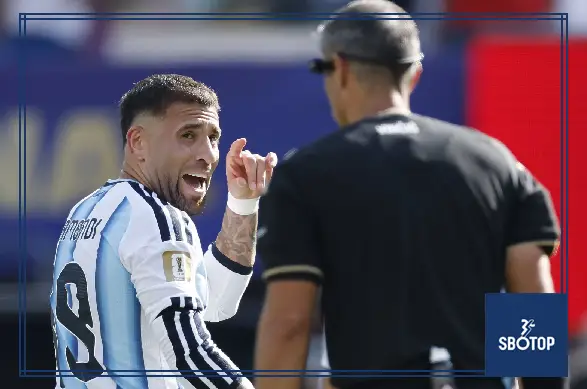
Nicolás Otamendi’s World Cup ended not only with a painful defeat but with an angry confrontation involving a familiar face.
Moments after Spain secured a 1-0 extra-time victory over Argentina in the 2026 World Cup final, Otamendi approached Spanish captain Rodri during the disorder that followed the final whistle. The experienced Argentine defender accused Rodri and Aymeric Laporte of spending the days before the match complaining about referees and attempting to influence how the final would be officiated.
Footage of the exchange showed an emotional Otamendi confronting Rodri as players from both teams gathered on the pitch. He reportedly told his former Manchester City teammate that he and Laporte had been “crying all week” about refereeing and insisted that their behaviour had not been right. Rodri appeared surprised by the accusation, while Spain forward Mikel Oyarzabal stepped between the pair to prevent the disagreement from escalating.
Otamendi’s frustration centred on pre-match comments from Spain’s camp about Argentina’s physical style. Laporte had publicly urged the referee to remain strong and argued that Argentina had sometimes escaped punishment for aggressive challenges earlier in the tournament. Rodri had also emphasised the importance of Spain maintaining discipline and refusing to react to provocation.
However, accusing opponents of creating pressure around a referee is very different from proving that the referee was improperly influenced.
No publicly available evidence has established that Rodri privately contacted officials, interfered with the appointment process or received favourable treatment through anything other than normal pre-match media coverage. Otamendi’s allegation emerged during an emotionally charged confrontation immediately after Argentina had lost the World Cup.
It therefore revealed far more about the bitterness surrounding the final than it did about any confirmed refereeing conspiracy.
Otamendi Confronts Spain’s Captain
The confrontation occurred during a chaotic conclusion to the tournament. Spain’s players had begun celebrating their second World Cup title when arguments broke out across the pitch. Several players became involved in pushing and shouting, with Argentina midfielder Leandro Paredes receiving a red card after the final whistle.
Amid that disorder, Otamendi moved toward Rodri and delivered his accusation directly.
The exchange carried additional significance because the two players knew one another from Manchester City. Rodri joined the English club in 2019, while Otamendi remained there until 2020, meaning they shared the dressing room during the 2019–20 season. Official Manchester City records show both players appearing together in the squad and starting the same matches during that campaign.
That previous relationship may explain why Otamendi spoke so directly.
He was not confronting a stranger or relying on comments delivered through the media. He appeared to believe that he could challenge Rodri personally and demand an explanation.
Rodri’s reaction suggested that he had not expected the accusation. The Spanish midfielder did not appear to answer with similar aggression, and Oyarzabal’s intervention helped bring the exchange to an end.
Nevertheless, the argument quickly became one of the most discussed moments after the final.
The Pre-Match Comments Behind the Anger
Otamendi’s complaint was linked primarily to remarks made by Laporte before the match.
The Spain defender had discussed Argentina’s reputation for physical football and argued that the referee needed to maintain control. He reportedly referred to challenges that had gone unpunished in previous rounds and suggested that Argentina sometimes pushed the limits of acceptable aggression.
Statistics published before the final also showed Argentina had committed significantly more fouls than Spain during the tournament. Laporte used that contrast to support his argument that the officials had an important responsibility to prevent the final from becoming uncontrolled.
Those comments were provocative, but they were not unprecedented.
Players and coaches regularly use pre-match press conferences to draw attention to an opponent’s tendencies. A manager facing a physically dominant striker may discuss shirt-pulling. A team playing against fast wingers may warn referees about tactical fouls. Others highlight time-wasting, simulation or aggressive behaviour around officials.
Such remarks can serve several purposes.
They may prepare the public for the tactical battle ahead. They can protect players by encouraging the referee to watch specific incidents. They can also create subtle psychological pressure by placing one interpretation of the match in the official’s mind before kickoff.
Otamendi clearly believed Spain had crossed the line from legitimate concern into deliberate influence.
Rodri’s Role Was Less Direct
Although Otamendi mentioned both Rodri and Laporte, the strongest public criticism of Argentina’s style had come from Laporte.
Rodri’s pre-final message focused largely on Spain’s own discipline. He warned teammates against responding emotionally to potential provocation and stressed that they needed to remain composed.
That advice proved relevant.
Argentina attempted to make the final physically demanding, while Spain tried to control it through possession. Rodri’s responsibility as captain was to ensure his players remained focused on their tactical plan rather than being dragged into constant confrontations.
It is possible Otamendi viewed Rodri’s comments as part of a coordinated Spanish narrative. From the Argentine perspective, repeated discussion about aggression may have created an atmosphere in which every physical challenge by Lionel Scaloni’s team was examined more severely.
Yet there remains no clear evidence that Rodri made an improper approach to the referee.
Speaking publicly about discipline is not the same as privately pressuring an official. Without proof of direct interference, Otamendi’s accusation must be treated as an emotional claim rather than an established fact.
Fernández’s Red Card Fuelled Argentina’s Anger
The most important refereeing decision came near the end of regulation time.
Enzo Fernández, who had already been booked, received a second yellow card after a late challenge on Spain defender Pau Cubarsí. The dismissal reduced Argentina to 10 players before extra time.
Reports described the challenge as reckless, with Cubarsí sent into the air by the contact. The referee produced the second yellow immediately, and Argentina were forced to complete the final with a numerical disadvantage.
For Argentina’s players, that decision may have appeared connected to Spain’s pre-match warnings.
Laporte had asked for strong officiating. Rodri had discussed the need to avoid provocation. Argentina’s aggressive reputation had become a major talking point.
When Fernández was dismissed, the defeated finalists may have felt the referee had entered the game already prepared to punish them.
But the context does not automatically make the decision incorrect.
Fernández was already on a yellow card and committed a forceful late challenge. Even without Spain’s pre-match comments, the incident carried a clear disciplinary risk. The referee’s decision may be debated, but it cannot reasonably be treated as proof that Rodri controlled the officiating.
Spain Had Been the Better Team Before the Dismissal
Argentina’s frustration also needs to be separated from the overall pattern of the final.
Spain did not win solely because Fernández was sent off.
Luis de la Fuente’s team had controlled possession and created nearly all the meaningful opportunities before Argentina were reduced to 10 players. Ferran Torres eventually scored in the 106th minute, but Spain had spent the majority of the contest applying pressure and preventing Argentina from developing sustained attacks.
Argentina goalkeeper Emiliano Martínez produced repeated saves to keep the match scoreless. Lionel Messi struggled to receive the ball in dangerous positions, while Spain’s midfield limited Argentina’s ability to counterattack.
The red card made an already difficult task more severe, but it did not transform a dominant Argentina performance into defeat.
Spain had been closer to scoring throughout the match. Their victory reflected sustained territorial and technical superiority, not one refereeing decision alone.
This is important when assessing Otamendi’s allegation.
Even those who believe Spain’s players attempted to shape the referee’s thinking must acknowledge that La Roja created the stronger footballing case for victory.
Rodri Controlled the Central Battle
Rodri’s influence extended far beyond any pre-match comments.
The Spain captain dictated the rhythm of the final, repeatedly offering himself during buildup and helping his team recover possession when Argentina attempted to break forward.
He had already been one of the tournament’s outstanding performers before the final. After Spain lifted the trophy, FIFA named him the Golden Ball winner as the best player of the 2026 World Cup.
That recognition made Otamendi’s confrontation even more symbolic.
Argentina’s veteran defender was accusing the tournament’s best player of achieving an unfair psychological advantage. Rodri, meanwhile, had just completed a performance that demonstrated why Spain did not need outside assistance.
He controlled space, selected the tempo and gave Spain stability even as the match remained goalless. When frustration could have encouraged La Roja to abandon their structure, Rodri helped them continue playing patiently.
Otamendi’s accusation focused attention on what Rodri said before the final.
The match itself was decided more clearly by what Rodri did during it.
Former Teammates on Opposite Sides
The disagreement also illustrated how international football can temporarily transform club relationships.
Rodri and Otamendi had once worked toward the same objectives under Pep Guardiola. They trained together, shared tactical meetings and represented Manchester City during the same season.
In the World Cup final, those connections became irrelevant.
Rodri captained a Spanish team attempting to reclaim the trophy after 16 years. Otamendi was trying to help Argentina retain the title and extend the most successful period of the national team’s modern history.
Their shared past did not soften the stakes.
If anything, familiarity may have made Otamendi’s accusation more personal. He may have expected greater understanding from a former teammate. He may also have believed Rodri would recognise the difference between genuine concern and an attempt to influence officials.
Rodri, from the Spanish perspective, had no obligation to protect Argentina from scrutiny. His responsibility was to Spain.
That conflict of loyalties turned a professional disagreement into an emotionally charged confrontation.
Argentina’s Frustration Spilled Beyond Otamendi
Otamendi’s argument was only one part of a much larger post-match breakdown.
The final whistle was followed by several confrontations involving players and staff. Reports described Paredes becoming physically involved with Eric García and Gavi, while other Argentine players also exchanged angry words with Spain’s squad.
The scenes damaged Argentina’s image at the end of an otherwise impressive tournament.
Scaloni’s team had reached a second consecutive World Cup final and come close to becoming the first country since Brazil in 1962 to retain the men’s title. Their defensive commitment kept them level against Spain for more than 100 minutes.
Those achievements deserved respect.
However, the inability of several players to accept defeat calmly shifted attention toward accusations, physical confrontations and disciplinary questions.
Otamendi’s comments fit within that emotional atmosphere. He was not speaking during a scheduled interview after reviewing the match calmly. He was confronting an opponent on the pitch while tempers were still high.
That context does not make his concerns meaningless, but it does affect how seriously the accusation should be interpreted.
Did Spain Engage in Gamesmanship
It would be naive to pretend Spain’s pre-match comments had no strategic purpose.
Elite teams understand the importance of controlling the narrative around major matches. Drawing attention to Argentina’s aggression may have encouraged the referee to watch physical challenges more closely.
That is a form of gamesmanship.
However, gamesmanship exists throughout elite football. Argentina are themselves highly experienced at appealing for decisions, influencing match tempo and creating emotional pressure around officials.
The difference between intelligent preparation and unacceptable manipulation depends on the methods used.
Publicly discussing an opponent’s foul record remains within football’s normal media environment. Secret communication with a referee, intimidation or institutional interference would represent something much more serious.
Otamendi accused Rodri of “crying” to referees, but no evidence has established that Spain’s captain engaged in prohibited contact.
The available information supports the conclusion that Spain attempted to frame the final around discipline.
It does not prove that the match officials were corrupted or controlled.
The Referee Still Had to Judge Each Incident
Referees at major tournaments are expected to prepare thoroughly.
They study the teams, review player tendencies and receive information about tactical patterns. They would already have known Argentina’s foul numbers and the emotional intensity of their previous matches without needing Spain’s players to explain them.
Laporte’s comments may have increased public attention, but the officials were not entering the final without independent preparation.
The Fernández challenge still had to be judged in real time.
The referee decided that it deserved a second yellow card. Video review did not overturn the outcome, and Argentina continued with 10 men.
Disagreement over that decision is legitimate. Claiming it was caused by Rodri requires evidence that has not been presented.
Otamendi’s accusation therefore risks turning disappointment into an allegation that cannot be substantiated.
Also Read:
- SBOTOP: Lionel Messi Faces Fierce Backlash Over ‘Embarrassing’ Bid to Get Marc Cucurella Sent Off in World Cup Final
- SBOTOP: Toni Kroos Hails Spain’s World Cup Triumph as a Victory for Football While Criticising Argentina
- SBOTOP: Rodri Crowned World Cup’s Best Player Ahead of Messi as Spain Dominate Post-Final Honours