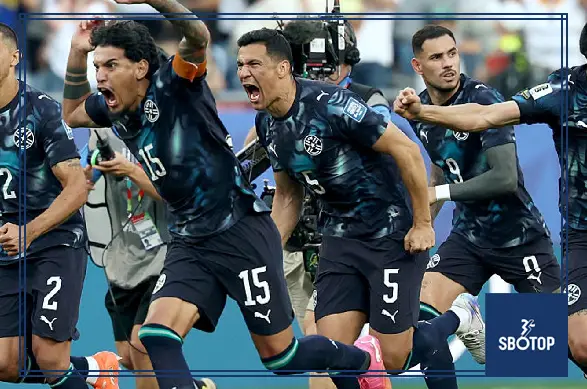
Germany entered the World Cup knockout stage carrying history, expectation, and the weight of four stars on their shirt. Paraguay entered with belief, structure, and the freedom of an underdog with nothing to lose. By the end of a tense, exhausting night in Foxborough, it was Paraguay celebrating one of the greatest results in their football history, while Germany were left staring at another devastating World Cup failure.
The match finished 1-1 after 120 minutes before Paraguay won 4-3 on penalties, eliminating the four-time world champions in the round of 32. Reuters described the result as one of the biggest upsets in World Cup history, with Jose Canale scoring the decisive penalty after Germany had missed three spot-kicks.
For Germany, this was more than a defeat. It was a collapse of identity. This is a nation long associated with tournament control, mental steel, and penalty shootout mastery. Yet against Paraguay, those familiar German qualities disappeared at the worst possible time. The team controlled large spells, created pressure, and still could not finish the job.
For Paraguay, it was a night of courage and discipline. They suffered, defended, waited, and then showed extraordinary nerve when the game reached its most brutal stage. Their reward was a place in the last 16 and a meeting with France, who had beaten Sweden to progress.
Paraguay Refused to Fear the Badge
Germany’s name alone usually creates pressure for opponents. Paraguay refused to let the badge win the match before a ball was kicked. They understood that Germany would dominate possession and push numbers forward, but they also trusted their defensive shape and their ability to hurt the favorites at decisive moments.
That belief became clear when Julio Enciso headed Paraguay in front before half-time. Sky Sports reported that Enciso opened the scoring in the 42nd minute, giving the South American side a shock lead and forcing Germany into a chase they never fully controlled.
The goal changed the emotional temperature of the match. Suddenly, Germany were not just trying to break down an organized opponent; they were fighting against time, nerves, and the possibility of humiliation. Paraguay, meanwhile, had proof that their plan was working.
The most impressive part of Paraguay’s performance was not just the goal. It was their refusal to panic after it. They did not treat the lead as a gift to protect desperately. They treated it as a platform. They kept making Germany uncomfortable, challenged duels, slowed the rhythm when needed, and forced Julian Nagelsmann’s side to search for solutions.
Havertz Restores Hope but Not Control
Germany eventually found their equalizer through Kai Havertz. Sky Sports recorded Havertz’s goal in the 54th minute, bringing Germany level and seemingly restoring order for a team expected to overpower Paraguay after the break.
Yet the equalizer did not bring true control. Germany had the ball, territory, and pressure, but they lacked the cold final action. Their attacks often carried urgency without clarity. Crosses went in, runs were made, and Paraguay’s box became crowded, but the decisive finish did not arrive.
That was the central frustration of Germany’s night. They were never completely absent from the game. They were not outplayed in the traditional sense. Instead, they were gradually dragged into a battle Paraguay preferred: tight, emotional, physical, and increasingly defined by moments rather than dominance.
The longer the match went on, the more Paraguay could sense that Germany’s confidence was not as deep as their reputation. The underdogs did not need to be perfect. They needed to remain alive long enough for pressure to become Germany’s enemy.
The VAR Moment That Deepened Germany’s Pain
Germany thought they had found the breakthrough in extra time when Jonathan Tah headed the ball into the net. In another version of the night, that goal becomes the rescue act, the moment Germany escape danger and turn a poor performance into a hard-fought win. Instead, VAR intervened.
Reuters reported that Tah’s header in extra time was disallowed, adding another layer of frustration to Germany’s bitter exit. Sky Sports also highlighted the incident as a major turning point, noting that Tah’s header was ruled out before Germany later fell apart in the shootout.
For Germany, the decision became part of the emotional story. But it could not be the full explanation. Joshua Kimmich’s post-match reaction was telling: he argued that Germany should not reduce the result to the referee or the shootout, because a team of Germany’s quality should be able to beat Paraguay over 120 minutes. Reuters reported that Kimmich accepted elimination as deserved if Germany could not win the match before penalties.
That honesty cut deeper than any excuse. It suggested that Germany’s problem was not merely one decision or one unlucky moment. It was the failure to turn superiority into victory.
Penalties Destroy a German Myth
For decades, World Cup penalty shootouts seemed almost designed for Germany. Other nations feared them. Germany mastered them. The walk from halfway, the calm face, the clean strike—those images became part of football folklore.
That aura shattered against Paraguay.
Germany missed through Havertz, Nick Woltemade, and Tah. Paraguay also had misses, but Canale kept his nerve when it mattered most and sent his country into celebration. Reuters reported that this was Germany’s first-ever World Cup penalty shootout defeat.
That detail matters. It is not just trivia. It is symbolism. Germany did not simply lose a match; they lost in a way that directly attacked one of their proudest football identities. The team once famous for composure became the team that could not finish from the spot.
The shootout was ruthless. Every penalty carried the burden of a nation. Every miss added pressure to the next taker. Paraguay’s players looked like men embracing the moment. Germany looked like a team trying to survive it.
Orlando Gill Becomes a National Hero
Paraguay’s victory needed a hero, and goalkeeper Orlando Gill stepped into that role. He made two key saves in the shootout, giving Paraguay the platform for Canale to deliver the decisive strike. ESPN’s match summary credited Gill’s saves and Canale’s sudden-death penalty as the defining actions in Paraguay’s 4-3 shootout victory.
Gill’s story became even more powerful in the days after the match. Reuters later reported that he had endured difficult personal circumstances earlier in his life, including selling a youth national team jersey and sports gear to support his family during financial hardship. His rise from struggle to World Cup hero added human depth to Paraguay’s achievement.
In football, goalkeepers can spend long stretches as background figures before suddenly deciding a nation’s fate. Gill did exactly that. Germany had more possession and more global stars, but when the match narrowed to one goalkeeper against one shooter, Paraguay had the man with the sharper edge.
His performance also showed how penalty shootouts have changed. Goalkeepers no longer just guess. They study, delay, read, distract, and use data. Gill looked prepared, and preparation became power.
Paraguay’s Discipline Beat Germany’s Reputation
Paraguay did not need to dominate the statistics to dominate the emotional core of the match. Germany had the stronger pedigree, but Paraguay had the clearer survival instinct. They understood who they were. They played within their limits, but they played those limits brilliantly.
Reuters quoted Paraguay captain Gustavo Gomez describing deep pride in his team and emphasizing that Paraguay had to be fully themselves in order to survive the challenge. That idea defined the match. Paraguay did not try to become Germany. They became the most resilient version of Paraguay.
Their defensive work was not passive. It was committed, aggressive, and emotionally intelligent. They forced Germany into uncomfortable areas, made central spaces hard to access, and dragged the match into a contest of patience. When the game reached penalties, they had already succeeded in making Germany suffer.
That is often the blueprint for historic upsets. The favorite is forced to play longer than expected, doubt enters the stadium, and every missed chance begins to feel like a warning. Paraguay held their nerve while Germany lost theirs.
Germany’s Tournament Crisis Gets Worse
This exit continued a disturbing pattern for Germany. Reuters noted that the defeat followed consecutive World Cup failures in 2018 and 2022, when Germany also fell well short of expectations. A separate Reuters report later stated that Nagelsmann was set to step down after talks with German football officials, and described the Paraguay defeat as Germany’s third successive World Cup flop.
That wider context makes the loss even more damaging. A single shock can be dismissed as tournament cruelty. Three World Cup disappointments in a row point to something deeper.
Germany still produce excellent players. They still have elite clubs, strong infrastructure, and a football culture built on ambition. But the national team no longer carries the same inevitability. Opponents no longer appear beaten by history. Paraguay proved that.
The post-2014 decline has become impossible to ignore. The world champions of Brazil once seemed like a model of planning, identity, and collective intelligence. This version of Germany looks talented but uncertain, dangerous but vulnerable, respected but no longer feared.
Also Read: