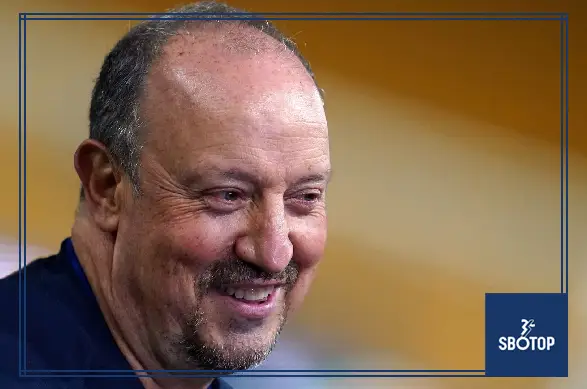
Rafa Benitez has opened the door to a possible move into international management after refusing to rule himself out of contention for the vacant Scotland job.
The former Liverpool, Real Madrid and Chelsea manager is available following the conclusion of his spell with Panathinaikos. When asked directly whether he would consider succeeding Steve Clarke at Hampden Park, Benitez confirmed that international football appealed to him and said he remained open to opportunities involving countries capable of achieving meaningful objectives.
His response stopped well short of announcing a formal application. However, it was sufficiently positive to ensure that the experienced Spaniard will feature prominently in discussions surrounding Scotland’s first managerial appointment in seven years.
Benitez told Sky Sports News that national-team football represented a different type of challenge from club management. He highlighted the motivation players receive from representing their country and suggested that working with a smaller, highly committed group could be attractive after managing large club squads.
Asked specifically about Scotland, he replied: “I’m open to all the good countries, yes.”
That brief statement has transformed him from a speculative name into a realistic figure for the Scottish Football Association to consider. Whether the interest develops into formal negotiations will depend on the organisation’s preferred profile, available budget and vision for the national team’s next cycle.
Scotland Begin a Major Transition
The vacancy was created when Steve Clarke stepped down on June 27 following Scotland’s elimination from the 2026 World Cup.
Scotland returned to the competition after a 28-year absence but failed to progress from Group C. They began with a victory over Haiti before losing to Morocco and Brazil, leaving them third in the section and outside the eight best third-placed teams that advanced to the expanded knockout stage.
Clarke’s resignation came only weeks after he had agreed a new four-year contract, making his decision particularly unexpected.
He had been in charge since 2019 and became the most successful Scotland manager of the modern era. Under his leadership, the national team qualified for consecutive European Championships before finally returning to the World Cup.
The Scottish FA praised the progress achieved during his seven-year tenure, noting that Scotland had risen from a fourth-seeded qualifying team to a side capable of topping a World Cup qualification group. Clarke described managing the players as an honour and wished his eventual successor well.
Replacing him will therefore require more than selecting a coach capable of organising the team for the next international window.
Scotland must identify someone who can protect the progress made under Clarke while introducing new ideas, developing younger players and preparing for Euro 2028, which will be hosted across the United Kingdom and Ireland.
Benitez Is Attracted by International Football
Rafa Benitez’s comments suggest he has begun thinking seriously about the differences between club and international management.
At club level, coaches work with players every day. They can develop detailed systems, correct tactical problems during regular training sessions and influence recruitment through transfer-market decisions.
International management offers none of those advantages.
A national coach must work within limited preparation periods, select from the players available and create a system simple enough to implement quickly. Injuries can remove key figures without giving the manager an opportunity to purchase replacements.
Benitez nevertheless sees benefits in that environment.
He explained that national-team players generally arrive fully motivated because representing their country carries a special emotional significance. He contrasted that with managing a club squad containing more than 30 players, where maintaining the enthusiasm of those receiving limited playing time can become difficult.
This perspective is important because Benitez has spent his entire senior managerial career in club football.
The Scotland position would require him to change his working methods. He would move from the daily rhythm of training and domestic competition to shorter, more intense international windows.
His tactical preparation, opposition analysis and tournament experience could transfer naturally. The greater question is whether he would enjoy the long periods between fixtures and the reduced control that comes with managing a national team.
His public remarks indicate that he is at least willing to consider that adjustment.
A Manager with Major European Experience
Benitez would bring a managerial reputation few recent Scotland candidates could match.
He won two La Liga titles and the UEFA Cup with Valencia before joining Liverpool in 2004. During his first season at Anfield, he guided the club to the Champions League title after the famous final comeback against AC Milan in Istanbul.
He later won the FA Cup and UEFA Super Cup with Liverpool, the Europa League with Chelsea, the Coppa Italia with Napoli and the Club World Cup during his time with Inter Milan. He also led Newcastle United back to the Premier League by winning the Championship.
His career has included spells at Real Madrid, Everton, Celta Vigo and, most recently, Panathinaikos.
The Greek club officially ended its cooperation with Benitez in May 2026, thanking him and his coaching staff for their professionalism. His departure means the 66-year-old can speak to interested teams or national associations without compensation negotiations involving another employer.
That availability makes him administratively attractive to the Scottish FA.
There would be no need to convince a club to release him. The challenge would instead be reaching an agreement over salary, staff, authority and expectations.
Benitez’s name would also give the appointment immediate international visibility. His background at Liverpool and Newcastle means he is already familiar to Scottish supporters and to many of the players operating in British football.
Why Scotland Could Appeal to Benitez
Scotland may not possess the resources or player depth of the world’s leading national teams, but the position offers several attractions.
The squad contains experienced Premier League footballers alongside younger prospects who could become central figures over the next four-year cycle. The team also has an established competitive identity created during Clarke’s tenure.
A new manager would not be starting from nothing.
Clarke rebuilt confidence, restored Scotland to major tournaments and created a strong connection between the squad and its travelling support. His successor would inherit a group that understands the demands of qualification and has experienced major international competitions.
Benitez’s preference appears to be an opportunity where achievement is possible rather than a prestigious role without realistic objectives. He said he would consider a country that could offer the possibility to accomplish something meaningful.
Scotland can make that case.
Reaching Euro 2028 should be a central objective, while returning to the World Cup in 2030 would represent another significant achievement. The Nations League also gives the next coach an immediate competitive platform.
The role would allow Benitez to pursue clearly defined goals without dealing with transfer windows, club ownership disputes or weekly domestic pressure.
After a long career in club management, that change may be increasingly attractive.
His Tactical Profile Could Suit Scotland
Benitez has traditionally been associated with structured, disciplined teams.
His strongest sides have generally been difficult to break down, tactically prepared and comfortable changing their approach according to the opposition. He has often prioritised compact distances between units, clear defensive responsibilities and carefully planned transitions.
Those principles could suit Scotland.
The national team is unlikely to dominate possession against the strongest European nations. Its success will continue to depend on organisation, collective effort and the efficient use of limited attacking opportunities.
Benitez would not need to transform Scotland into a possession-heavy side built around constant territorial control. He could instead refine the existing defensive foundation while improving how the team progresses the ball and attacks after recoveries.
His experience in European knockout football may also be valuable.
International tournaments frequently produce matches decided by small tactical details. Set pieces, substitutions, defensive positioning and game management become especially important when teams have little time to establish rhythm.
Benitez has spent much of his career preparing for those situations.
However, the Scottish FA must decide whether his approach represents evolution or excessive continuity. One criticism directed at Clarke was that Scotland could appear too cautious and predictable against opponents they were expected to challenge more aggressively.
The next manager may be asked to preserve defensive discipline while creating a more flexible and ambitious attacking identity.
The Squad Requires Gradual Renewal
Whoever succeeds Clarke will inherit an experienced group, but several important players are approaching the later stages of their international careers.
Captain Andy Robertson remains central to the team and was closing in on Kenny Dalglish’s national appearance record. Other established figures, including John McGinn, Ryan Christie, Grant Hanley, Kenny McLean and Craig Gordon, have provided much of Scotland’s leadership during the Clarke era.
Some will remain important in the short term, but the next coach must begin preparing younger players for greater responsibility.
Sky Sports identified Ben Gannon-Doak, Lennon Miller, Findlay Curtis, Tyler Fletcher, James Wilson and Luke Graham among those who could form part of Scotland’s future. The goalkeeping position will also require long-term planning as the established options grow older.
This transition would test Benitez in a different way.
He would need to balance immediate results with gradual squad development. Removing too many senior players could weaken leadership and stability, but delaying change could leave Scotland unprepared for future qualification campaigns.
Benitez’s reputation has largely been built around organising senior professionals rather than overseeing a national youth transition.
That does not mean he could not manage the process. His experience across several leagues has exposed him to different football cultures, squad structures and levels of expectation.
The Scottish FA would nevertheless need to understand his development plan before making an appointment.
Financial Questions Could Become Decisive
Benitez’s experience will inevitably influence his financial expectations.
The Scotland role cannot compete economically with the wealthiest clubs or national associations. The Scottish FA must therefore establish whether Benitez’s interest is strong enough for him to accept a package consistent with its resources.
This does not necessarily make an agreement impossible.
International management can appeal to experienced coaches for reasons beyond salary. It offers a different lifestyle, fewer matches, freedom from transfer-market politics and the chance to lead a country at a major tournament.
Benitez may also value the opportunity to work again within British football, where he retains strong professional and personal connections from his time at Liverpool, Chelsea, Newcastle and Everton.
Yet the financial discussion cannot be ignored.
A high-profile coach may request a substantial salary, a large technical staff and significant control over football operations. Each demand would increase the total cost of the appointment.
The Scottish FA must decide whether investing heavily in a famous manager would produce greater value than appointing a less expensive coach and directing additional resources toward player development, analysis and support structures.
The answer should depend on the quality of Benitez’s proposal rather than the size of his reputation.
Also Read: