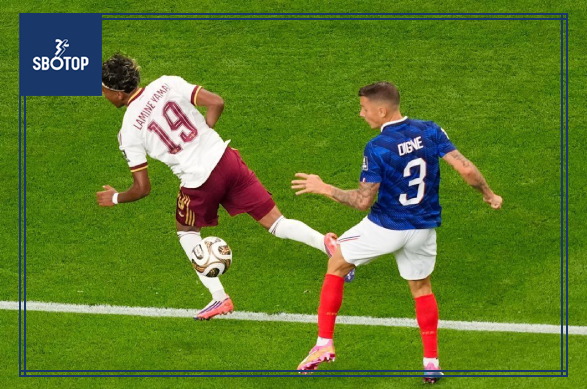
Lamine Yamal became the center of attention during the 2026 FIFA World Cup semifinal between Spain and France at AT&T Stadium, Arlington. A controversial incident involving the Barcelona winger sparked heated debate after Spain was awarded a first-half penalty.
Spain eventually secured a place in the World Cup final after defeating France 2-0. Mikel Oyarzabal opened the scoring from the penalty spot in the 22nd minute, while Pedro Porro added a second goal in the 58th minute to seal a historic victory for La Roja.
The result sent Spain through to the final, where they will face the winner of the other semifinal between England and Argentina. Meanwhile, France will have to settle for a third-place playoff.
However, much of the post-match discussion focused on the penalty decision that gave Spain the lead.
Lamine Yamal Penalty Incident Sparks Debate
The controversy occurred when France defender Lucas Digne attempted to clear the ball inside the penalty area but made contact with Lamine Yamal’s leg.
French players immediately protested the referee’s decision, arguing that the ball had struck Yamal’s arm before the contact occurred. They believed the incident should have been reviewed and the penalty decision overturned.
Despite the protests, the referee remained firm and awarded Spain a penalty after judging that Digne had committed a foul on the teenage winger.
The incident was then checked by the Video Assistant Referee (VAR), but the review did not recommend changing the original decision.
Mikel Oyarzabal stepped up confidently and converted the penalty past Mike Maignan, giving Spain a crucial 1-0 advantage in the semifinal.
Why Was Spain’s Penalty Allowed to Stand?
The decision quickly became a major talking point among fans and football analysts. Many questioned why VAR did not intervene and cancel the penalty.
During ITV’s match coverage, former referee analyst Christina Unkel explained why the decision was considered correct according to the laws of the game.
According to Unkel, the ball did not strike an illegal part of Yamal’s arm. Instead, the contact occurred around the upper arm and shoulder area, which is not considered handball under current football regulations.
“The analysis is correct. The contact happened on Yamal’s upper arm, around the sleeve area, which is not considered part of the hand,” Unkel explained.
She added that the situation did not meet the criteria for a handball offense, meaning VAR had no reason to overturn the referee’s original decision.
Unkel also highlighted that Lucas Digne still had the ability to avoid making contact with Yamal despite committing to the challenge.
“This is not something that would be reviewed as a handball offense, so the penalty decision remains valid. Similar to situations involving players like Harry Kane, defenders commit themselves to a challenge but still have the option to avoid making contact,” she added.
VAR Review Confirms Referee’s Decision
Under VAR protocols, officials can only overturn a referee’s decision if there is a clear and obvious error. Since the incident was judged to involve a legitimate foul and no clear violation occurred beforehand, the on-field decision remained unchanged.
The technology was used to review the situation, but after examining the footage, VAR officials determined that the referee’s call was within the laws of the game.
As a result, Oyarzabal’s penalty stood, becoming the turning point in Spain’s victory over France.
Penalty Goal Changed the Direction of the Match
The opening goal from Mikel Oyarzabal gave Spain greater control over the semifinal. After taking the lead, La Roja displayed excellent defensive organization and prevented France from creating clear scoring opportunities.
Despite having several talented attacking players, France struggled to break down Spain’s disciplined defensive structure.
Spain then doubled their advantage in the 58th minute when Pedro Porro finished a quick combination play with Dani Olmo, leaving France with a difficult task to recover.
The score remained 2-0 until the final whistle, confirming Spain’s place in the 2026 FIFA World Cup final.
Spain Move One Step Closer to World Cup Glory
Although the penalty decision involving Lamine Yamal will continue to generate debate, VAR officials confirmed that the referee’s decision was consistent with the rules.
The controversial moment ultimately became a key turning point in a match where Spain demonstrated their quality, composure, and tactical discipline.
With a place in the World Cup final secured, Spain now stand just one victory away from lifting the trophy. Their ability to overcome France, one of the strongest teams in international football, has strengthened their reputation as one of the favorites to become world champions in 2026.
ALSO READ :