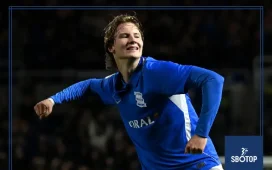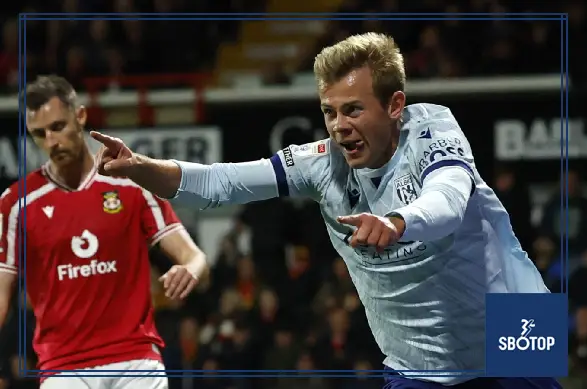
Aune Heggebo delivered the decisive finish as West Bromwich Albion overturned a second-half deficit to defeat Wrexham 2-1 at the Racecourse Ground.
Kieffer Moore’s spectacular opener had placed the hosts in a promising position, but Isaac Price equalised in the 79th minute before supplying Heggebo for the winner five minutes later. The substitute’s intervention completed a turnaround that transformed the closing stages of an otherwise closely contested Championship encounter.
For West Brom, the victory on Tuesday, 13 October 2026, provided a welcome response to consecutive defeats against Midlands rivals. For Wrexham, it brought the frustration of seeing a lead disappear shortly before full-time, leaving Phil Parkinson’s side to examine how a potentially valuable home result slipped away.
A Quiet Opening Keeps the Contest Balanced
The first half offered limited sustained attacking rhythm, with neither side consistently turning possession into clear opportunities. Wrexham registered an early attempt through George Dobson, whose effort was gathered by Max O’Leary. The midfielder was making his 400th career appearance, but the opening did not develop into a prolonged spell of home pressure.
West Brom also struggled to translate their passing into decisive penetration. They moved the ball without finding the final action required to unsettle Wrexham regularly.
That balance made the opening period more measured than the dramatic finish might suggest. Neither team had established an advantage, and both remained dependent on individual moments or well-executed deliveries to create danger.
The eventual outcome would be decided by improvements made after the interval rather than any commanding first-half lead.
Moore Gives Wrexham a Clear Attacking Target
Wrexham’s most recognisable first-half threat came through Moore, particularly when deliveries reached him around the penalty area.
His presence gave the hosts a target from corners and free kicks. Even when those situations did not produce a goal, they required West Brom to defend carefully and remain alert to the next touch.
Moore went close before the interval, with O’Leary making an important intervention to preserve the goalless score.
The striker’s influence illustrated why aerial ability remains valuable even in matches dominated by discussion of passing patterns. A well-directed delivery can create an immediate opportunity without requiring a long sequence of possession.
For West Brom, limiting those situations was one task. Dealing with them effectively when they occurred was another.
They reached half-time having managed both sufficiently to remain level.
West Brom Show More Intent After the Break
Albion’s attacking threat became more evident early in the second half.
Price had an opportunity that Anthony Patterson stopped, while George Campbell threatened from a corner. Those moments indicated that the visitors were beginning to add end product to their possession.
An improved attacking spell does not necessarily mean a team has taken complete control. It does, however, change the demands placed on the opposition.
Wrexham now needed to defend more direct threats while retaining enough quality in possession to prevent the game being played entirely towards their own goal.
The match remained goalless, leaving room for one successful action to change the balance.
That action came from Moore, whose finish supplied a breakthrough of a quality neither side had previously managed.
Moore Produces a Stunning Opener
Wrexham took the lead in the 64th minute when Moore collected possession outside the penalty area and struck powerfully into the top corner.
The finish gave O’Leary little opportunity to intervene and lifted the home side into a position from which victory appeared achievable.
It was an example of individual execution changing a match that had offered relatively few clear openings. Moore did not need a close-range chance to make the difference; he created the decisive outcome through the quality of his strike.
Yet the goal also changed Wrexham’s responsibilities.
They now had an advantage to protect, while West Brom had a clear reason to increase their attacking commitment. The remaining minutes would test the hosts’ ability to combine defensive discipline with enough attacking threat to relieve pressure.
Wrexham Must Adapt to Defending a Lead
Leading a match requires different judgments from playing at 0-0.
A team may need to protect central areas more carefully, decide when to press and retain possession long enough to prevent opponents from mounting repeated attacks.
Those are general tactical requirements rather than confirmed instructions issued by Parkinson during this match.
For Wrexham, the practical challenge was to avoid allowing the lead to become an invitation for uninterrupted West Brom pressure.
That does not mean the hosts should simply have attacked more. Committing additional players forward can create opportunities but also leave space behind them.
The important balance concerns support and decision-making. Whether defending deep or attempting to advance, players need to remain connected so that one unsuccessful action does not expose the next phase.
Morrison Turns to His Bench
James Morrison introduced Heggebo and Jimmy Morgan in the 76th minute, providing West Brom with fresh attacking options while they were still behind.
The timing left the replacements limited time to affect the contest. Nevertheless, both became involved in the recovery.
Substitutions are often assessed through the final result, but their value depends on what the incoming players actually contribute. Freshness alone does not guarantee improved attacking quality.
In this instance, the replacements added meaningful actions rather than merely increasing the number of forward players.
Heggebo’s eventual finish became the headline moment, while Morgan contributed to the move that brought Albion level.
Their involvement gave Morrison a tangible return for his changes and demonstrated the importance of players remaining prepared to influence a match from the bench.
Price Brings Albion Back Into the Match
West Brom equalised in the 79th minute through Price.
The midfielder found space at the far post and finished into the roof of the net after Albion kept the attack alive. The goal rewarded their persistence and removed Wrexham’s advantage.
It also changed the closing stages psychologically and tactically, although the players’ private reactions cannot be assumed.
The visible situation was clear enough: Wrexham no longer had a lead to protect, while West Brom had an opportunity to pursue more than a draw.
An equaliser can become a natural point at which a team settles for avoiding defeat. Albion instead produced another successful attack.
Price would again be central, moving from scorer to provider in the sequence that completed the turnaround.
Heggebo Finishes the Comeback
The winner arrived in the 84th minute.
Price delivered the ball into the penalty area, and Heggebo finished from close range to put West Brom ahead for the first time.
The action combined the quality of the delivery with the striker’s movement and execution. Finding a receiver is only part of a successful cross; the attacker must also reach the right position and complete the finish.
Heggebo did precisely that, turning his substitute appearance into the decisive contribution.
The score had changed from 1-0 to 1-2 within five minutes.
For Wrexham, the speed of the reversal left little time to recover their earlier position. For West Brom, it created a final task: defending the advantage they had worked to establish.
Wrexham’s Late Changes Cannot Restore Parity
Parkinson introduced additional attacking options as Wrexham searched for an equaliser of their own.
The need was understandable. Having led until the final quarter-hour, the hosts were suddenly facing defeat and required a direct response.
However, changing personnel does not guarantee that a clear opportunity will follow. The opposition can adjust its positioning, slow the development of attacks and contest deliveries with greater numbers.
Wrexham could not find the goal needed to restore parity before the final whistle.
That outcome did not erase Moore’s contribution or the periods when the home side competed effectively. It did establish that their performance lacked the final defensive security required to turn the opener into points.
The distinction would shape the post-match assessment.
Parkinson Identifies Errors in the Build-Up
Parkinson expressed disappointment at losing from a promising position and highlighted mistakes in the sequences leading to West Brom’s goals.
He also explained that earlier substitutions had been made to introduce freshness. That was his stated reasoning; the result alone does not prove those changes were inherently wrong.
A more useful review would examine how players defended each developing situation, including the opportunities to interrupt the move before the final pass or shot.
Parkinson’s wider response emphasised pulling together and preparing a stronger collective performance.
That approach avoided assigning the defeat entirely to one individual. Two late goals can involve several decisions, and improving the outcome requires understanding how those actions connected.
Wrexham’s challenge was to turn that review into more dependable game management.
Morrison Welcomes a Timely Response
Morrison acknowledged that pressure had increased after West Brom’s defeats against Wolves and Birmingham.
He praised the players’ response and credited the substitutes with helping change the match. The victory lifted Albion into the Championship’s top four immediately after the fixture.
That position provided encouragement, but it did not settle the direction of their season. A successful comeback is valuable evidence of resilience rather than a guarantee of consistent results.
Morrison’s side had still needed to recover after falling behind. Their next objective was to combine the attacking quality shown late on with a more complete performance.
At the Racecourse, however, the response was sufficient. Price supplied a goal and an assist, and Heggebo completed the opportunity that secured three points.
Five Minutes Decide the Evening
The match demonstrated how quickly a narrow lead can disappear when an opponent continues creating opportunities.
Moore supplied its outstanding individual strike, but West Brom completed the decisive collective response.
Their substitutes contributed, Price influenced both goals, and Heggebo supplied the winning finish. Wrexham were left with the harder task of explaining how a strong position became a home defeat.
Neither side’s season could be defined by one October evening. The immediate lesson was more specific: establishing an advantage and preserving it are separate challenges.
Wrexham achieved the first through Moore. West Brom ultimately completed both, taking the lead late and retaining it until the contest ended.