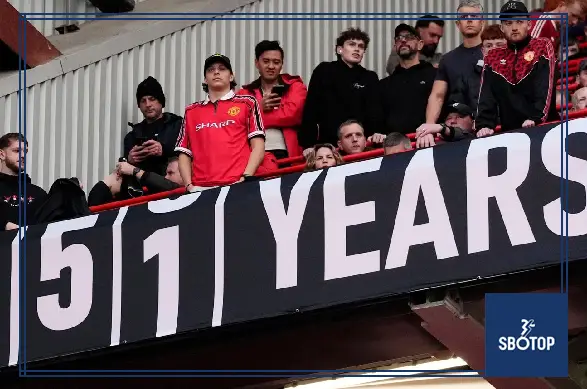
Manchester United supporters revived one of Old Trafford’s most recognisable displays before the match against Tottenham Hotspur on Saturday, 10 October 2026. The returning ticker banner aimed at Manchester City brought an old rivalry symbol into a new debate about financial rules, sporting achievement, and the unresolved consequences of a disciplinary ruling.
The original banner counted the years since City’s last major trophy. Its revived version referred back to their 1976 League Cup victory, effectively rejecting the legitimacy of the honours they have won since their ownership changed.
That message requires an important distinction. The display expressed supporters’ views; it did not announce an official decision to remove trophies. City had been found responsible for serious financial-rule breaches by an independent commission, but the club disputed the findings and appealed. The banner’s return was therefore a public response to a significant ruling within a process that remained unfinished.
A Familiar Symbol with a Different Purpose
The ticker first appeared in 2000, when it displayed 24 years since City’s 1976 League Cup success. Its number increased annually, turning a prolonged wait for major silverware into a recurring feature of the Manchester rivalry.
The joke depended on a simple and verifiable sporting sequence. City had not won another major trophy, and United supporters could update the counter as each season passed.
The revived display operated differently. City have won trophies since 1976, so the new banner was not a literal record of a continuing drought.
Instead, it offered a provocative argument about which achievements supporters were willing to recognise. That change gave the familiar design a new purpose: a counter once used to mock a lack of success became a statement challenging the standing of later success.
The Trophy That Ended the Original Count
City ended their long wait by beating Stoke City in the 2011 FA Cup final. That victory brought the original banner’s premise to an end.
Its removal mattered because the joke had always relied on the drought continuing. Once City won the cup, there was no longer a factual basis for increasing the number.
The return in 2026 deliberately revisited that history. It invited supporters to look past the trophies won in the intervening period and resume counting from 1976.
That was an act of rivalry and interpretation, rather than an alteration to the record books. Understanding the original banner’s ending helps explain the new display: its impact came from reviving something City’s success had previously made obsolete.
What the Revived Number Represented
Coverage of the returning banner described a counter showing 50 years and moving towards 51, while other reports referred to the display as reading 51 years. The central message was consistent: supporters were counting from City’s 1976 League Cup win.
Neither description should be mistaken for proof that City had officially lost their subsequent honours. The number formed part of the supporters’ taunt.
Its effectiveness as a visual message came from compression. A short phrase and a counter could communicate a broad rejection of City’s achievements without explaining every charge or procedural step.
That same simplicity also creates a risk of misunderstanding. A banner can express what supporters believe should happen, but it cannot establish what a commission or appeal board has decided.
The Ruling Behind the Renewed Hostility
The backdrop was the independent commission’s decision concerning Manchester City’s compliance with Premier League financial rules. The case addressed conduct across the period from the 2009/10 season to 2017/18, alongside issues concerning cooperation with the investigation.
The league announced that charges had been proved and that sanctions would be addressed separately. That distinction separates a finding about breaches from the punishment that follows.
Supporters may respond immediately to a ruling, but the formal process contains different stages. Establishing responsibility does not, by itself, answer every question about penalties or historical honours.
The banner turned the ruling into a forceful sporting message. A factual account must also preserve what remained unresolved, particularly the appeal and the separate question of sanctions.
City Dispute the Findings
Manchester City maintained their denial of wrongdoing and challenged the commission’s conclusions. In their public response, the club argued that the decision contained material errors and said they would pursue available appeal routes.
Those assertions represent City’s position. They should neither be presented as proof that the ruling will be overturned nor omitted from an account of an ongoing dispute.
An appeal also does not make the original findings disappear. It means the club is seeking to have them reviewed through the applicable process.
The accurate position therefore contains both elements: an independent commission had made findings against City, and City contested those findings. The outcome of that challenge could not be determined by supporters’ confidence, managerial assurances, or a stadium display.
A Banner Cannot Reassign a Championship
The strongest implication of the revived ticker was that City’s later achievements should not count. That is a supporter judgement with potentially far-reaching meaning.
However, stripping a title and awarding it to another club are distinct actions. Neither can be assumed simply because financial breaches have been established.
Any such consequence would require an official determination through the relevant process. The banner itself carried no authority to change competition outcomes.
This boundary is essential to reporting the incident accurately. United supporters were taking aim at their rivals and questioning the legitimacy of their success. They were not displaying a confirmed list of revoked honours or newly awarded championships. The emotional force of the protest and its procedural significance were different things.
Why Financial Rules Become Personal
Financial regulation can appear remote from matchday experience. It concerns information, accounts, compliance, and obligations that supporters do not see unfolding on the pitch.
Yet those matters can become deeply connected to how fans remember seasons. A title race is experienced through results, anticipation, disappointment, and celebration.
When a subsequent ruling raises questions about the conditions behind those competitions, supporters may revisit memories they once considered settled.
That explains the banner’s appeal as an expression of rivalry. It connected a complicated disciplinary dispute to a familiar sporting grievance. This is an interpretation of why the symbol resonated, not evidence that every United supporter shared the same view or wanted the same punishment.
The Importance of Keeping Different Periods Separate
The commission’s findings concerned a defined period. The banner’s message was broader, discounting City’s later success collectively.
Those are not equivalent positions. A ruling about conduct during particular seasons should not automatically be described as a determination about every trophy won afterwards.
Nor does the existence of a disputed period establish the precise effect on each individual match. Sporting outcomes involve many events, and formal consequences require specific decisions.
This difference is one reason the banner needs explanation. It was designed to make a sweeping point, whereas factual reporting must preserve dates and limits. The supporters’ argument can be described clearly without extending the commission’s findings beyond what was actually established.
Rivalry Gives the Message Its Reach
The display’s recognisable history helped it attract attention. Supporters familiar with the original ticker could understand the reference without a lengthy explanation.
Its return also reversed an earlier change in the rivalry. City’s 2011 FA Cup victory had ended the old taunt; the financial ruling gave United supporters a reason to revive it in altered form.
From a cultural perspective, that reuse shows how football symbols can acquire new meanings. A banner’s significance depends not only on its wording but also on the memories attached to it.
Still, familiarity does not make its claim official. The display’s reach came from history and rivalry, while any consequences for City had to come from the disciplinary process.
Sanctions Remain a Separate Question
The league’s statement explained that punishment would be considered in a further hearing. It also identified City’s right to appeal the commission’s findings.
That framework left important questions open. Supporters could demand severe consequences, but a demanded punishment was not an announced punishment.
Similarly, predictions about how quickly the case would end required caution. An intention to conclude proceedings promptly does not provide certainty about every remaining stage.
The confirmed position was narrower and more useful: findings had been issued, City had challenged them, and sanctions required further consideration. Reporting the banner alongside those facts avoids treating the strongest public reaction as the final outcome.
Public Reaction and Formal Resolution
The ticker’s return demonstrated that the case had become part of the atmosphere surrounding football matches beyond City’s own fixtures. United were hosting Tottenham, yet the display directed attention towards their Manchester rivals.
That visibility is significant without proving a particular effect on players, officials, or appeal proceedings. There is no basis to claim the banner influenced a formal decision.
Its role was communicative. Supporters used a familiar object to express rejection, mockery, and a view of City’s achievements.
The response also showed why precision matters. Public opinion can move quickly and speak categorically. A disciplinary process must address evidence, findings, challenges, and consequences separately. Both belong to the story, but they should not be merged.
An Old Counter in an Unfinished Story
The revived banner gave Manchester United supporters a striking way to respond to the ruling against City. It brought back an established rivalry symbol and adapted it to challenge the meaning of their neighbours’ success.
The verified event was the return of the display at Old Trafford. Its wider claim remained the supporters’ interpretation, rather than a confirmed removal of trophies.
City’s appeal and the unresolved sanction process meant the story was still developing. Neither certainty about vindication nor certainty about the harshest possible punishment was justified.
For now, the ticker represented a forceful public judgement from rival fans. The final sporting consequences belonged elsewhere: with the bodies responsible for completing the process and announcing decisions that could actually change the official record.
Also Read: