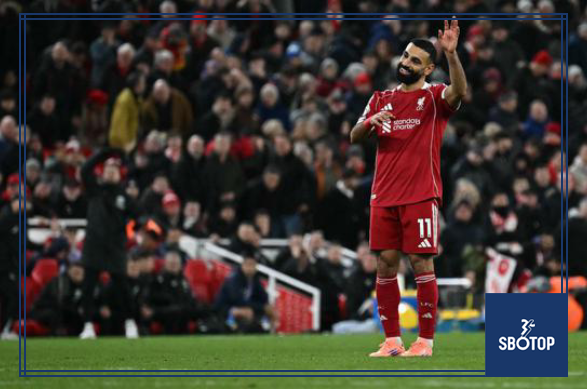
Mohamed Salah found himself at the center of intense scrutiny after a controversial post-match interview sparked debate about his role and future at Liverpool. The Egyptian forward later moved quickly to address the fallout, issuing an apology to his teammates in an effort to calm tensions inside the dressing room.
The incident came during a difficult spell for Salah, who had been left out of Liverpool’s starting lineup for three consecutive matches and made only one appearance as a substitute. Frustration appeared to boil over following a dramatic 3–3 draw against Leeds United at Elland Road, where Liverpool dropped valuable points despite leading twice.
Emotional Interview Sparks Debate
Speaking in the mixed zone after that match, Salah delivered unusually candid comments. He suggested that he felt “sacrificed” by the club and admitted that he no longer felt a strong “connection” with Liverpool head coach Arne Slot.
Those remarks immediately sent shockwaves through the football world. Questions were raised not only about Salah’s relationship with Slot, but also about his long-term future at Anfield. For a player who has been one of Liverpool’s defining figures of the modern era, the public nature of his frustration marked a rare and striking moment.
Pundits and supporters alike debated whether Salah’s comments reflected deeper issues behind the scenes or were simply the emotional reaction of a fiercely competitive player struggling with a reduced role.
Apology Behind Closed Doors
According to Curtis Jones, Salah’s words did have an impact internally. However, Jones revealed that the forward took responsibility and addressed the squad directly soon after.
“Mo is Mo, and he will say what he feels,” Jones told Sky Sports. “But he came to us and said, ‘If I affected anyone or made anyone uncomfortable, I’m sorry.’ That’s just who he is.”
Jones emphasized that Salah’s apology was sincere and well received, helping to defuse any lingering tension within the group.
“I can only speak from my experience of knowing Mo and how he treats us,” Jones continued. “He stayed positive. He was the same Mo, smiling, and everyone treated him exactly the same way.”
The midfielder suggested that Salah’s reaction was rooted in his relentless desire to win rather than any personal agenda.
“That’s probably part of his winning mentality,” Jones added. “And I don’t think he’ll be the last player like that.”
Frustration Born From Ambition
Jones also offered a broader perspective on emotional reactions within elite squads, arguing that visible frustration is often preferable to indifference.
“I understand there are ways to say things,” he explained. “But if you have a player who is happy sitting on the bench, doesn’t want to play, and doesn’t want to help the team, that’s a much bigger problem.”
In his view, moments of anger or disappointment—whether from Salah or other players—usually come from good intentions.
“Any frustration we’ve ever shown, including from me, has always come from a good place,” Jones said. “Sometimes the delivery isn’t right in the moment, but it’s never meant to hurt the team, the staff, the manager, or anyone else.”
He believes the squad has already moved on.
“That’s all in the past now. We’re back together as a team, playing well, and starting to win games again.”
Temporary Calm, Lingering Questions
On the pitch, Salah’s return to action in the recent match against Brighton & Hove Albion appeared to signal a cooling of the situation. His inclusion suggested that the coaching staff were willing to turn the page and refocus on results.
Yet, despite the apology and improved atmosphere, uncertainty surrounding Salah’s long-term future at Liverpool remains. The interview is widely seen as a moment that could influence how the club approaches its planning, particularly as Liverpool continue to evolve under Slot.
Reports linking Liverpool with Antoine Semenyo as a potential attacking target have added further intrigue. While there is no official indication that Salah is being pushed out, speculation persists that the club may already be considering life beyond their iconic No. 11.
Legacy and a Crossroads
Salah’s status at Liverpool is beyond question. Since arriving at Anfield, he has become one of the club’s greatest modern legends, delivering goals, trophies, and unforgettable moments. His professionalism and consistency have earned him enormous respect from teammates and supporters alike.
However, rebuilding trust after such a public episode is rarely straightforward. Even with apologies accepted, the road back to a completely settled situation can be complex, especially when contract timelines, tactical changes, and generational transitions are all in play.
For some observers, a future separation—handled carefully and respectfully—could ultimately benefit all sides. For others, Salah’s apology and renewed involvement suggest there is still plenty of shared success ahead.
Focus Shifts Back to Football
For now, Liverpool’s priority is clear: maintain momentum on the pitch and keep internal unity intact. Salah, for his part, has responded by training with intensity and maintaining a positive presence around the squad.
Curtis Jones’ comments paint a picture of a dressing room that understands emotion, values honesty, and has chosen to move forward together. Whether that unity proves permanent or temporary remains to be seen.
What is certain is that Mohamed Salah’s words—and his subsequent apology—have added another chapter to a career already rich with drama and achievement. As Liverpool navigate this delicate moment, the coming months will be decisive in determining whether this episode becomes a footnote or a turning point in Salah’s Anfield story.
ALSO READ :