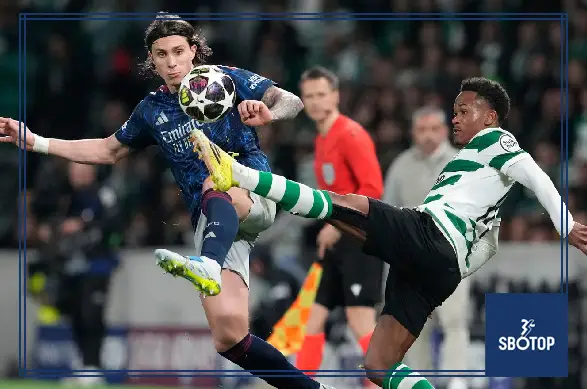
A narrow victory away from home is often celebrated as a major step toward qualification in European competition. Yet for Arsenal, their hard-fought win against Sporting CP in Lisbon felt less like a decisive breakthrough and more like the opening chapter of a finely balanced tactical duel. The Gunners may have secured a one-goal advantage, but the tie remains delicately poised ahead of the return leg.
This was not a game defined by dominance or flair alone—it was a contest shaped by structure, discipline, and calculated risk. Both sides demonstrated clear tactical identities, and while Arsenal found a way to edge the result, Sporting showed enough resilience and threat to keep their Champions League hopes alive.
A Game of Fine Margins
From the opening whistle, it was clear that this would not be a free-flowing spectacle. Instead, the match unfolded as a chess game between two well-coached teams, each attempting to impose their philosophy without exposing vulnerabilities. Under Mikel Arteta, Arsenal have developed a reputation for positional control and structured build-up play. Meanwhile, Sporting CP approached the match with a compact defensive shape and an emphasis on quick transitions.
The result was a tightly contested encounter where chances were scarce and every moment carried significant weight.
Arsenal’s Positional Play Control Without Comfort
Arsenal’s approach centered on controlling possession and dictating the tempo. Their buildup often started from deep, with defenders spreading wide and midfielders dropping into pockets to receive the ball.
-
Structured Build-Up
The Gunners aimed to create overloads in midfield, using short passing combinations to progress the ball. Players like Martin Ødegaard played a crucial role in linking defense and attack, constantly searching for spaces between Sporting’s lines.
However, control did not always translate into penetration. Sporting’s defensive discipline limited Arsenal’s ability to create clear-cut chances, forcing them to rely on patience rather than directness.
Sporting CP’s Defensive Organization
Sporting CP deserve significant credit for their defensive setup. Their structure was compact, with minimal gaps between lines, making it difficult for Arsenal to exploit central areas.
-
Compact Mid-Block
Rather than pressing aggressively, Sporting often settled into a mid-block, inviting Arsenal to advance before attempting to win possession in key areas.
This approach disrupted Arsenal’s rhythm and forced them into less dangerous zones, particularly wide areas where crosses could be dealt with more effectively.
The Decisive Moment
In matches like this, a single moment can define the outcome. Arsenal’s goal came not from sustained pressure but from a well-executed attacking move that caught Sporting slightly off balance.
The sequence highlighted Arsenal’s ability to capitalize on small openings. Quick passing, intelligent movement, and clinical finishing combined to produce the breakthrough.
Yet even after taking the lead, Arsenal were unable to fully assert control over the game.
Transition Threats Sporting’s Key Weapon
While Arsenal dominated possession, Sporting remained dangerous on the counterattack. Their transitions were swift and purposeful, often catching Arsenal’s defensive line in vulnerable positions.
-
Exploiting Space
Whenever Arsenal committed players forward, Sporting looked to exploit the spaces left behind. This created several moments of danger, even if they did not always result in clear chances.
The threat of these transitions prevented Arsenal from overcommitting, adding another layer of complexity to their tactical approach.
Midfield Battle The Heart of the Contest
The midfield duel was perhaps the most crucial aspect of the game. Both teams relied heavily on their central players to dictate play and disrupt the opposition.
-
Arsenal’s Control
Arsenal’s midfield focused on maintaining possession and recycling the ball efficiently. Their ability to retain control helped limit Sporting’s attacking opportunities.
-
Sporting’s Resistance
Sporting, on the other hand, emphasized defensive discipline and quick recovery. Their midfielders worked tirelessly to close down spaces and intercept passes.
The result was a balanced contest where neither side gained complete dominance.
Defensive Solidity vs Attacking Efficiency
One of the defining features of the match was the contrast between Arsenal’s defensive solidity and their attacking efficiency.
While they managed to keep Sporting largely at bay, Arsenal struggled to convert possession into goals. This inefficiency could prove costly in the second leg.
The Role of Individual Brilliance
In tightly contested matches, individual moments often make the difference. Players like Bukayo Saka provided flashes of creativity and unpredictability for Arsenal.
His ability to take on defenders and create opportunities added an extra dimension to Arsenal’s attack, even if the overall output remained limited.
Tactical Adjustments and In-Game Management
Both managers made subtle adjustments throughout the game, attempting to gain an edge.
Mikel Arteta introduced fresh legs to maintain intensity, while Sporting’s coach adjusted positioning to counter Arsenal’s movements.
These changes reflected the tactical awareness on both sides and contributed to the overall balance of the match.
Why the Tie Remains Open
Despite Arsenal’s victory, the tie is far from decided. Several factors contribute to this uncertainty:
- A one-goal margin is inherently fragile
- Sporting have shown they can create chances
- The second leg will present a different dynamic
Arsenal’s inability to extend their lead means that Sporting remain firmly in contention.
Psychological Edge Who Holds the Advantage
Winning away from home provides Arsenal with a psychological boost, but it also comes with pressure. Expectations will be higher in the return leg, and any slip could be costly.
Sporting, meanwhile, can approach the second leg with a sense of opportunity. Knowing that a single goal could level the tie may encourage a more aggressive approach.
Lessons for Arsenal
There are several key takeaways for Arsenal ahead of the second leg:
- Improve attacking efficiency
- Maintain defensive discipline
- Manage transitions more effectively
- Capitalize on key moments
Addressing these areas will be crucial if they are to secure progression.
What Sporting Must Do
For Sporting CP, the path forward is clear:
- Increase attacking intensity
- Take more risks in the final third
- Exploit Arsenal’s defensive transitions
If they can implement these strategies effectively, they have a realistic chance of overturning the deficit.
The Importance of the Second Leg
European ties are often decided over two legs, and this one is no different. The return match will likely be more open, with both teams adjusting their approaches based on the first leg.
Arsenal may look to control the game once again, while Sporting could adopt a more aggressive stance in search of goals.
A Tactical Battle Worth Watching
Beyond the scoreline, this tie represents a fascinating clash of tactical philosophies. Arsenal’s structured approach contrasts with Sporting’s disciplined and opportunistic style.
For fans and analysts alike, the second leg promises another intriguing chapter in this strategic battle.
Also Read: