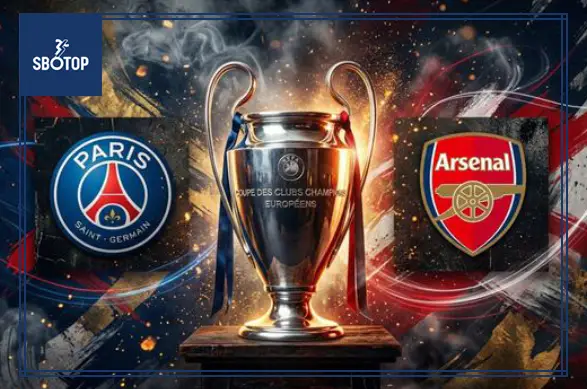
Arsenal stand just one victory away from achieving one of the greatest milestones in the club’s history: lifting the UEFA Champions League trophy for the first time. However, before Mikel Arteta’s side can celebrate European glory, they must overcome a formidable challenge in the final against Paris Saint-Germain (PSG) on Saturday night.
The showdown presents a fascinating contrast of styles. Arsenal have built their European campaign on defensive discipline and tactical control, while PSG have terrorized opponents with one of the most explosive attacks seen in this season’s competition.
As anticipation builds for the biggest match in club football, the question remains: How can Arsenal stop PSG and become champions of Europe?
Arsenal’s Defensive Strength Could Be Their Biggest Weapon
One of Arsenal’s most impressive achievements during this Champions League campaign has been their defensive consistency.
The Gunners have recorded nine clean sheets, more than any other team in the tournament. Arteta’s possession-based philosophy has not only helped Arsenal dominate games but has also significantly reduced the number of chances opponents create.
Unlike teams that rely solely on defensive blocks, Arsenal defend through ball control. By maintaining possession and controlling the tempo, they force opponents into uncomfortable situations and limit dangerous transitions.
PSG, meanwhile, have taken a very different route to the final.
Luis Enrique’s side has managed only five clean sheets but has compensated with extraordinary attacking firepower, scoring 44 goals throughout the competition. Arsenal, by comparison, have scored 29.
The final therefore sets up a classic battle:
The tournament’s strongest defense versus its most dangerous attack.
Why Arsenal Must Be Brave Against PSG’s High Press
Despite Arsenal’s defensive reputation, Arteta is unlikely to approach the final with a cautious mindset.
Instead of sitting deep and absorbing pressure, Arsenal may attempt to disrupt PSG’s rhythm by pressing aggressively in advanced areas. Similar tactics proved effective during previous encounters between the two clubs, where Arsenal frequently challenged PSG high up the pitch.
A key component of this strategy could involve utilizing a flexible center-forward capable of disrupting PSG’s defensive structure.
The “False Nine” Solution That Could Unlock PSG
One tactical move that worked well against PSG in previous meetings was deploying a striker who could drop into midfield rather than staying fixed between the center-backs.
Mikel Merino excelled in that role.
PSG often press aggressively using a man-oriented system when opponents try to build from the back. Their forwards and midfielders closely track individual opponents, making it difficult to find passing lanes.
However, such systems can be exploited.
When Merino dropped into midfield areas, PSG center-back Willian Pacho frequently chose not to follow him. While this allowed PSG to maintain numerical superiority in defense, it created a different problem.
Arsenal gained an extra player in midfield.
As PSG midfielders stepped forward to track Merino, spaces opened elsewhere, enabling Arsenal to progress through pressure and move closer to PSG’s penalty area.
Although Viktor Gyokeres has enjoyed a sensational season, players like Merino and Kai Havertz may actually be better suited for this specific tactical role because of their intelligence, movement, and ability to rotate positions.
Their versatility could become a crucial factor in disrupting PSG’s defensive organization.
Direct Play Could Be Arsenal’s Escape Route
Another option Arsenal may utilize is bypassing PSG’s first pressing line altogether.
Both Havertz and Merino possess the physical qualities needed to receive long passes from goalkeeper David Raya, hold possession, and bring teammates into play.
This direct approach could prove valuable whenever PSG commit large numbers forward to press.
Gyokeres, meanwhile, offers a different threat.
His pace, physicality, and ability to attack open spaces behind defenders make him an ideal target for direct balls into wide areas. Once isolated against defenders, he can create dangerous situations through his runs and aerial duels.
Having multiple attacking solutions could prevent PSG from predicting Arsenal’s buildup patterns.
Attacking Through Central Areas Could Be the Key
One issue Arsenal faced in previous meetings with PSG was converting chances.
A major reason for that was the outstanding performances of PSG goalkeeper Gianluigi Donnarumma.
However, several teams have demonstrated ways to expose PSG’s defensive structure this season, including Chelsea, Bayern Munich, and Lens.
These teams succeeded by drawing PSG players into congested areas before quickly switching play into newly created spaces.
When PSG commit several players to one side of the field, gaps often emerge elsewhere.
Moving the ball rapidly from crowded zones into open central channels can create opportunities that many teams fail to exploit.
Traditionally, Arsenal have been cautious when attacking through the middle. Arteta often prefers controlled possession and crossing situations because losing the ball centrally can trigger dangerous counterattacks.
Yet a Champions League final may require calculated risks.
Players such as:
- Bukayo Saka
- Kai Havertz
- Leandro Trossard
- Martin Zubimendi
- Eberechi Eze
all possess the technical quality needed to operate under pressure in tight spaces.
Their ability to combine quickly could help Arsenal create chances through central areas rather than relying solely on crosses and wide attacks.
Stopping Khvicha Kvaratskhelia Is Essential
While PSG possess attacking threats all over the pitch, Arsenal’s primary concern will likely be Khvicha Kvaratskhelia.
The Georgian winger has become one of Europe’s most devastating attacking players and represents a constant danger whenever he receives the ball.
Luis Enrique’s tactical system is built around fluid movement.
Players frequently exchange positions throughout matches, but the overall structure remains intact. Wide areas stay occupied, central spaces remain covered, and attacking positions continue to be filled.
What changes is not the location—but the player occupying it.
This continuous rotation can create confusion among defenders.
Kvaratskhelia often starts from the left wing but rarely stays there.
His off-ball movement is particularly dangerous.
He constantly varies his runs, pretending to attack behind defenders before dropping short, then accelerating into space once defenders lose concentration.
These movements create hesitation and uncertainty, often opening passing lanes that PSG’s creative players exploit with devastating efficiency.
Arsenal Must Decide How to Defend Against PSG
Arteta faces a critical tactical decision.
Should Arsenal aggressively mark players receiving the ball between the lines?
Or should they focus on protecting space behind the defensive line?
Both approaches carry risks.
Last season, Arteta successfully adjusted his defensive structure after a difficult opening period against PSG.
One notable change involved Martin Odegaard’s pressing responsibilities, while William Saliba received a more specialized role tracking Ousmane Dembele even when the French forward drifted into deeper positions.
The adjustments helped Arsenal regain control of the match and limit PSG’s effectiveness.
Former Chelsea manager Enzo Maresca offered a similar perspective after defeating PSG 3-0 in the 2025 FIFA Club World Cup.
“Our idea was to play man-to-man. PSG are so good that if you give them time, they will hurt you. You need to press them very aggressively.”
That philosophy could heavily influence Arsenal’s approach in the final.
Set Pieces Could Decide the Champions League Final
If there is one area Arsenal must maximize, it is set pieces.
Despite conceding only 29 league goals this season, PSG have shown vulnerability from dead-ball situations.
Six of those goals came from non-penalty set pieces.
The Parisian side lacks overwhelming aerial dominance compared to many elite European teams, creating an opportunity Arsenal could exploit.
Tottenham demonstrated this weakness effectively.
Even in matches they ultimately lost, Spurs repeatedly troubled PSG through corner-kick routines and indirect free-kicks.
A particularly effective strategy involved delivering the ball beyond the far post before redirecting it back across goal with a header.
PSG defenders often struggle when forced to retreat, reposition themselves, and react to second balls inside the penalty area.
This weakness aligns perfectly with one of Arsenal’s greatest strengths.
With players like William Saliba, Gabriel Magalhães, Kai Havertz, and Declan Rice attacking aerial deliveries, every corner kick and dangerous free kick could become a genuine scoring opportunity.
Arsenal Have Every Reason to Believe
Champions League finals are often decided by moments of brilliance that no tactical plan can fully predict.
A spectacular individual performance, a moment of magic, or a single mistake can change everything.
Yet based on the tactical evidence from this season, Arsenal have legitimate reasons to believe they can defeat PSG.
Their defensive organization is among the best in Europe. Their pressing structure has matured significantly under Arteta. Their flexibility in attack offers multiple solutions against elite opposition. And their excellence from set pieces provides an additional weapon that could prove decisive.
If Arsenal execute their game plan effectively, remain disciplined defensively, and capitalize on PSG’s weaknesses, the North London club may finally achieve its long-awaited dream and lift the UEFA Champions League trophy for the very first time.
ALSO READ :
- SBOTOP: PSG and Arsenal Combined XI Revealed as Analysts Debate Champions League Final Edge in Budapest Showpiece
- SBOTOP: Nathan Collins Fires Republic of Ireland to Narrow Friendly Victory Over Qatar in Ten-Man Battle
- SBOTOP: Steve Parish Reflects on Crystal Palace’s Fairytale European Triumph as Belief and Persistence Finally Deliver Glory