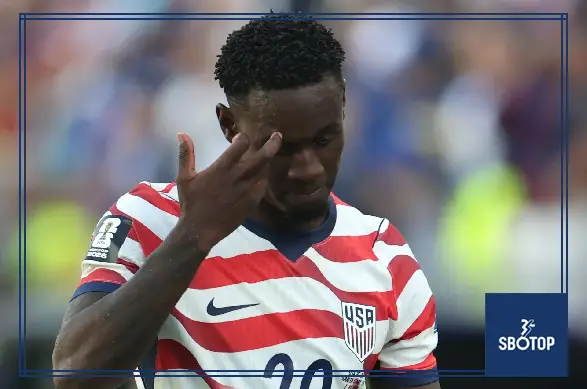
The controversy surrounding Folarin Balogun’s red card ban has become one of the most explosive off-field stories of the 2026 World Cup. What began as a disciplinary case involving a United States striker quickly turned into a major institutional dispute between FIFA and UEFA, with questions of fairness, transparency, political pressure and sporting integrity all colliding at once.
Balogun had been sent off during the United States’ Round of 32 victory over Bosnia and Herzegovina, a dismissal that normally carried an automatic one-match suspension. That punishment should have ruled him out of the last-16 clash against Belgium. Instead, FIFA chose to suspend the enforcement of the ban for a one-year probationary period, allowing the USMNT forward to play. UEFA responded furiously, describing the decision as unprecedented and warning that football had entered dangerous territory.
For UEFA, the issue was not simply whether Balogun’s red card was harsh. It was whether FIFA had the right to delay an automatic suspension without creating a damaging precedent. For Belgium, the issue was even more immediate: they were preparing for a knockout game against a player they believed should have been ineligible.
UEFA’s Strongest Message Yet
UEFA’s statement cut straight to the heart of the dispute. The European governing body argued that a one-match ban following a red card is not supposed to be optional, flexible or open to political interpretation. In its official statement, UEFA said football depends on rules as the foundation of fair, honest and transparent competition, and insisted that this was not a case where interpretation should apply.
That position was powerful because it framed the case as bigger than Balogun. UEFA was not only defending Belgium’s interests. It was defending the principle that automatic sanctions must remain automatic. If FIFA can choose when to enforce them, then the word “automatic” begins to lose meaning.
The phrase “crossed a red line” captured the mood perfectly. UEFA appeared to be saying that FIFA had not merely made a controversial judgment call, but had stepped beyond the acceptable boundaries of football governance. In a tournament where every team is supposed to operate under the same framework, even the perception of special treatment can cause serious damage.
Why Balogun’s Case Became So Sensitive
Balogun’s red card became controversial because of the sequence that followed it. Reports stated that U.S. President Donald Trump contacted FIFA president Gianni Infantino and asked for the incident to be reviewed. FIFA later suspended the ban, although the red card itself was not erased from the record. Reuters reported that the punishment was delayed under Article 27 of FIFA’s disciplinary code, with the suspension placed on a one-year probationary basis.
That timing created the storm. Even if FIFA’s disciplinary committee acted within its legal powers, the public narrative was already shaped by the political intervention. A head of state had contacted FIFA about a player from his own national team. Soon after, the player was cleared to play. In football politics, sequence matters almost as much as substance.
FIFA insisted that its judicial bodies operate independently. Infantino denied that he personally decided the outcome, and FIFA defended the ruling as a legal disciplinary measure rather than a political concession. But for UEFA, Belgium and many neutral observers, the damage was already done. The decision looked extraordinary, and extraordinary decisions require extraordinary transparency.
Belgium’s Frustration and Failed Challenge
Belgium had every reason to feel aggrieved. They were the direct opponent affected by Balogun’s availability. If the red card suspension had been enforced normally, the United States would have had to face Belgium without one of its key forwards. Instead, Balogun was cleared to start.
The Royal Belgian Football Association challenged the situation, but FIFA rejected the protest as inadmissible, saying Belgium was not a party to the original disciplinary proceedings. Reuters reported that Belgium also complained about a lack of documentation, explanation and clarity around FIFA’s handling of the case.
That procedural rejection added more tension. From Belgium’s view, they were being told that Balogun could play against them, but that they had limited standing to challenge the decision that made him eligible. In a normal legal context, such procedural boundaries might make sense. In a World Cup knockout context, it felt deeply unsatisfying.
Football is not only about written rules. It is also about trust. Belgium wanted to know why the usual automatic suspension had not been applied. UEFA wanted to know what this meant for future cases. FIFA’s legal answer did not fully calm either concern.
FIFA’s Defense Legal Power Not Rule-Breaking
FIFA’s argument centered on Article 27 of its disciplinary code. The governing body maintained that it had not overturned the red card. Instead, it had delayed the execution of the suspension. That distinction became central to FIFA’s defense. The red card remained in place, but the ban was effectively paused.
According to reports, FIFA described the decision as a balanced measure and said its disciplinary committee had the authority to postpone the effects of certain sanctions. FIFA also pushed back against UEFA by pointing out that disciplinary discretion exists in other football systems and accusing UEFA of hypocrisy in the broader debate.
Legally, FIFA may have believed it was standing on solid ground. But legal defensibility and competitive credibility are not always the same thing. The problem was not only whether FIFA could make the decision. The problem was whether it should have made it in this context, at this time, after this kind of outside attention.
The World Cup is not a domestic league with weekly fixtures and long appeal windows. It is a compressed tournament where one disciplinary decision can shape a knockout match. That is why UEFA’s response was so severe.
The Political Shadow Over the Case
The involvement of Trump pushed the controversy beyond sport. In a normal disciplinary appeal, a federation argues its case through sporting channels. In this case, the president of a World Cup co-host nation reportedly contacted FIFA’s president directly about the matter. That immediately raised questions about influence, access and pressure.
FIFA’s defenders may argue that asking for a review is not the same as forcing a decision. That distinction matters. But UEFA’s concern was not only about direct interference. It was about the appearance of influence. In global sport, perception can be just as damaging as proven misconduct.
When fans, federations or players begin to believe that some teams can access higher levels of power than others, the entire idea of equal competition becomes fragile. This is why the Balogun case became such a big institutional test. It touched the boundary between sport and politics, and many felt that boundary had been blurred.
The Player Caught in the Storm
Folarin Balogun was at the center of the story, but he was not the only figure responsible for it. He received the red card, yes. He benefited from FIFA’s ruling, yes. But the wider controversy was created by the system around him: the disciplinary process, the political attention, the legal interpretation and the institutional reaction.
For Balogun, the situation was complicated. He was available to play for his country in a World Cup knockout match, something any player would want. Yet his selection carried baggage. Every touch, every challenge and every attacking run against Belgium was viewed through the lens of eligibility.
Reuters reported that Balogun did start against Belgium after the suspension was delayed, and he was expected to lead the U.S. attack alongside Christian Pulisic. But his presence did not become the decisive sporting factor the U.S. had hoped for. Instead, the controversy became bigger than his performance.
Belgium’s 4-1 Response on the Pitch
In the end, Belgium did what teams often dream of doing in controversial situations: they answered on the field. The Red Devils beat the United States 4-1, ending the hosts’ World Cup run and turning the disciplinary debate into a backdrop for a dominant footballing response. Reuters reported that Charles De Ketelaere scored twice as Belgium advanced to the quarter-finals, while the Balogun row overshadowed the buildup.
For Belgium, the victory felt like a form of sporting justice. Nicolas Raskin suggested after the match that there was “justice” in the result, reflecting the emotional charge inside the Belgian camp.
That result softened Belgium’s immediate competitive damage, but it did not erase the institutional problem. If Belgium had lost, the controversy would likely have become even bigger. But even with Belgium winning, UEFA’s argument remained relevant. A questionable process does not become acceptable simply because the disadvantaged team eventually wins.
Why UEFA’s Anger Matters
UEFA’s reaction matters because it exposed a rare and public fracture at the top of world football. FIFA runs the World Cup, but UEFA represents many of the most powerful football nations, leagues and clubs in the world. When UEFA openly accuses FIFA of crossing a line, the issue moves beyond one match.
This was a governance confrontation. UEFA was effectively warning that FIFA’s disciplinary authority must have limits, especially when automatic sanctions are involved. If FIFA’s judicial bodies can delay automatic red-card bans during a tournament, then future teams may demand similar treatment. Every red card could become a legal argument. Every suspension could become a political debate.
That would be dangerous for tournament management. Football already has enough controversy around refereeing, VAR and disciplinary consistency. If suspensions become negotiable, the game risks losing clarity at the exact moment it needs certainty.
The Integrity Question
The word “integrity” appeared repeatedly in reactions to the case because it goes to the foundation of sport. Integrity does not mean every decision is perfect. It means the process is clear, consistent and trusted. In Balogun’s case, that trust was damaged.
UEFA’s central argument was that red-card suspensions exist to protect competition fairness. A player who is sent off is usually punished not only in the match itself, but also in the next match. That is part of the cost of serious misconduct. If that cost can be delayed during the most important stage of the tournament, then the deterrent effect is weakened.
FIFA may argue that exceptional cases require discretion. That is not unreasonable in principle. But discretion must be accompanied by transparency. The more unusual a decision becomes, the more detailed the explanation must be. Without that, people fill the gaps with suspicion.
A Dangerous Precedent for Future Tournaments
The most important long-term issue is precedent. What happens the next time a star player is sent off before a major knockout match? What happens if a host nation, major commercial market or politically powerful country pushes for a review? What happens if a smaller federation asks for the same treatment and is denied?
These are the questions UEFA’s statement seemed designed to raise. FIFA’s decision may have been limited to one player, one card and one match, but the consequences could stretch much further.
In tournament football, precedent spreads quickly. If one team gets relief from an automatic suspension, others will demand equal consideration. If FIFA refuses, it will be accused of inconsistency. If FIFA agrees, automatic bans become less automatic. Either way, the system becomes harder to manage.
This is why UEFA’s anger was not simply emotional. It was strategic. The confederation was trying to protect the future enforceability of disciplinary rules.
Also Read:
- SBOTOP: Vinicius Junior Reveals Penalty Decision as Bruno Guimaraes Miss Leaves Brazil Haunted Against Norway
- SBOTOP: Cristiano Ronaldo Fires Back at Retirement Talk as Portugal Icon Hints 2026 Could Be His Final World Cup Stage
- SBOTOP : Roberto Martinez Breaks Silence “Portugal Did Not Fail at the World Cup”