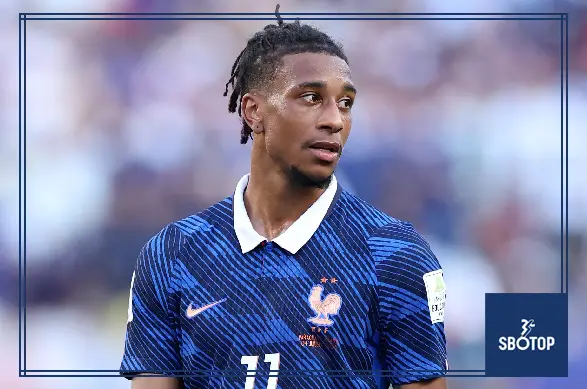
France’s World Cup preparations have been hit by a disciplinary setback after FIFA turned down the French Football Federation’s appeal against Michael Olise’s yellow card. The decision means the talented France attacker will carry his booking into the next match, adding another layer of pressure before a crucial World Cup clash against Morocco.
For Didier Deschamps and his squad, this is not a crisis, but it is certainly an unwanted complication. At this stage of the tournament, every detail matters. Every tactical decision, every fitness update, every refereeing interpretation, and every disciplinary risk can influence a team’s path. France are still alive, still confident, and still one of the most dangerous sides in the competition, but Olise’s caution creates a situation that must now be managed carefully.
The yellow card was shown during France’s victory over Paraguay in the knockout stage, and France attempted to have it rescinded before facing Morocco. FIFA, however, rejected the appeal, leaving Olise one caution away from suspension if France progress further. If he is booked again against Morocco, he would miss a potential semi-final against either Spain or Belgium.
A Small Card with Big Consequences
In normal league football, a single yellow card is often a minor detail. It may affect how a player behaves for the rest of the match, but it rarely dominates wider discussion. In tournament football, however, cautions carry heavier emotional and tactical consequences. A player does not only risk being sent off during a match. He also risks suspension from the next stage. That is why Michael Olise’s booking matters. France are not simply thinking about Morocco. They are also thinking about the possible semi-final. Deschamps must prepare for the immediate challenge while protecting the team’s future options. If Olise starts, he must play with intelligence. If he is asked to press, tackle, and compete, he must do so without crossing the line.
This can affect a player psychologically. Wingers and attacking midfielders are often judged by what they create, but they also have defensive responsibilities. They press full-backs, track runners, block passing lanes, and sometimes commit tactical fouls to stop transitions. When a player is already booked in the tournament, those small defensive actions become more dangerous.
Olise now has to balance aggression with control. That is easier said than done in a World Cup knockout match.
Why France Appealed
France’s decision to appeal showed how important Olise has become to the team. Federations do not usually challenge every yellow card unless they believe there is a strong sporting reason to do so. In this case, the French camp clearly wanted to protect one of their most creative players from unnecessary suspension risk.
Olise has been one of France’s most influential attacking figures during the tournament. His creativity, movement, and ability to connect midfield with attack have given Deschamps another weapon alongside established stars. Reports around the tournament have described him as a key provider and a central part of France’s attacking rhythm.
That makes the failed appeal more significant. This is not a fringe player carrying a minor disciplinary issue. This is a player who can change the tempo of a match, unlock defensive blocks, and give France a different technical profile. Losing him for a semi-final, should France get there, would be a serious blow.
The appeal was therefore a practical move. France wanted clarity and protection. FIFA’s refusal means they now have neither.
Olise’s Rise Has Changed France’s Attack
Michael Olise’s emergence has added a fascinating dimension to France’s World Cup story. He is not the loudest personality in the squad, nor the most established name. Yet his football has spoken powerfully. His game is elegant, intelligent, and unpredictable. He glides between lines, sees passes early, and can create chances without needing to dominate the ball for long periods.
France have often been associated with explosive attacking power. Kylian Mbappe gives them speed, directness, and ruthless finishing. Other forwards bring physicality, pressing, and penalty-box presence. Olise offers something slightly different: rhythm. He can slow the game down, accelerate it with one touch, or find angles that others do not see.
That kind of player becomes extremely valuable in knockout football. Matches are tighter. Space is limited. Opponents defend deeper and with more discipline. The ability to find a clever pass or shift the defensive shape matters enormously.
This is why France will be careful with him. They need his creativity against Morocco, but they also need him available if they reach the next round.
Deschamps Faces a Selection Puzzle
Deschamps is experienced enough to understand the balance. He could decide that Olise is too important to protect and simply start him as usual. He could tell him to play naturally but stay calm in defensive situations. He could also adjust France’s structure to reduce the number of risky duels Olise must take.
Another option would be to manage his minutes. If France are leading, Deschamps could withdraw him earlier than usual to reduce disciplinary exposure. If the match is tight, however, taking off one of the team’s most creative players may not be simple. Quarter-finals are not matches where coaches can plan everything in advance. The game state decides many choices.
The failed appeal does not force Deschamps into one decision, but it removes flexibility. Without the yellow card, Olise could approach the Morocco match freely. With the yellow card still active, every challenge carries a second meaning.
France must now think not only about how Olise can hurt Morocco, but also about how Morocco might draw him into uncomfortable defensive moments.
Morocco Will Be Aware of the Situation
Opponents notice these things. Morocco’s staff will know Olise is walking a disciplinary tightrope. That does not mean they will openly target him, but they will understand the advantage of forcing him into duels, transitions, and defensive decisions.
If Olise plays on the right side, Morocco may try to overload that channel. They may attack the space behind him, force him to track runners, or isolate him in one-on-one defensive moments. Every time he stretches for a tackle, France supporters will hold their breath.
This is part of elite tournament strategy. Teams search for pressure points. Sometimes that pressure point is tactical. Sometimes it is physical. Sometimes it is emotional or disciplinary. Olise’s booking gives Morocco one more detail to consider.
France must respond with structure. If Olise is protected by the midfield and full-back, he can focus more on attacking. If he is left exposed, the risk increases.
France Cannot Let the Issue Become a Distraction
The danger for France is not only the booking itself. It is the possibility that the conversation around it becomes too loud. Tournament camps thrive on focus. If every question to Deschamps becomes about Olise’s yellow card, the issue can grow beyond its real size.
France have bigger priorities. They must prepare for Morocco’s defensive organization, transitional threat, and emotional intensity. They must manage Mbappe’s role, midfield balance, set pieces, and concentration. Olise’s disciplinary status is important, but it cannot dominate the entire build-up.
This is where Deschamps’ calm leadership matters. He has handled major tournament pressure many times. He knows when to protect players, when to deflect questions, and when to keep the squad concentrated on football rather than noise.
His message will likely be simple: Olise is available, France trust him, and the team must focus on winning the match.
The Fine Line of Modern Refereeing
The appeal also raises the broader issue of yellow-card decisions in major tournaments. Players, coaches, and supporters often feel that bookings are subjective. One referee may punish a challenge or reaction that another might only warn. In knockout football, that subjectivity can feel enormous because the consequences are so severe.
France clearly felt there was enough doubt around the Olise booking to challenge it. FIFA disagreed. Once the appeal was rejected, the matter became final from a sporting perspective. Still, the debate reflects a recurring frustration in football: disciplinary decisions can shape tournaments in ways that feel disproportionate.
A yellow card is supposed to control behavior and protect the game. But when accumulated cautions threaten to remove key players from semi-finals or finals, the stakes grow dramatically. That is why federations sometimes fight even small decisions.
In Olise’s case, the appeal failed. France must now live with the outcome.
Olise Must Show Maturity
This is also a test of Olise’s maturity. Great players are not only judged by what they do with the ball. They are judged by how they manage pressure. A young or emotional player might become hesitant because of the booking. Another might become reckless and risk suspension. The best response is balance.
Olise must continue demanding the ball, creating chances, and expressing himself. France cannot afford for him to become passive. At the same time, he must avoid unnecessary confrontations, late tackles, dissent, and emotional reactions. He has to play with freedom in possession and discipline without it.
That combination is difficult, but it is part of becoming a top international player. World Cups create these tests. They expose not only technical ability, but decision-making under stress.
If Olise handles the Morocco match well, the yellow-card issue could become another sign of his growth.
France’s Squad Depth Offers Protection
One reason France remain strong despite the setback is their depth. Deschamps has options. If Olise were suspended later, France would still have enough talent to compete. That is one of the advantages of being a major tournament contender.
However, depth is not the same as replacement. Olise has a particular style. Not every player can provide his blend of creativity, control, and subtle movement. France may have other attackers, but they may not reproduce the same rhythm.
This is why Deschamps will want him available for as long as possible. Tournament-winning squads often rely on different players in different moments. A semi-final may require a moment of invention. A final may be decided by one pass. Creative players become more valuable as opponents grow stronger.
France can survive without Olise, but they would rather not be forced to find out.
Morocco Clash Becomes Even More Intense
France’s match against Morocco already had plenty of storylines. It is a meeting full of history, emotion, talent, and tactical intrigue. Morocco have shown they can compete with elite opponents, while France are trying to maintain their pursuit of another world title.
Now Olise’s booking adds one more layer. Every attacking run, every defensive recovery, and every referee whistle involving him will be watched closely. This is the kind of subplot that can define a match if things go wrong.
For France, the solution is to start fast and control the game. If they dominate possession and territory, Olise is less likely to be pulled into desperate tackles. If Morocco force transitions and make the game chaotic, the risk increases.
The entire team therefore has a role in protecting him. Good structure reduces individual danger. Poor structure exposes players to decisions they do not want to make.
Also Read: