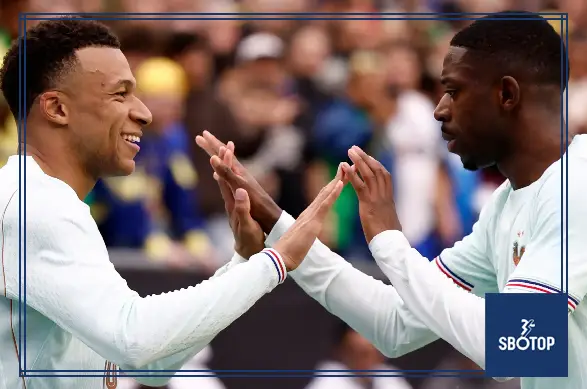
Ousmane Dembélé’s transformation from an injury-plagued winger into a Ballon d’Or winner has changed the way football views his career. Once discussed mainly as a symbol of unrealized potential, he is now a Champions League winner, the attacking leader of Paris Saint-Germain and an important figure for a France side pursuing another World Cup title.
That rise has naturally encouraged increasingly ambitious claims about his place in French football history. During a recent street debate organized by GOAL’s FanZone, one supporter named Dembélé as the greatest French player of all time, pointing to his Ballon d’Or triumph, his success with PSG and the possibility that he could help France win another World Cup.
The suggestion was immediately challenged. Another fan argued that Zinedine Zidane remained the superior choice and claimed Dembélé benefited from reaching his peak after the era dominated by Lionel Messi and Cristiano Ronaldo.
Had Dembélé competed at his best alongside those two giants, the supporter suggested, his reputation would have been considerably less impressive. The exchange quickly became a wider argument about different eras, individual awards and what “greatest of all time” should actually mean.
The dismissal was severe, but the underlying discussion is legitimate. Dembélé has reached a level few expected during his difficult years at Barcelona. Whether that late-career explosion is enough to place him above Zidane, Thierry Henry, Michel Platini, Kylian Mbappé and other French legends is a far more complicated question.
A Fan Debate That Became Much Bigger
The original conversation produced several different answers. One supporter selected Dembélé, another preferred Henry, while others backed Zidane because of his technical control, composure and influence in midfield.
The strongest reaction came when the Zidane supporter heard Dembélé’s name. Rather than merely disagreeing, he argued that the PSG forward was being elevated because Messi and Ronaldo were no longer controlling football’s biggest individual prizes.
That reflects a common way supporters compare generations.
Messi and Ronaldo established an extraordinary standard for more than a decade. They scored at a rate previously considered unrealistic, collected major trophies and occupied the leading positions in Ballon d’Or voting almost every year.
Outstanding seasons from Xavi, Andrés Iniesta, Franck Ribéry, Neymar, Luis Suárez and Robert Lewandowski were repeatedly judged against those two superstars.
Dembélé’s Ballon d’Or victory came in a different competitive landscape. That does not make the prize less legitimate or his performances less impressive. It does, however, allow critics to ask whether he would have received the same recognition during the previous era.
The answer can never be proven.
Footballers do not choose the generation into which they are born, and greatness cannot be measured by placing someone into an imaginary decade. Still, the comparison explains why the fan reacted so strongly. In his view, Dembélé’s recent success was being confused with an entire career of historical greatness.
Dembélé’s Reinvention Cannot Be Dismissed
The insulting description used during the debate may attract attention, but it does not accurately represent Dembélé’s achievements.
His 2024-25 season was exceptional. Repositioned into a more central attacking role under Luis Enrique, he became a much more efficient scorer while retaining the dribbling, creativity and two-footed unpredictability that had defined him as a young player.
Dembélé won the 2025 Ballon d’Or after helping PSG secure their first Champions League title. UEFA credited him with 37 goals and 15 assists across the campaign and named him the Champions League Player of the Season. He finished ahead of Lamine Yamal and PSG teammate Vitinha in the Ballon d’Or voting.
Those accomplishments cannot be explained only by the absence of prime Messi and Ronaldo.
Dembélé did not receive football’s biggest individual prize by default. He became the attacking leader of a title-winning side and delivered a level of production that had been missing from earlier stages of his career.
His development was especially significant because of where he had started.
At Rennes and Borussia Dortmund, Dembélé looked like one of Europe’s most exciting young attackers. His acceleration, confidence with either foot and ability to create chances made him appear capable of becoming a generational star.
Barcelona paid heavily to sign him in 2017, but his years in Spain were repeatedly interrupted by physical problems. There were flashes of brilliance, yet consistency remained elusive. He was criticized for his decision-making, fitness record and perceived lack of professionalism.
Many players never recover from such a prolonged period of frustration.
Dembélé did.
His move to PSG provided a different environment, while Luis Enrique eventually found a position that transformed his attacking output. That reinvention deserves admiration even from supporters who reject the idea that he is France’s greatest player.
The Best Season Is Not Always the Greatest Career
The strongest argument against calling Dembélé France’s GOAT is not that his peak lacks quality. It is that historical greatness normally requires sustained influence over several seasons and multiple major tournaments.
One Ballon d’Or campaign can establish someone as the best player in the world at a particular moment. It does not automatically place that player above figures who shaped French football for a decade.
Zidane’s case rests on defining performances at the highest level.
He scored twice in the 1998 World Cup final as France defeated Brazil and lifted the trophy for the first time. Two years later, he helped Les Bleus win the European Championship. Near the end of his career in 2006, he produced another memorable World Cup run and led France back to the final.
His influence extended beyond goals and assists. Zidane controlled the technical and emotional rhythm of major matches. Teammates looked toward him when the pressure increased, while opponents adjusted their plans because of his presence.
Henry offers a different argument. He combined international success with one of the finest club careers produced by a French attacker. His pace, finishing and creativity made him an Arsenal icon, while he won the 1998 World Cup and finished his France career with 51 goals from 123 appearances.
Platini’s claim is equally powerful. He became the first player to win three consecutive Ballon d’Or awards and captained France to the 1984 European Championship, scoring nine goals during the tournament.
Mbappé already possesses another compelling case. He scored in the 2018 World Cup final, produced a hat-trick in the 2022 final and has continued breaking individual records on the sport’s largest stage.
Against those careers, Dembélé’s case remains incomplete.
He owns a World Cup winner’s medal from 2018, but he was not one of the defining figures of that triumph. He also featured at the 2022 tournament, although the final became associated far more strongly with Mbappé’s extraordinary performance and Argentina’s victory.
Dembélé’s recent rise has transformed his legacy, but he still needs more seasons and additional defining international performances before his historical argument can become truly convincing.
France’s 2026 Run Gives Him an Opportunity
Dembélé is at least creating the opportunity to add those missing moments.
At the 2026 World Cup, he delivered one of the tournament’s standout group-stage performances by scoring a first-half hat-trick in France’s 4-1 victory over Norway.
The three goals arrived within 25 minutes and made him only the third French player to score a World Cup hat-trick, following Just Fontaine and Mbappé.
That performance carried additional importance because Dembélé had entered the tournament under pressure. He had faced fitness concerns and questions about whether the authority he displayed for PSG could be reproduced consistently for the national team.
The Norway hat-trick offered a powerful response.
He later scored France’s second goal in the 2-0 quarter-final victory over Morocco, helping Les Bleus reach a third consecutive World Cup semi-final. France’s attack remained led by Mbappé, but Dembélé again demonstrated that Didier Deschamps possessed another elite match-winner.
The French Football Federation lists Dembélé with 65 senior appearances and 12 goals following the Morocco match. That scoring total remains modest when compared with France’s legendary forwards, although it reflects many years in which he was used primarily as a wide creator rather than as the central goalscorer he later became at PSG.
A World Cup triumph featuring decisive goals from Dembélé could significantly reshape the conversation.
Supporters often remember tournament-defining moments more vividly than long periods of strong club form. A winning goal in a semi-final or final can transform how an entire career is viewed.
Dembélé therefore has a chance to strengthen his historical case, even if the GOAT label remains premature.
The Messi and Ronaldo Argument Is Too Simple
The claim that Dembélé would have been exposed during the Messi-Ronaldo era assumes individual awards are the only meaningful measure of quality.
That is unfair.
Messi and Ronaldo did not merely prevent other footballers from winning prizes. They changed expectations to an extreme degree. A forward could score 30 goals, provide important assists and win domestic trophies, yet still appear ordinary beside players producing 50 or 60 goals.
Had Dembélé’s 2024-25 campaign occurred during their peaks, he might not have won the Ballon d’Or.
That would not have made him a fraudulent player. It would simply have meant he was competing against two of the most productive footballers in history.
The same logic would diminish several genuine legends.
Iniesta won the World Cup and played a central role in Barcelona’s greatest teams but never claimed the Ballon d’Or. Xavi transformed how midfield football was understood without winning the prize. Lewandowski produced exceptional scoring seasons during the closing period of the Messi-Ronaldo rivalry.
Greatness cannot be reduced to whether someone finished first in an annual vote.
Dembélé should be judged through his performances, influence, trophies and longevity. On those measures, his peak is completely genuine, but his historical résumé is still developing.
Also Read: