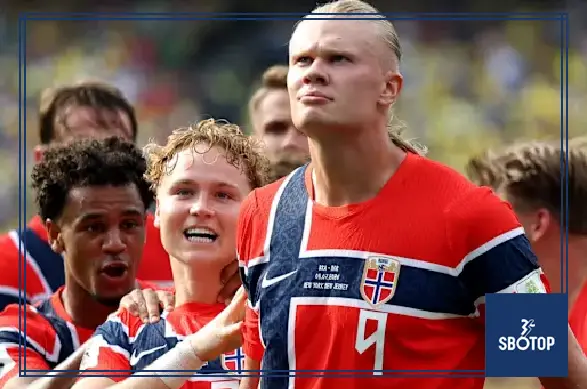
England’s path to the 2026 World Cup semi-finals is blocked by one of the most devastating centre-forwards in modern football. Erling Haaland has already scored seven goals at the tournament and arrives at the quarter-final carrying the confidence generated by Norway’s historic victory over Brazil. He can spend long periods on the edge of a match, barely touching the ball, before suddenly producing the movement and finishing that decide the result.
That ability makes him one of football’s most difficult opponents to manage. Defenders cannot relax when he appears uninvolved because his apparent absence is often temporary. One perfectly timed run, one delivery into the penalty area or one loose ball can be enough for Haaland to transform the contest.
Former England centre-back Des Walker believes the solution is built around two qualities: concentration and collective unity.
Walker, who won 59 caps for England, argued that stopping Haaland cannot be treated as a private battle between the Norwegian and one central defender. Every England player must contribute by pressuring the pass, protecting dangerous spaces and remaining mentally alert until the final whistle. His warning was simple: a defence can contain Haaland for almost the entire match and still lose control in its final moments.
For Thomas Tuchel’s side, that message could determine whether England reach another World Cup semi-final or become the latest team punished by Norway’s extraordinary No. 9.
Walker Identifies Concentration as England’s Greatest Weapon
Walker built his reputation as one of England’s quickest and most reliable defenders. He faced elite forwards throughout his international and club career, giving him a clear understanding of the psychological demands involved in marking a world-class striker.
His main advice ahead of England’s meeting with Norway is not based on aggression or physical intimidation.
It is based on concentration.
Haaland does not need to dominate possession to dominate a result. He may make several runs that are ignored, remain isolated while Norway defend or appear frustrated as the opposition controls the ball. None of those situations removes his threat.
The danger begins when defenders interpret his lack of involvement as evidence that the plan has succeeded.
That is when Haaland attacks.
He studies the positioning of centre-backs, identifies which defender is watching the ball and waits for a moment when the defensive line becomes uneven. His acceleration over a short distance can create separation before the defender has time to react.
Walker stressed that England cannot allow their focus to decline, even after a long period of defensive success. He also pointed to the team spirit displayed during England’s dramatic last-16 victory over Mexico as the kind of collective commitment required against Norway.
The challenge is therefore psychological as much as tactical.
England’s defenders must treat every Norwegian possession as potentially decisive, whether it occurs in the first minute or deep into stoppage time.
Haaland’s Brazil Performance Proved Walker’s Point
Norway’s victory over Brazil offered an ideal demonstration of Haaland’s unusual influence.
For much of the round-of-16 match, he was not the dominant figure. Brazil restricted his touches and prevented him from becoming heavily involved in Norway’s buildup. To an observer, it might have appeared that the five-time world champions had successfully removed him from the contest.
Then everything changed.
Haaland scored twice after the 79th minute, overturning the direction of the match and carrying Norway into the quarter-finals for the first time in their men’s team history. His first goal came after Andreas Schjelderup provided an accurate delivery, while the second confirmed one of the tournament’s greatest upsets.
The performance illustrated why judging Haaland through involvement can be misleading.
Some forwards influence matches by constantly receiving the ball. They drop into midfield, combine with teammates and create chances through repeated touches.
Haaland’s influence can be far more concentrated.
He may contribute relatively little for 70 minutes and then become the most important player on the pitch through two movements. That is not accidental. It is the result of patience, positioning and an exceptional ability to convert chances under pressure.
England must remember Brazil’s experience.
Keeping Haaland quiet for most of the match is not the same as stopping him.
One Defender Cannot Handle the Assignment Alone
Walker rejected the idea that England should simply nominate one centre-back to follow Haaland across the pitch.
That strategy would create several problems.
Haaland is physically powerful enough to occupy an isolated defender, while his movement could drag that player away from England’s preferred defensive structure. Norway’s other attackers would then gain access to the spaces created by the man-marking assignment.
A successful plan requires several layers.
The centre-backs must track Haaland’s movements, but England’s midfielders must also reduce the quality of passes played toward him. The full-backs must prevent Norway’s wide players from delivering uncontested crosses, while the forwards must apply enough pressure to make Norway’s buildup uncomfortable.
Walker described the task as one in which everyone must perform a role. Defenders need support in front of them, runners must be tracked and spaces must be closed before Norway can exploit them.
This is the central tactical truth of the quarter-final.
England cannot defeat Haaland by concentrating only on Haaland.
They must disrupt the entire structure designed to supply him.
Cutting the Supply Line Is Essential
England midfielder Morgan Rogers offered a similar assessment when discussing the threat posed by Norway’s striker.
Rogers acknowledged that completely stopping Haaland may be unrealistic, but suggested England could limit him by preventing the ball from reaching him in favorable positions. The objective is to disrupt the passes and crosses that create his chances rather than relying exclusively on emergency defending inside the penalty area.
That means England must apply pressure earlier.
Martin Ødegaard is one of the most obvious sources of danger. The Arsenal captain can receive between midfield lines, carry the ball forward and deliver passes into narrow spaces. Giving him time would allow Haaland to begin his runs before England’s defenders are prepared.
Sander Berge can also help Norway progress possession, while Schjelderup demonstrated his creative value by setting up Haaland against Brazil.
England’s midfield shape will therefore be critical.
If the midfielders press too aggressively without coordination, Norway could play through the pressure and expose the centre-backs. If England remain too passive, Ødegaard and his teammates will have the time required to select their passes.
The press must be organized rather than emotional.
The first England player should force the Norwegian ball-carrier toward a less dangerous option. The players behind him must then close the available passing routes, especially those leading toward Ødegaard or directly into Haaland.
Stopping the supplier is often more realistic than stopping the finish.
England’s Familiarity Could Provide an Advantage
Many England players know Haaland’s qualities from the Premier League.
The Norwegian has spent four seasons terrorising English defences with Manchester City, establishing himself as one of the competition’s most prolific scorers. Several members of Tuchel’s squad have faced him repeatedly at club level and understand how quickly he can punish a positional mistake.
That familiarity may help England prepare.
The defenders know that Haaland is stronger than he sometimes appears when shielding the ball. They understand that giving him space behind the line is dangerous and that crosses cannot be defended casually.
They will also have studied the specific runs he makes at Manchester City.
Haaland frequently begins between the centre-back and full-back, where neither defender is entirely certain who should track him. He may then attack the front post, hold his run for a cutback or move toward the far side when the defence shifts across.
However, familiarity does not guarantee success.
Premier League defenders have studied Haaland for years, yet he continues to score at an extraordinary rate. Knowing what a striker intends to do and physically preventing it are separate challenges.
England’s experience should improve their preparation, but it cannot replace execution.
The Defensive Line Must Find the Right Height
One of Tuchel’s most important decisions will concern the position of England’s defensive line.
Defending high can compress the pitch and help England pressure Norway’s midfield. It reduces the distance between the defence and midfield, making it more difficult for Ødegaard to receive freely.
The risk is obvious.
Any poorly coordinated step or unpressured pass could release Haaland into open space. Once he accelerates beyond the defence, recovering is extremely difficult.
Defending deeper removes some of that space, but it creates different problems. Norway would be able to advance closer to the penalty area, deliver crosses and compete for second balls.
Haaland is also highly effective against deep blocks because of his strength, aerial ability and movement inside crowded areas.
England cannot simply choose one defensive height and maintain it regardless of the match situation.
They must recognize triggers.
When pressure is applied to the ball, the defence can move higher because the Norwegian passer has less time and visibility. When the ball-carrier is free, England may need to retreat and protect the space behind.
Communication will be vital.
One defender stepping forward while another drops would create exactly the type of gap Haaland attacks.
Physical Contact Must Be Controlled
England’s centre-backs will need to compete physically, but they cannot allow the contest to become reckless.
Haaland uses his body intelligently. He can absorb contact, protect the ball and create enough separation to shoot. Defenders who attempt to overpower him in every duel may concede free kicks, lose their balance or become vulnerable to his movement.
The better approach is to establish contact early and then react to the ball.
A defender should know where Haaland is before the delivery arrives, but he must avoid becoming so focused on wrestling with the striker that he loses sight of the pass.
Discipline is especially important inside the penalty area.
A desperate pull or mistimed challenge could give Norway a penalty and turn a strong defensive performance into a defeat.
England must also avoid collecting unnecessary yellow cards early in the match. A booked centre-back would be forced to defend Haaland with greater caution for the remaining minutes.
The contest requires aggression, but it must be intelligent aggression.
England Cannot Ignore Ødegaard
The attention surrounding Haaland creates an opportunity for Norway’s other leading player.
Ødegaard may receive more freedom if England’s midfield collapses toward the striker.
That would be dangerous.
The midfielder’s vision and passing are central to Norway’s ability to create. He can control the tempo, combine in tight areas and deliver the final ball that releases Haaland.
Rogers specifically acknowledged that Haaland is not Norway’s only Premier League threat, highlighting Ødegaard’s quality as another major concern.
England must therefore maintain balance.
One midfielder may need to screen the route into Haaland while another remains available to pressure Ødegaard. The wide players must recover when Norway’s full-backs advance, preventing overloads that could pull England’s shape apart.
Focusing exclusively on Haaland would allow Norway to play naturally around him.
The objective should be to make the entire attack less comfortable.
If Ødegaard is forced backward, if the wide players are pressured and if Norway must attempt low-percentage passes from deep positions, Haaland’s opportunities will become less frequent.
Also Read: