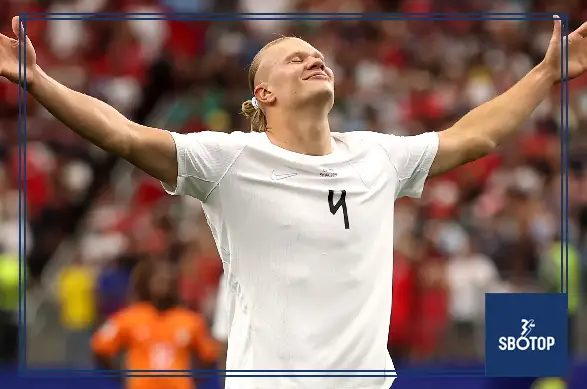
When England discovered that Norway would stand between them and a place in the 2026 World Cup semi-finals, almost every tactical discussion revolved around one name: Erling Haaland.
The Manchester City striker had arrived at the quarter-final as one of the tournament’s most dangerous players. His combination of speed, strength, movement and ruthless finishing had helped Norway eliminate Brazil, ensuring that Thomas Tuchel’s defenders would face their most physically demanding assignment of the competition.
Yet former England captain Bryan Robson believed the defender best equipped to handle Haaland was not even in North America.
Robson identified Harry Maguire as the ideal opponent for Norway’s goal machine, arguing that the experienced centre-back possessed the physical power required to compete with Haaland. Maguire, however, had been left out of Tuchel’s 26-man World Cup squad despite returning to the England setup only a few months earlier.
The debate raised an uncomfortable question before the quarter-final. Had Tuchel sacrificed precisely the type of defender England needed for one of the biggest matches of their campaign?
England ultimately defeated Norway 2-1 after extra time and prevented Haaland from scoring. That outcome justified the defenders who were selected, but it did not make Robson’s argument irrelevant. Instead, the match illustrated the complexity of squad selection, the challenge of containing an extraordinary striker and the difference between stopping Haaland as an individual and controlling Norway as a team.
Robson’s Case for Maguire
Robson’s reasoning was based on a straightforward comparison of physical qualities. Erling Haaland is not a conventional penalty-box striker who waits for crosses or loose balls. He uses his body to establish position, protect possession and force defenders into uncomfortable areas. He can run behind a high defensive line, but he is equally capable of receiving direct passes with his back to goal before bringing teammates into the attack.
Robson believed Maguire’s frame, aerial strength and willingness to engage in physical duels made him the most natural English defender for that challenge. The former Manchester United midfielder acknowledged that Tuchel’s selected centre-backs offered speed, but questioned whether they could match Haaland’s power as effectively as Maguire.
Maguire stands at 6ft 4in and has accumulated 66 England caps. He has also played 12 times at World Cups, giving him extensive experience of knockout football and the pressure surrounding major international tournaments.
Those characteristics explain why Robson described him as the best man for the assignment. Against certain opponents, mobility and recovery pace are the priorities. Against Haaland, strength, positioning and comfort in direct confrontation can become equally valuable.
Robson was not claiming that Maguire could erase Haaland from the match by himself. No centre-back can guarantee that. His point was that Maguire represented a specialist profile England no longer had available.
Tuchel’s Decision to Move On
Maguire’s omission was one of several major calls made when Tuchel finalised his World Cup squad. The England coach also excluded other recognised names as he prioritised what he described as the team’s balance and chemistry. The decision left Maguire shocked and disappointed, especially because the defender believed the 2026 tournament might represent his final realistic chance to appear at another World Cup.
The omission was particularly striking because Maguire had been recalled for England’s March fixtures against Uruguay and Japan. He featured during that international window, recording an assist against Uruguay and appearing as a substitute during the defeat by Japan.
Reports surrounding the decision suggested that Tuchel wanted a more dynamic defensive group capable of operating in a proactive system. That preference naturally favoured centre-backs with greater acceleration, versatility and comfort defending large spaces.
From Tuchel’s perspective, a World Cup squad could not be designed around one potential opponent. England had to prepare for different tactical problems across a lengthy tournament.
A defender suited to wrestling with Haaland might not be the ideal choice against a fluid attack built around rapid combinations and constant positional changes. Tuchel therefore selected players who could contribute across several scenarios rather than preserving one place for a specific matchup that might never occur.
The irony was that Norway did appear in England’s path—and Haaland was exactly as dangerous as Robson had warned.
Why Haaland Demands a Different Defensive Plan
There is no single reliable way to stop Haaland because his threat changes according to the spaces an opponent allows.
Defend with a high line and he can sprint behind. Drop too deep and Norway can deliver passes or crosses into the penalty area. Engage him too aggressively and he may roll the defender or create space for Martin Ødegaard and the supporting attackers.
The problem becomes even greater when the defensive team focuses exclusively on the striker.
Norway’s attack was not simply a mechanism for feeding Haaland. Ødegaard could dictate possession, Andreas Schjelderup offered speed and creativity, and the team had already demonstrated its ability to punish established football nations. Haaland attracted attention, but that attention could free teammates in dangerous positions.
That is precisely what happened when Norway took the lead against England. Schjelderup, rather than Haaland, scored the opening goal after 36 minutes. England’s defensive problems were therefore not limited to the direct duel with the centre-forward.
A successful plan had to control the passes into Haaland, track runners around him and prevent Norway from progressing cleanly through midfield.
The centre-backs were important, but England’s entire structure carried responsibility.
Stones Offered England an Inside Advantage
John Stones became central to England’s solution.
The experienced defender has spent years training and playing alongside Haaland at Manchester City. That familiarity did not make the Norwegian easy to stop, but it gave Stones first-hand knowledge of his movement, habits and physical preferences.
A defender who faces Haaland in daily training understands that the danger often begins before the final pass. The decisive moment may be the striker’s first movement away from the defender, the angle of his body or the instant he identifies an unprotected channel.
Stones’ task was not simply to win every duel. He needed to recognise when to step forward, when to maintain distance and when to rely on support from his defensive partner.
Reports after England’s victory highlighted his role in limiting his club teammate. Haaland was kept off the scoresheet for the first time during the tournament and was eventually substituted as Norway’s energy declined.
That did not mean Stones dominated every encounter. Haaland remained physically involved and had a goal ruled out following a foul during the attacking move. His presence also helped pull defenders away from their preferred positions.
Still, England achieved the main objective. Norway’s greatest goalscoring weapon did not score.
Maguire’s Absence Became More Noticeable Before Kick-Off
The selection debate intensified because England entered the quarter-final with additional defensive uncertainty.
Jarell Quansah was unavailable after his red card against Mexico resulted in a two-match suspension, ruling him out of both the Norway game and the subsequent semi-final. The punishment reduced Tuchel’s options and made the decision to omit an experienced defender such as Maguire appear more significant.
Robson’s concern was understandable. Tournament squads are supposed to provide solutions when suspensions, injuries or tactical emergencies appear.
Maguire’s profile would have offered England another way to defend. He could have been introduced late to deal with crosses, selected from the beginning for a physically demanding contest or used as part of a back three.
His international record also suggested that he would not have been overwhelmed by the occasion. Whatever criticism he has received at club level, Maguire has frequently performed reliably for England at major tournaments.
Tuchel, however, had already chosen a different direction. Once the tournament began, the coach had to trust the players available rather than revisit decisions that could no longer be changed.
England’s Defensive Task Was About Space, Not Strength Alone
Robson’s claim naturally focused attention on physical duels, but England’s success showed why defending Haaland requires more than matching his strength.
If a centre-back waits until the ball reaches the Norwegian, the defence may already be in trouble. The more effective approach is to disrupt the supply line.
England’s midfielders attempted to pressure Norway’s playmakers and restrict the quality of passes entering the final third. The defenders then worked to maintain compact distances, reducing the space Haaland could attack.
The plan was not executed perfectly. Norway created dangerous situations, had a goal disallowed and forced England to remain alert throughout an exhausting contest. Tuchel later described his team’s overall performance as sloppy and acknowledged that fortune played a part in their survival.
Nevertheless, Haaland rarely received the kind of clear chance from which he normally scores.
That outcome reinforced an important tactical principle. A defender does not stop a striker alone. The nearest midfielder, full-back, defensive partner and goalkeeper all contribute to controlling the spaces around him.
Maguire might have been stronger in direct contact, but Tuchel’s selected defenders compensated through organisation, familiarity and collective support.
Haaland Still Influenced the Match Without Scoring
A goalless performance does not necessarily mean a striker has been completely neutralised.
Haaland’s movements continually demanded attention from England. When he moved toward the ball, a defender had to decide whether to follow. When he threatened the space behind, the defensive line had to adjust its depth.
That influence helped create room for others, particularly during Norway’s strongest periods. Analysis of the match noted that Haaland dragged England defenders out of position and remained central to Norway’s attacking structure even though he did not score.
This distinction matters when assessing whether England truly “stopped” him.
They prevented the outcome they feared most—a Haaland goal—but they did not remove Norway’s attacking threat. Schjelderup scored, Ødegaard continued searching for openings, and the quarter-final remained balanced until extra time.
England required two goals from Jude Bellingham to overturn the deficit. His first arrived shortly before half-time, while the second came after Norway goalkeeper Ørjan Nyland failed to hold Morgan Rogers’ shot during extra time.
The match was therefore not a comfortable defensive masterclass. It was a narrow survival in which England contained Haaland well enough to give their match-winners time to respond.
Would Maguire Have Improved England’s Performance?
That question cannot be answered with certainty.
Maguire might have handled several physical exchanges better than England’s selected defenders. His aerial ability could also have helped during set pieces and direct Norwegian attacks.
However, his inclusion would have created different risks.
Haaland is powerful, but he is also extremely fast. Norway could have attempted to isolate Maguire in open space or exploit the areas around him through Schjelderup and Ødegaard. A defender cannot be selected only for the qualities he possesses; the coaching staff must also consider how the opponent might target his limitations.
England’s eventual defensive pairing benefited from mobility and familiarity with Haaland’s Premier League habits. Stones in particular had direct knowledge of how the striker prefers to move.
There is also no guarantee that Maguire would have started. Robson considered him the ideal matchup, but Tuchel may still have preferred a more mobile defensive line.
The fairest conclusion is that Maguire would have given England a useful alternative. His absence did not make the team incapable of stopping Haaland, but it reduced the range of solutions available to the coach.
Squad selection is often judged by results. Because England advanced and Haaland did not score, Tuchel’s decision escaped the harshest possible scrutiny.
Had Norway won through a dominant Haaland performance, Maguire’s omission would have become one of the central stories of England’s elimination.
Also Read: