Spain’s return to the summit of world football should have ended with nothing but celebration. Ferran Torres had scored the goal of his life, La Roja had secured their second World Cup crown, and a new generation was preparing to lift the trophy after ending the country’s 16-year wait.
Instead, the final whistle triggered one last explosion of emotion.
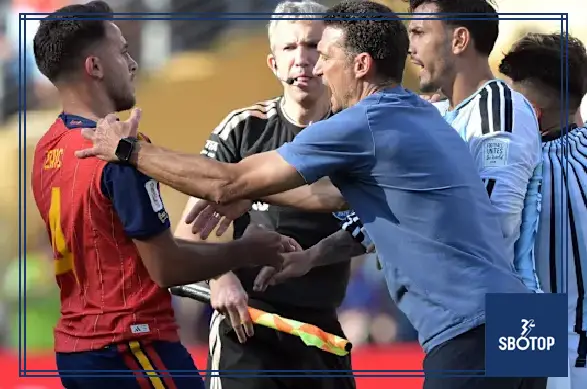
Players from Spain and Argentina became involved in an angry confrontation only moments after Spain completed a 1-0 extra-time victory at New York New Jersey Stadium. Pushing and shoving quickly spread across the pitch, forcing teammates, officials and Argentina manager Lionel Scaloni to intervene before the scenes became even more serious.
Leandro Paredes was at the centre of the confrontation and received a red card following the final whistle. Spanish and Argentine players exchanged words and physical challenges as the champions attempted to celebrate and the dethroned holders struggled to process an agonising defeat.
It was an ugly conclusion to a final already filled with fouls, frustration and emotional pressure.
For Spain, however, the disturbance could not diminish the scale of the achievement. Torres’ 106th-minute winner delivered the country’s first men’s World Cup title since 2010 and confirmed La Roja as the outstanding international team of their era. Argentina, meanwhile, were left with the pain of losing their crown and the uncomfortable images of their discipline collapsing after the result had been decided.
A Final That Never Found Its Rhythm
The confrontation did not emerge from nowhere. Tension had been building throughout a contest in which Argentina prioritised resistance, disruption and defensive discipline over attacking ambition.
Spain dominated possession and spent most of the match attempting to break through a crowded Argentine defensive block. Rodri controlled midfield, Pedro Porro and Marc Cucurella pushed forward from full-back, and Spain repeatedly moved the ball from one side of the pitch to the other.
Argentina’s plan was clear: remain compact, deny space between the lines and survive long enough to create one decisive moment or reach a penalty shootout.
The approach frustrated Spain, but it also left Lionel Messi and Julián Álvarez isolated. Argentina became the first team to complete the regulation 90 minutes of a men’s World Cup final without producing a shot. Spain, by contrast, registered 20 attempts before their opponents finally managed one during extra time.
The longer the match remained goalless, the more physical it became. Argentina attempted to interrupt Spain’s passing rhythm with tactical fouls, close marking and repeated contact.
Spain responded with their own aggression whenever Argentina attempted to counterattack. Challenges became heavier, complaints to the referee became more frequent, and confrontations followed several decisions.
It was not the flowing final many had expected from two teams filled with world-class talent. It became a test of patience, concentration and emotional control.
Emiliano Martínez Keeps Argentina Alive
Spain’s territorial superiority would have produced a far more comfortable scoreline without Emiliano Martínez.
The Argentina goalkeeper delivered another outstanding performance on the biggest stage, making a World Cup final-record 12 saves. He denied Spain throughout normal time and maintained the possibility that Argentina could drag the contest toward penalties, where his reputation alone would have created additional pressure for La Roja.
Martínez’s performance gave Argentina hope despite their inability to attack.
Spain created opportunities through wide combinations, crosses and cutbacks, but the final touch repeatedly failed them. Lamine Yamal and Mikel Oyarzabal tested the goalkeeper, while Dani Olmo searched for openings between Argentina’s midfield and defence.
Every Martínez save increased the tension. Spain knew they were the stronger team, yet the scoreboard refused to reflect their dominance.
Argentina sensed that survival was possible. Their defenders celebrated blocks and clearances, while midfielders attempted to slow the game whenever Spain built momentum.
The contest gradually became less about which team could produce the best football and more about which side could avoid the decisive mistake.
Enzo Fernández’s Dismissal Raises the Temperature
Argentina’s challenge became significantly harder near the end of normal time.
Enzo Fernández, already carrying a yellow card, made a reckless challenge on Spain defender Pau Cubarsí during stoppage time. The tackle sent the young centre-back into the air and resulted in a second booking.
Fernández’s dismissal reduced Argentina to 10 players just before extra time and increased the emotional intensity surrounding the match. Several players immediately moved toward the incident, while the referee attempted to restore control.
Argentina had already spent most of the match defending. Losing a midfielder forced Scaloni to make his side even more cautious.
Álvarez was eventually withdrawn for an additional defender, leaving Messi as the only meaningful attacking outlet. Argentina appeared prepared to sacrifice almost everything in pursuit of penalties.
Spain recognised the opportunity. Their substitutes increased the pace, the full-backs advanced even higher and the pressure around Martínez’s goal intensified.
The dismissal did not decide the final by itself, but it changed the balance of extra time. Argentina’s players were exhausted, their attacking threat had almost disappeared, and Spain could commit more bodies forward without fearing a sustained counterattack.
Spain’s Substitutes Transform the Contest
Luis de la Fuente’s bench ultimately separated the two teams.
Spain’s starting attack had controlled possession without finding a finish. De la Fuente responded by introducing Torres, Nico Williams and Pedri, giving his side greater speed, energy and directness.
Williams attacked defenders instead of simply recycling possession. Pedri increased the tempo through midfield. Torres moved continuously across the Argentine back line, waiting for a loose ball or defensive hesitation.
The changes placed even greater pressure on Argentina.
Williams briefly appeared to have scored during extra time, only for the effort to be disallowed. Spain could have become frustrated after another opportunity disappeared, but they continued to play with discipline.
The breakthrough arrived in the 106th minute.
Porro delivered a cross toward the far post, Williams redirected the ball into the centre, and Torres reacted before the surrounding defenders. The substitute struck powerfully with his left foot, sending the ball beyond Martínez and beneath the crossbar.
It was Torres’ first goal of the tournament and Spain’s 20th attempt of the final. More importantly, it was the strike that ended 16 years of waiting.
Torres Delivers Spain’s Second Star
Torres’ celebration captured the release of pressure that had built throughout the afternoon.
He sprinted away as teammates chased him toward the corner. Players left the bench, Spanish supporters erupted, and De la Fuente embraced members of his coaching staff.
The moment immediately recalled Andrés Iniesta’s winning goal in the 2010 final. Spain’s first World Cup title had also been decided during extra time, with Iniesta scoring against the Netherlands in Johannesburg.
Sixteen years later, another substitute had written his name into Spanish football history.
Torres later described the goal as belonging to the entire Spanish population. The statement reflected the collective character of the victory. Spain’s success had not depended on one superstar. Their midfield controlled matches, their defence conceded only once during the tournament, and their substitutes repeatedly made important contributions.
Argentina attempted one final response. Messi delivered a late corner, and Giuliano Simeone sent a difficult chance over the crossbar.
When the final whistle sounded, Spain’s players began celebrating a deserved victory.
Argentina’s emotions moved in the opposite direction.
Celebration Turns Into Confrontation
The first seconds after the whistle should have belonged entirely to Spain. Instead, attention shifted toward a series of clashes involving players from both teams.
Reuters reported pushing, shoving and players falling to the ground as Argentina’s frustration developed into a brawl. AP also recorded Scaloni and players from both sides becoming involved in the disorder.
According to the detailed account published by El País, the initial tension included a confrontation involving Nahuel Molina and Spanish captain Rodri. Eric García then moved toward the dispute, before Paredes became heavily involved.
The same report stated that Paredes confronted García physically and that Gavi rushed in after seeing his Spain teammate involved. Gavi was then knocked to the ground as more players arrived.
With the incident spreading, substitutes and coaching staff ran onto the pitch. Scaloni was among the first senior figures to enter the crowd and attempt to separate the players. Spain forward Borja Iglesias was also reported to have helped calm the situation.
The scenes were chaotic rather than organised. Several smaller arguments appeared to develop simultaneously, making it difficult for officials to identify every action immediately.
Paredes was eventually shown a red card after the match had ended.
Scaloni Forced Into Peacemaker Role
Scaloni’s intervention created one of the final’s most striking images.
Only moments earlier, the Argentina manager had watched his team lose a World Cup final after spending nearly two hours resisting Spain. He was dealing with the end of Argentina’s title defence, Messi’s likely final World Cup appearance and uncertainty about his own future.
Despite that emotional burden, Scaloni had to move quickly from defeated coach to peacemaker.
He entered the confrontation and attempted to pull players away from one another. His priority was preventing frustration from producing an incident that could further damage Argentina’s reputation.
The intervention was necessary because the situation had already gone beyond an ordinary exchange of words. Players were pushing, grabbing and surrounding one another while the Spanish squad attempted to begin its celebration.
Scaloni could not reverse the defeat, but he could attempt to prevent the evening from ending with a more serious act of violence.
His presence also offered a contrast with the behaviour of some players. While emotions overwhelmed those involved in the confrontation, the manager recognised the need to restore control.
Paredes at the Centre of Criticism
Paredes’ conduct became one of the main talking points after the final.
The midfielder had entered the match during the second half and quickly adopted an aggressive approach. His physical challenges reflected Argentina’s broader attempt to disrupt Spain, but he frequently operated close to the limit of what the referee would permit.
After the final whistle, that aggression appeared to spill beyond the competitive boundaries of the match.
Television footage and media reports placed Paredes at the centre of confrontations with García and Gavi. The red card ensured that the incident would become part of the official record, despite occurring after the game had ended.
Further disciplinary consequences could follow if FIFA reviews the available footage and referee’s report. Post-match dismissals can carry suspensions into future international fixtures, while additional misconduct may result in further sanctions.
Whatever the final punishment, Paredes’ actions distracted from the commitment Argentina’s players had shown during the tournament.
Losing a World Cup final produces extraordinary disappointment. It does not remove the responsibility to accept the result without attacking opponents.
Argentina’s Frustration Boils Over
Argentina’s anger was understandable, even if the physical response was not.
The defending champions had entered the tournament attempting to become the first team since Brazil in 1962 to retain the World Cup. Messi had returned at the age of 39 for one final opportunity, and Scaloni’s side had survived a difficult route to the final.
They were then outplayed by Spain and forced to depend almost entirely on Martínez.
For more than 100 minutes, Argentina remained close enough to believe they could escape with the trophy. Torres’ goal destroyed that possibility in a single movement.
The final whistle confirmed the end of a successful era, or at least the end of one important chapter. Several senior players may never appear at another World Cup, while Messi left the pitch in tears after being denied a second consecutive title.
Those emotions explain why Argentina were devastated. They do not excuse the scenes that followed.
The greatest teams are judged not only by how they celebrate victory but also by how they respond to defeat. Argentina’s immediate reaction fell below the standard expected of former champions.
Also Read:
- SBOTOP: Declan Rice Makes England Captaincy History but Rejects Empty Trophy Talk After Fresh World Cup Pain
- SBOTOP World Cup Final Fallout: Argentine Press Rallies Behind Messi’s Side After Disappointing Defeat to Spain
- SBOTOP Spain vs Argentina: Messi Denied a Final Masterpiece as Super-Subs Deliver World Cup Glory for La Roja