Argentina’s defence of the World Cup ended with defeat, frustration and an ugly confrontation that threatened to overshadow everything Lionel Scaloni’s team had achieved during another deep tournament run.
Spain defeated the defending champions 1-0 after extra time in the 2026 World Cup final, with substitute Ferran Torres scoring the decisive goal in the 106th minute. La Roja deservedly secured their second world title after controlling possession, creating most of the chances and restricting Lionel Messi’s side to very little attacking threat.
Yet the final did not conclude with Spain’s players being allowed to celebrate peacefully.
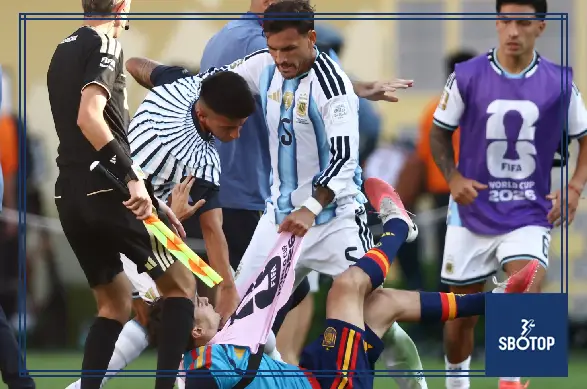
Seconds after the referee ended the match, Argentina midfielder Leandro Paredes became heavily involved in a confrontation with Spanish players. Pushing and shoving spread across the pitch as substitutes, coaches and officials rushed toward the dispute. Paredes knocked Gavi to the ground during the incident and was shown a red card after the final whistle. Argentina coach Scaloni had to enter the crowd and attempt to restore order.
It was a bitter and embarrassing conclusion for the former champions. Argentina had lost an intensely competitive final, but the behaviour that followed turned understandable disappointment into an unnecessary display of indiscipline.
Spain Earn the Right to Celebrate
Spain’s victory was not the product of luck or one isolated mistake. Luis de la Fuente’s team controlled the final from its opening stages. Rodri dictated the tempo in midfield, Spain’s full-backs advanced aggressively, and the wide players stretched Argentina’s defensive structure. Every time La Albiceleste recovered possession, Spain pressed quickly and prevented Messi or Julián Álvarez from leading a meaningful counterattack.
Argentina defended with commitment but offered little going forward. Messi was regularly forced to drop into midfield simply to receive the ball, while Álvarez spent long periods isolated between Spain’s centre-backs.
Emiliano Martínez prevented the scoreline from becoming more comfortable. The goalkeeper produced a series of important saves as Spain repeatedly tested Argentina’s resistance.
However, Spain continued attacking rather than becoming frustrated. Their patience was eventually rewarded when Torres converted during extra time, ending the country’s 16-year wait for another men’s World Cup crown. Spain had last lifted the trophy in 2010, when Andrés Iniesta also scored an extra-time winner.
The Spanish players therefore had every right to flood the pitch after the final whistle.
Their substitutes ran toward the starting players, staff members embraced, and celebrations began across the stadium. It was the release of years of preparation and more than 120 minutes of pressure.
That should have been the final image of the night.
Instead, Argentina’s anger interrupted the celebration.
Paredes at the Centre of the Flashpoint
The confrontation reportedly began as Spanish substitutes entered the pitch and several players exchanged words near midfield.
Nahuel Molina became involved in an argument with Rodri, prompting Spain defender Eric García to approach. Paredes then moved quickly toward García, and the dispute became physical. Reports described Paredes making contact around García’s neck or throat before further players arrived. Gavi rushed into the confrontation and was subsequently forced to the ground as the incident escalated.
What began as a disagreement rapidly developed into a mass confrontation.
Players from both squads surrounded one another. Some attempted to separate their teammates, while others added to the confusion by pushing or shouting. Coaching staff ran from the technical areas, and officials tried to identify the most serious offences.
Paredes remained one of the central figures throughout the incident.
The referee eventually produced a red card, officially ending the midfielder’s tournament in disgrace. The dismissal came after the final whistle, but it may still result in a suspension for Argentina’s future international fixtures.
The card also ensured that Paredes’ behaviour became part of the official record of the final rather than merely an unfortunate exchange hidden within Spain’s celebrations.
Aggression Had Been Building Throughout the Match
The post-match scenes were shocking, but the tension had been increasing long before the final whistle.
Argentina approached the game with a physical strategy designed to disrupt Spain’s rhythm. Scaloni’s players defended compactly, challenged aggressively and attempted to prevent La Roja’s midfielders from receiving the ball comfortably.
Paredes entered from the bench and immediately brought additional intensity. He was booked after shoving Rodri in an off-the-ball incident during the second half. Players from both sides gathered around the referee after the challenge, offering an early warning that emotions were approaching dangerous levels.
Enzo Fernández was later dismissed after receiving a second yellow card during stoppage time. His red card left Argentina with 10 men for extra time and placed even more pressure on an exhausted defensive unit.
Spain recognised the advantage and pushed forward with greater freedom. Nico Williams attacked tired defenders, Pedri accelerated the passing in midfield, and Torres searched for spaces across Argentina’s back line.
When Spain finally scored, Argentina were physically and emotionally drained. They had spent most of the contest resisting pressure while creating almost nothing themselves.
That frustration did not disappear when the referee ended the match. It exploded.
Defeat Explains the Emotion, Not the Behaviour
Losing a World Cup final is one of the most painful experiences in professional football.
Argentina were attempting to retain the title they had won in Qatar four years earlier. Victory would have made them the first country since Brazil in 1962 to win consecutive World Cups.
The final also carried enormous emotional significance because it was expected to be Messi’s last appearance at the tournament. At 39, Argentina’s captain had returned for one final attempt to lift football’s greatest trophy.
Torres’ goal destroyed that dream.
Argentina had survived Spain’s pressure for more than 100 minutes. Martínez had made save after save, and the team appeared increasingly focused on reaching penalties. One goal changed everything.
Those circumstances explain why Argentina’s players were devastated. They do not justify confronting opponents who were attempting to celebrate.
Professional footballers are expected to control themselves even in the most painful moments. Argentina had already demonstrated their ability to win with passion. The final required them to show that they could lose with dignity.
Several players failed that test.
Scaloni Forced to Stop His Own Players
Scaloni’s intervention was one of the most revealing moments of the confrontation.
The Argentina manager had just experienced the crushing disappointment of losing a World Cup final. He was also facing questions about Messi’s future, the ageing core of his squad and whether his own successful era as national-team coach was approaching its conclusion.
Despite those emotions, Scaloni recognised that the situation required immediate action.
He entered the confrontation, gestured toward the players and attempted to separate those involved. Other staff members joined him as the argument continued.
The manager’s response prevented the incident from becoming even more serious. It also highlighted the contrast between leadership and uncontrolled anger.
Scaloni could not change the result, but he understood that Argentina’s reputation was being damaged in real time. The longer the confrontation continued, the more it distracted from the team’s journey to the final and reinforced criticism that the defeated champions were behaving like sore losers.
For a coach who had worked hard to create unity and discipline, being forced to physically calm his own players was an unfortunate final responsibility.
Paredes’ Conduct Attracts Heavy Criticism
Paredes has long been known as a combative midfielder.
His willingness to challenge opponents, protect teammates and engage in the emotional side of matches has made him valuable to Argentina. During the successful Scaloni era, that competitive edge often contributed to the team’s resilience.
There is, however, a difference between competitive aggression and misconduct.
Paredes crossed that line after the final.
He had already been booked during the game and was fortunate to remain available until the end. His decision to become involved in another confrontation after the contest had finished showed poor judgement.
Commentators and former players reacted strongly. The midfielder was accused of embarrassing Argentina and turning the closing moments of the World Cup into an unnecessary spectacle. Some reports described punches or throat contact during the dispute, while television footage clearly showed Gavi being shoved to the ground.
Paredes may argue that he was responding to provocation or defending a teammate. That explanation would not remove his responsibility.
The match was over. Spain had won. Walking away was the only sensible option.
Argentina’s Broader Discipline Problem
Paredes was not the only Argentine player whose conduct attracted attention.
Fernández’s second yellow card left his team at a severe disadvantage during extra time. Molina was involved in the initial post-match dispute, while other substitutes entered the confrontation rather than immediately attempting to end it.
Argentina’s players also drew criticism during the presentation ceremony. Reports from Spain claimed that members of the defeated squad turned away or moved toward their supporters instead of observing the champions’ trophy celebration in the expected manner.
Individually, each action might be dismissed as a product of disappointment. Combined, they created an unpleasant picture.
Argentina have built much of their recent success on emotional intensity. Their players compete for every ball, defend one another and treat the national shirt with enormous seriousness.
That identity has brought trophies. It can also become destructive when the emotion is not controlled.
The final demonstrated the danger. The same passion that carried Argentina through difficult knockout matches became anger once victory was no longer possible.
Martínez Deserved a Better Ending
The chaos was particularly unfortunate because it distracted from Martínez’s exceptional performance.
Argentina’s goalkeeper was their outstanding player. He repeatedly denied Spain and kept the defending champions level long after the balance of play suggested they should have been behind.
Martínez’s positioning, reactions and composure gave Argentina a realistic chance of reaching penalties. Considering his record in shootouts, Spain would have understood the danger of allowing the contest to remain goalless.
Torres eventually beat him from close range, but the goalkeeper had done everything possible to keep his country in the final.
His performance deserved to be remembered as an example of resistance under extreme pressure. Instead, much of the immediate conversation focused on the post-match brawl.
The same was true for Argentina’s defenders, who had worked tirelessly despite Spain’s dominance. Their effort was imperfect, but it kept the final alive until the second period of extra time.
Paredes’ conduct shifted attention away from those contributions.
Messi’s Farewell Overshadowed
The incident also complicated what may have been Messi’s final World Cup appearance.
Argentina’s captain could not influence the game as he had hoped. Spain surrounded him whenever he received possession and prevented him from operating near the penalty area.
There was no final dribble, decisive pass or late goal.
After the defeat, Messi appeared emotional as he received his runners-up medal. His disappointment became one of the night’s most powerful images.
That moment should have represented the end of an extraordinary World Cup story. Messi had experienced heartbreak in 2014, completed his career by winning in 2022 and returned four years later to lead Argentina into another final.
His legacy did not depend on defeating Spain.
Unfortunately, the confrontation added an ugly distraction to the possible farewell. Instead of the world reflecting only on Messi’s achievements and Spain’s victory, the discussion quickly moved toward Paredes’ red card and Argentina’s lack of discipline.
Messi had given Argentina countless moments of pride. His teammates should have ensured his final World Cup ended with dignity, regardless of the result.
Also Read:
- SBOTOP: World Cup Final Erupts in Chaos as Scaloni Intervenes After Spain End 16-Year Title Wait
- SBOTOP: Declan Rice Makes England Captaincy History but Rejects Empty Trophy Talk After Fresh World Cup Pain
- SBOTOP World Cup Final Fallout: Argentine Press Rallies Behind Messi’s Side After Disappointing Defeat to Spain