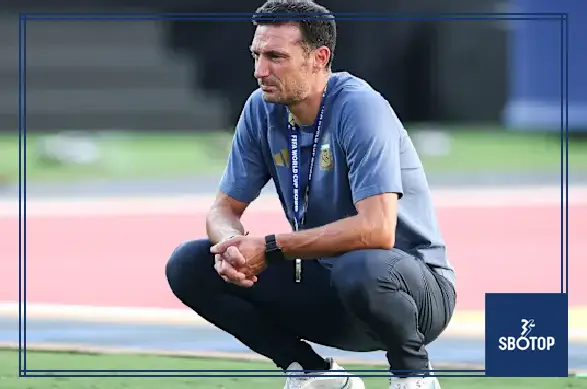
Lionel Scaloni entered Argentina’s post-match press conference carrying the emotional weight of a lost World Cup final, the possible end of an extraordinary footballing cycle and a decision that could reshape the future of the national team.
For several minutes, the Argentina manager attempted to analyse the 1-0 extra-time defeat to Spain with the calmness that had defined his leadership. He acknowledged that Spain deserved to win, thanked his players for taking the defending champions to another final and urged supporters to remain proud of a team that had given everything.
Then the emotion became impossible to contain.
As Scaloni discussed whether he could rebuild Argentina for another four-year journey, his voice weakened. He wiped away tears, apologised to the journalists in front of him and left the room to sustained applause. His departure created one of the most powerful images of the 2026 World Cup’s final night.
Scaloni did not formally resign. He confirmed that he intended to complete his contract, which runs until December 2026, and said he would speak with Argentine Football Association president Claudio Tapia. However, his admission that he needed time to reflect immediately created uncertainty around the position he has held since 2018.
The question is no longer whether Scaloni has achieved enough to deserve the job. His record has answered that beyond doubt.
The question is whether he still possesses the emotional energy required to begin again.
A Painful Ending in New Jersey
Argentina arrived at New York New Jersey Stadium hoping to become the first men’s team since Brazil in 1962 to retain the World Cup. Instead, their title defence ended against a Spain side that controlled the final and eventually secured victory through Ferran Torres’ 106th-minute goal.
Scaloni’s team defended deeply for long periods and relied heavily on Emiliano Martínez to remain level. Their challenge became even more difficult when Enzo Fernández received a second yellow card near the end of normal time, leaving Argentina with 10 players for extra time.
They came within minutes of forcing a penalty shootout. Torres’ finish ended that possibility and delivered Spain’s second men’s World Cup crown.
Scaloni did not attempt to disguise the balance of the match afterward. He accepted that Spain had been superior and said Argentina had to show the same dignity in defeat that they had shown during their greatest victories.
That response was significant after a tense conclusion that included a post-match confrontation and Leandro Paredes being sent off after the final whistle. While frustration spread among some of his players, Scaloni’s public message remained one of acceptance, responsibility and gratitude.
He was clearly devastated, but he did not blame the referee, the schedule or individual mistakes. He focused on the effort of his squad and the difficulty of accepting that their remarkable journey had ended one victory short.
“It Hurts My Soul”
The emotional atmosphere intensified when Scaloni was asked about his own future.
He explained that continuing as Argentina manager would require far more than signing another contract or selecting another squad. It would mean mentally resetting, reconstructing the group and finding a new collective purpose after years of extraordinary success.
Scaloni said the situation hurt him deeply and suggested it was “only fair” that he be allowed time to think before making a final decision. He then became overwhelmed, apologised and left the press conference.
The applause that followed him out of the room reflected the respect he has earned from the Argentine media.
Managers are often questioned aggressively after losing major finals. Scaloni was instead recognised as someone confronting the possible end of a historic era. The journalists present were not simply watching a coach refuse to provide an immediate answer. They were witnessing the emotional cost of eight years spent carrying the expectations of one of football’s most demanding nations.
His tears were not only about losing to Spain.
They reflected the accumulated pressure of rebuilding Argentina, protecting Lionel Messi, managing generational expectations and maintaining a standard that became almost impossible to satisfy.
From Temporary Appointment to National Icon
Scaloni’s rise remains one of the most unexpected managerial stories in international football.
He was appointed after Argentina’s disappointing exit from the 2018 World Cup, initially with limited expectations. His lack of senior head-coaching experience generated significant scepticism, and many considered him a temporary solution while the federation searched for a more established figure.
Instead, Scaloni gradually transformed Argentina.
He simplified the tactical structure, introduced younger players and created an environment in which Messi could operate without carrying every responsibility alone. Rodrigo De Paul, Cristian Romero, Lautaro Martínez, Julián Álvarez, Alexis Mac Allister and Emiliano Martínez became central members of a group defined as much by emotional unity as technical quality.
Argentina ended a 28-year major-trophy drought by winning the 2021 Copa América. They followed that achievement by lifting the 2022 World Cup and then successfully defending the Copa América in 2024. Scaloni subsequently guided the team into a second consecutive World Cup final in 2026.
He became only the second Argentine manager to reach consecutive World Cup finals, following Carlos Bilardo in 1986 and 1990, and only the fifth coach of any nationality to achieve that distinction.
Scaloni began as an uncertain appointment. He could leave as the most decorated manager in Argentina’s history.
The Difficulty of Recreating the Group
Scaloni’s uncertainty appears to be driven less by fear of failure than by his understanding of what success required.
Argentina’s greatest achievements under him were not produced only by a formation or a group of talented individuals. They depended on trust, shared suffering and the development of a squad that believed completely in its manager and in one another.
Rebuilding that chemistry is not automatic.
Several senior players are approaching the end of their international careers. Messi is 39, while other members of the core that won in Qatar may no longer be central figures by the next World Cup. Eight Argentina players started both the 2022 and 2026 finals, demonstrating the continuity Scaloni maintained across the two tournaments. A new cycle would almost certainly require substantial change.
Scaloni would need to identify new leaders, introduce younger players and create an identity less dependent on the generation that delivered Argentina’s greatest modern period.
That task may excite another coach. For Scaloni, it also represents an enormous emotional challenge.
He knows what was required to create the first version of this team. He knows how many difficult decisions, private conversations and moments of doubt occurred before the trophies arrived. Beginning that process again would mean accepting that part of his original group is ending.
His tears suggested that he was not yet ready to confront that reality.
A Decision Must Not Be Made in Defeat
Scaloni’s request for time was sensible.
Major decisions made immediately after a World Cup final can be shaped by exhaustion rather than clear judgement. The Argentina manager had just completed an intense tournament in which his team survived difficult knockout matches before facing Spain.
The defeat remained fresh. Messi had left the field in tears. Scaloni’s players were processing the loss of their title, while questions about retirements and disciplinary incidents were already beginning.
Under those circumstances, a definitive announcement would have served the media cycle more than the national team.
Scaloni indicated that he already had an idea of what he wanted to do, but he also recognised the importance of speaking with Tapia and allowing himself time to recover before confirming it publicly. He said he would honour the remainder of his contract before determining the next step.
That distinction matters.
He has not abandoned Argentina in the immediate aftermath of defeat. He has asked for space to consider whether he remains the right person to oversee the next stage.
After everything he has delivered, that request is reasonable.
Tapia Faces a Crucial Conversation
The next discussion between Scaloni and Tapia could determine the direction of Argentine football.
The federation president supported Scaloni when the coach was still viewed with suspicion. That decision produced a period of success few could have predicted. Their relationship will now be tested by a very different challenge.
Tapia must determine whether Scaloni’s uncertainty is temporary emotional exhaustion or evidence that his cycle has reached a natural conclusion.
Convincing a successful coach to remain can be tempting, but continuation must be based on commitment rather than gratitude. If Scaloni stays only because players, supporters or officials pressure him, the arrangement could become damaging once the difficult rebuilding work begins.
Argentina need a manager fully prepared to make unpopular decisions. Some celebrated veterans may need to be replaced. Younger players will require opportunities, and tactical adjustments will be necessary as Messi’s role changes or disappears completely.
Scaloni must decide whether he wants responsibility for those choices.
Tapia must decide whether Argentina should wait for him.
Messi’s Future Adds Another Layer
Scaloni’s decision is closely connected to the uncertainty surrounding Messi.
The 2026 final may have been the captain’s final World Cup appearance, but Scaloni said he had not held a definitive conversation with him about retirement. He maintained that Messi should continue playing until he personally chooses to stop and praised the 39-year-old’s tournament.
Messi scored eight goals in the competition and played every minute of Argentina’s knockout campaign. His influence helped carry the team into another final, although Spain successfully limited him in the decisive match.
Scaloni described him as the greatest footballer to play the game and urged supporters to appreciate both his 2026 performance and everything he had already achieved for Argentina.
The relationship between coach and captain has been central to Argentina’s success.
Scaloni helped create the environment in which Messi finally won major international trophies. Messi, in return, gave authority and belief to a young coach attempting to establish himself.
Should both depart within the same period, Argentina would face a complete transformation.
Replacing Messi’s goals and creativity would be difficult enough. Replacing the emotional stability created by his partnership with Scaloni would be even harder.
Pride Despite the Defeat
Although his future dominated the press conference, Scaloni did not allow uncertainty to erase his pride in the players.
Argentina’s route to the final had been demanding. Their knockout campaign included narrow and emotionally draining contests, yet the defending champions continued finding ways to advance.
Against Spain, they were unable to impose themselves with the ball, but they defended with determination and remained close to penalties despite playing extra time with 10 men.
Scaloni said the players had left everything on the pitch and argued that such commitment made criticism difficult. He thanked them for reaching another World Cup final and presenting an example of resilience to the country.
He also addressed Argentina’s supporters, recognising that finishing second could not produce the same joy as becoming champions. His message was that defeat had to become the starting point for recovery rather than the reason for destroying everything the team had built.
It was an important reminder.
Argentina lost the trophy, but they did not lose the achievements of the Scaloni era. One extra-time goal could not erase two Copa América titles, the 2022 World Cup or the connection established between the national team and its public.
The Emotional Cost of Constant Expectations
Success transformed the way Argentina judged Scaloni.
At the beginning of his tenure, reaching a final would have represented progress. After repeated trophies, anything less than winning began to feel disappointing.
That change created a difficult environment. Scaloni was no longer managing a team attempting to recover from failure. He was managing champions expected to remain champions indefinitely.
Every squad selection became a national debate. Every tactical decision was measured against previous triumphs. Every younger player was asked whether he could preserve a golden era.
The expectation to reproduce historic success can become more exhausting than the original pursuit of it.
Scaloni’s remarks revealed that burden. He questioned whether something of the same magnitude could be created again and emphasised the mental reset required to continue.
There is no weakness in recognising exhaustion.
International management is often portrayed as less demanding than club football because coaches oversee fewer matches. The emotional pressure can be greater, particularly in Argentina, where the national team is tied closely to identity, memory and public mood.
Scaloni has carried that pressure for eight years.
Reasons for Scaloni to Continue
There are strong arguments for him to remain.
Argentina still possess an excellent squad, a winning culture and several younger players capable of becoming the foundation of a new team. Scaloni understands the federation, the dressing room and the expectations surrounding the job better than any external candidate.
He has also demonstrated an ability to evolve.
The side that won the 2021 Copa América was not identical to the team that lifted the World Cup in 2022. The 2026 finalists also included tactical and personnel changes. Scaloni has never depended exclusively on one formation.
Remaining would give him the opportunity to manage the transition himself rather than leaving another coach to interpret the culture he created.
There may also be unfinished emotional business. Losing to Spain could motivate him to pursue another major title and prove that Argentina’s success can continue beyond the original generation.
But those reasons matter only if Scaloni feels renewed after reflecting.
Also Read:
- SBOTOP: Kylian Mbappé Makes World Cup History with Second Golden Boot After Record-Shattering 2026 Run
- SBOTOP: Argentina’s World Cup Final Shame as Paredes Ignites Post-Match Brawl and Is Sent Off After Spain Triumph
- SBOTOP: World Cup Final Erupts in Chaos as Scaloni Intervenes After Spain End 16-Year Title Wait