Spain returned to the summit of world football by refusing to abandon the principle that has shaped its greatest teams: control the ball, control the spaces and trust that patience will eventually create victory. The 2026 World Cup final was not Spain’s most beautiful performance. It was tense, exhausting and frequently frustrating. Argentina defended with determination, goalkeeper Emiliano Martínez produced a historic display, and the match remained goalless deep into extra time. Yet Spain continued passing, probing and believing until substitute Ferran Torres struck in the 106th minute to secure a 1-0 victory and the country’s second men’s World Cup title.
That decisive goal rewarded more than one night of persistence. It completed a tournament in which Spain remained faithful to a collective style built around possession, movement and shared responsibility. Eight different players contributed to their 14 goals, underlining that this was not a campaign dependent on a single superstar or one extraordinary scorer. Spain’s strength came from a system in which every player understood the ball as both a creative weapon and a form of protection.
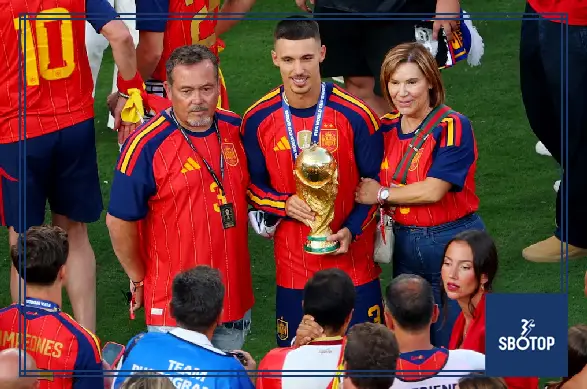
When Rodri finally lifted the trophy in New Jersey, the celebration spread far beyond the stadium. Supporters filled streets, squares and beaches across Madrid, Barcelona and other parts of the country. In Rocafonda, the working-class neighbourhood where Lamine Yamal learned to play, residents celebrated one of their own becoming a world champion. The triumph became a national experience shared across generations, regions and communities.
Spain had won the World Cup with the ball at their feet. The country embraced the victory with its arms around one another.
A Final That Tested Spain’s Faith
The final against Argentina challenged Spain’s footballing convictions more severely than any previous match in the tournament.
Lionel Scaloni’s defending champions approached the contest with a compact structure designed to deny space between the lines. Lionel Messi often dropped deeper to help Argentina escape pressure, while the players around him concentrated on closing passing lanes and frustrating Spain’s attacking rhythm.
Spain dominated possession and territory but initially struggled to convert control into goals. They circulated the ball through Rodri, moved Argentina from side to side and repeatedly advanced into dangerous areas. However, Martínez stood between them and the trophy.
The Argentina goalkeeper made a World Cup final-record 12 saves. Spain produced 20 attempts before Argentina managed its first genuine shot, yet the score remained level through regulation time. Only Martínez’s reactions, positioning and refusal to be beaten prevented the match from being decided earlier.
That imbalance created a psychological test.
Possession can become meaningless when it produces no reward. A team can dominate the ball and still begin to doubt itself. Passes that once expressed confidence can become cautious, and players can start forcing shots or abandoning their positions.
Spain resisted that temptation.
They did not treat the absence of a goal as proof that their approach had failed. They continued to build patiently, trusted their substitutes and maintained enough defensive balance to stop Argentina from threatening on the counterattack.
Their reward arrived in extra time.
Ferran Torres Delivers the Goal of a Lifetime
Torres began the final on the bench and entered knowing that one action could change his career forever. His tournament had not been defined by goals. Spain’s attacking success had been distributed across the squad, and other forwards had received more attention. Yet when a bouncing ball fell inside the penalty area in the 106th minute, Ferran Torres reacted before the exhausted Argentine defenders around him.
He struck with his left foot, sending the ball beneath the crossbar and beyond Martínez.
The finish ended Spain’s 16-year wait for another men’s World Cup and transformed Torres from substitute into national hero. He later described it as a goal scored by Spain’s entire population, a reflection of how completely the moment belonged to the country rather than to one player alone.
The goal also represented the final product of Spain’s collective patience.
It did not emerge from abandoning possession or launching desperate passes into the penalty area. Spain had continued to move Argentina, recover second balls and keep the defending champions under pressure. Torres provided the decisive touch, but the opportunity was created by a team that refused to lose its shape or its belief.
In that sense, he was the perfect match-winner for this Spanish side.
The champions had never been about one dominant figure. Their glory belonged to every player who started, every substitute who entered and every squad member who sustained the standards behind the scenes.
Rodri Gives Spain Its Rhythm
At the centre of Spain’s triumph stood Rodri.
The captain did not need to score the winning goal to determine the final. His influence could be seen in the rhythm of the match, the positions Spain occupied and the security with which they continued attacking.
Rodri repeatedly offered himself to defenders building from the back. When Argentina attempted to press, he found the angle that allowed Spain to escape. When possession reached the final third and an attack broke down, he positioned himself to recover the ball or delay the counterattack.
His intelligence allowed Spain to attack without becoming reckless.
That balance was essential because the final remained goalless for so long. Had Spain committed too many players forward in frustration, Messi and Argentina might have found the transition they were waiting for. Rodri ensured the team remained ambitious without losing control.
His contribution across the competition earned him the Golden Ball as the World Cup’s best player. The award recognised a type of excellence that is sometimes hidden behind goals and assists: the capacity to understand every phase of a match and to make an entire team function more effectively.
Rodri lifted the trophy as Spain’s captain, but he also embodied the philosophy that had delivered it.
He treated possession not as decoration but as responsibility.
More Direct Than the Champions of 2010
Spain’s 2026 triumph inevitably invited comparisons with the team that won the country’s first World Cup in South Africa.
The 2010 champions were built around Xavi, Andrés Iniesta, Sergio Busquets and Xabi Alonso. They suffocated opponents through long passing sequences and controlled matches with exceptional technical precision. Their victory also came through an extra-time goal, with Iniesta scoring against the Netherlands.
The new champions shared the same respect for possession but expressed it differently.
This Spain played with greater width and more direct acceleration. Lamine Yamal and the other wide attackers stretched defensive structures, inviting full-backs and midfielders to exploit the spaces created inside. The team could circulate patiently, but it could also attack quickly once an opening appeared.
That evolution was important.
Spain’s unsuccessful campaigns after 2010 had shown that possession alone could become predictable. Opponents learned to defend narrowly, allow harmless passing and wait for mistakes. Luis de la Fuente’s side kept the traditional foundation while adding speed, aggression and positional flexibility.
They did not worship the ball simply because it was beautiful.
They valued it because it allowed them to dictate where the match was played.
A Defence Built Through Possession
Spain’s attacking identity attracted most of the attention, but their defensive record was equally important.
La Roja conceded only one goal in eight matches, setting a record for the fewest goals allowed by a World Cup champion. Unai Simón collected the Golden Glove, while Pau Cubarsí was named the tournament’s leading young player.
Those achievements were not separate from Spain’s possession game.
Keeping the ball reduced the time opponents had to attack. Immediate pressure after losing possession stopped counterattacks before they could develop. Rodri protected the centre, while Spain’s defenders stepped forward confidently because they trusted the structure around them.
The final demonstrated that connection.
Argentina possessed Messi and several dangerous forwards, yet Spain prevented them from registering a shot on target. The defending champions spent so much energy without the ball that their attacking players often received possession too far from goal to cause damage.
Spain defended through positioning, concentration and control.
The clean sheet was not the product of sitting deep around their own penalty area. It resulted from pushing the match into Argentina’s half and making the opposition chase.
Argentina’s Resistance Nearly Succeeded
Spain’s superiority should not erase the courage of Argentina’s defensive performance.
The defending champions understood that they could not allow the final to become an open technical contest. They reduced space, challenged aggressively and trusted Martínez to deal with the chances that escaped their structure.
For more than 100 minutes, the plan kept them alive.
Argentina’s hopes became more difficult when Enzo Fernández was dismissed late in regulation time following a reckless challenge. Playing extra time with 10 men forced Scaloni’s side even deeper and increased the pressure on an already exhausted defence.
They still came close to penalties, where Martínez’s reputation might have transformed the final again.
Spain therefore needed more than technical quality. They required emotional control.
They had to accept that dominating a match did not guarantee an immediate reward. They had to continue making correct decisions even as the clock moved closer to a shootout.
That persistence separated the champions from a team merely capable of attractive football.
Spain’s possession was supported by resilience.
A Generation Built for Shared Success
The distribution of Spain’s goals illustrated the collective character of their campaign.
Their 14 goals were scored by eight players. That pattern echoed their European Championship success in 2024, when a broad range of contributors made them difficult to contain. Opponents could not simply remove one striker or one creative midfielder and expect Spain’s threat to disappear.
The final provided the clearest example.
Torres came from the bench to score. Rodri controlled midfield. Simón completed another clean sheet. Cubarsí defended with the composure of a veteran, while Spain’s wide players continued creating space even when Argentina crowded the centre.
Every part of the team supported another.
The young players brought fearlessness and speed. The experienced players supplied structure and calmness. De la Fuente created an environment in which neither group appeared limited by age.
This balance offers Spain reason to believe the World Cup may represent the beginning of another dominant period rather than the end of a single tournament journey.
Many of the team’s most important players remain young enough to influence several future competitions.
Thirty-Eight Matches Without Defeat
Spain’s World Cup victory extended their unbeaten run to 38 matches, establishing a new record for a European men’s national team. The sequence included 29 victories and nine draws and surpassed Italy’s previous 37-match run.
That record demonstrated the consistency behind the trophy.
World Cups can sometimes be won by teams that find form at the perfect moment. Spain’s success was different. It formed part of a sustained period in which they repeatedly imposed their style across competitive matches.
The European Championship in 2024 restored Spain to the top level of international football. The World Cup confirmed that their development had continued.
They defeated different types of opponents throughout the knockout rounds. Portugal tested their patience, Belgium challenged their control and France brought pace and individual quality. Argentina offered defensive resistance and tournament experience.
Spain found a solution each time.
Their football was recognisable, but it was not rigid.
Also Read:
- SBOTOP: Nicolás Otamendi Blasts Rodri Over Alleged Referee Pressure After Argentina’s World Cup Final Loss
- SBOTOP: Lionel Messi Faces Fierce Backlash Over ‘Embarrassing’ Bid to Get Marc Cucurella Sent Off in World Cup Final
- SBOTOP: Toni Kroos Hails Spain’s World Cup Triumph as a Victory for Football While Criticising Argentina