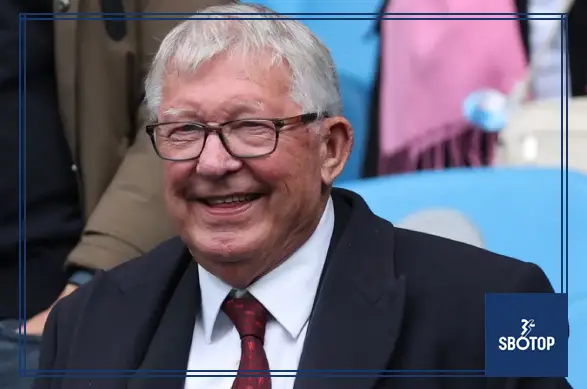
Few football rivalries carry the emotional weight of Manchester United and Liverpool. Over the years, the two clubs have produced unforgettable matches, heated exchanges and plenty of mind games. Sir Alex Ferguson, one of the greatest managers in football history, was particularly famous for his fierce approach to rivalry.
But one story from the early 1990s reveals a much more personal side of Ferguson.
The legendary Manchester United manager reportedly stopped acknowledging Gary McAllister for more than two decades after hearing a spontaneous comment from the former Leeds United midfielder. What started as a joke during a title celebration eventually became a remarkable story of silence, pride and, ultimately, compassion.
The Incident That Started It All
The story goes back to the end of the 1991/92 First Division season.
At the time, McAllister was playing for Leeds United, who were competing for the English title. Leeds could secure the championship if Manchester United failed to beat Liverpool in their final league fixture.
McAllister watched Liverpool vs Manchester United at teammate Lee Chapman’s home, alongside Eric Cantona, David Batty and a television crew.
The result went exactly the way Leeds needed.
Liverpool won 2-0, allowing Leeds to finish at the top of the table and claim the First Division title. For McAllister and his teammates, it was a moment of celebration.
However, the mood became even more memorable when Ferguson appeared on television after the defeat.
McAllister’s Spontaneous Comment
Ferguson was clearly unhappy with the result. According to McAllister, the Manchester United manager appeared on television looking furious and insisted that Leeds had not truly won the championship.
Ferguson’s message was essentially that Manchester United had lost the title rather than Leeds winning it.
Watching the broadcast, McAllister could not resist making a joke.
He later recalled the moment in an interview with Sport & Fitness Middle East in 2017, explaining that he made a remark about Ferguson’s appearance and his reaction to defeat.
McAllister described Ferguson’s red-faced expression as being, in his words, not particularly graceful in defeat.
The joke seemed harmless to everyone in the room.
Then came the warning.
Manchester United legend Denis Law was working as a commentator and reportedly communicated with the television crew.
His message to McAllister was simple: Ferguson could hear him.
That was apparently enough to turn an innocent joke into a relationship that would remain frozen for years.
Ferguson Refused to Speak to Him
According to McAllister, Ferguson did not forget the comment.
For more than 20 years, the Manchester United boss reportedly refused to acknowledge him whenever they crossed paths.
Their encounters were sometimes surprisingly awkward.
McAllister recalled seeing Ferguson at airports and hotels, including during trips to Lithuania and Albania. Yet despite being in the same place, Ferguson would simply walk past without saying a word.
The former Leeds midfielder later told the story with humor, but the length of the silence showed just how strongly Ferguson had taken the comment.
It was classic Ferguson in some ways: fiercely competitive, proud and unwilling to forget a perceived slight.
The episode also illustrated how football rivalries could extend beyond the pitch.
A Long Silence Finally Came to an End
Despite the extraordinary length of their cold war, the relationship eventually changed because of a far more serious event.
In 2006, McAllister’s wife, Denise, sadly died after battling cancer.
That tragedy completely changed the situation between the two men.
At a moment when McAllister was experiencing one of the most difficult periods of his life, Ferguson reached out.
According to McAllister, Ferguson was among the first people to contact him.
That gesture had a profound impact on the former footballer.
McAllister later described it as an example of Ferguson’s true character. The man who had ignored him for more than two decades suddenly showed tremendous compassion when it mattered most.
Ferguson Revealed a Different Side
The story became more than just an amusing tale about football rivalry.
McAllister explained that Ferguson invited him to Manchester United’s Carrington training ground and told him that he would always be welcome at Old Trafford.
Even more touching was the fact that the first condolence card McAllister received came from Ferguson’s wife.
For McAllister, those gestures changed his perception of the legendary manager.
The lessons he took from the experience were clear:
- Ferguson was intensely competitive on the football pitch.
- He could hold a grudge when he felt disrespected.
- His personal character went beyond his image as a ruthless manager.
- He was willing to put rivalry aside when someone was facing genuine hardship.
That final point is arguably the most important part of the story.
More Than a Football Rivalry
Sir Alex Ferguson built his Manchester United legacy on an extraordinary level of competitiveness. During his reign, he constantly searched for ways to gain an advantage, whether through tactics, motivation or psychological pressure.
The story involving Gary McAllister fits perfectly into that image.
A casual remark made after a Manchester United defeat apparently remained in Ferguson’s memory for more than 20 years. Yet when McAllister faced personal tragedy, the old rivalry suddenly became irrelevant.
That contrast makes the story so fascinating.
On the football field, Ferguson could be relentless. Away from it, McAllister discovered a much warmer and more compassionate side.
Their unusual relationship ultimately serves as a reminder that football rivalries can create strong emotions, but there are moments in life when those rivalries no longer matter.
For more than two decades, Ferguson and McAllister barely acknowledged each other. In the end, however, it was not a football match that brought them together again. It was an act of kindness during one of the darkest moments of McAllister’s life.
And perhaps that says more about the character of Sir Alex Ferguson than any trophy ever could.
ALSO READ :
- SBOTOP: Rafael Leao Set to Leave AC Milan for Saudi Arabia?
- SBOTOP: Marcus Rashford Decides to Stay at Manchester United
- SBOTOP Three Years of Deco at Barcelona: The Architect Behind the Blaugrana’s New Era