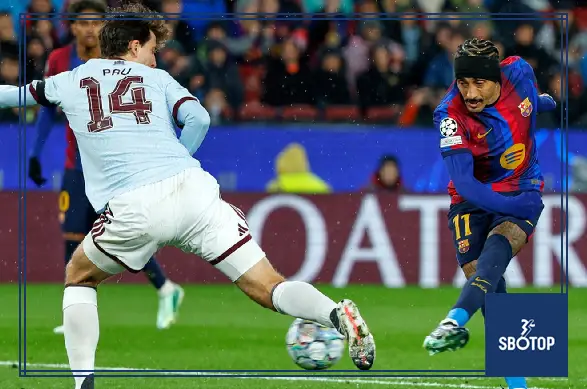
Barcelona climbed to second in the Champions League league-phase standings after Raphinha’s second-half double secured a 3-0 victory over Aston Villa at the Camp Nou. Lamine Yamal provided the early breakthrough before the Brazilian transformed a competitive encounter into a convincing home win.
The result on November 3 took Barcelona to nine points from four matches, ending Villa’s perfect start after three successive European victories. Their second-place position was provisional, with further fixtures in the round still to be played.
For Hansi Flick’s side, the evening brought attacking quality and a valuable clean sheet. For Unai Emery’s visitors, it exposed the cost of an early mistake and opportunities left unfinished. Villa threatened during the first half, but Barcelona’s sharper execution after the interval ultimately created a clear separation between the teams.
Yamal Punishes an Early Mistake
Barcelona needed only seven minutes to establish their advantage. Villa attempted to build from a short goal-kick, but João Gomes’ misplaced pass inside his own penalty area presented Yamal with an opportunity.
The Barcelona forward responded decisively, directing his finish into the far corner and immediately changing the terms of the contest. Villa were behind before they had established any sustained control.
The incident illustrated the risk attached to playing through pressure close to goal. A misplaced pass in midfield may allow time for recovery; the same error inside the penalty area can leave defenders and goalkeeper with almost no opportunity to intervene.
Barcelona still required an accurate finish to exploit the mistake. Yamal supplied it, ensuring that Villa’s unsuccessful attempt to retain possession carried the maximum penalty.
The hosts now had an early lead, while the visitors faced a test of composure.
Villa Find Reasons for Encouragement
Villa did not allow the opening setback to dictate every aspect of their first-half performance. Matty Cash threatened with a volley that was deflected away, while Gomes also had an effort blocked.
Johan Manzambi subsequently shot wide after receiving Nicolas Jackson’s low delivery. Jackson himself was then denied by Joan García, who advanced to interrupt another promising Villa attack.
Those opportunities demonstrated that Barcelona’s lead did not amount to complete control. Villa could reach threatening positions and create problems when moving forward quickly.
Their difficulty was turning those situations into an equaliser. The distinction became increasingly important as the match progressed: finding a route towards goal was possible, but finishing the move remained unresolved.
For Emery, there was encouragement in his team’s response. Nevertheless, opportunities against opponents of Barcelona’s attacking quality can become expensive when they pass without reward.
García Helps Preserve the Advantage
Barcelona’s goalkeeper played an important role in maintaining the lead through an open first half. His interventions allowed the hosts to reach the interval ahead despite Villa’s willingness to attack.
At the other end, Zion Suzuki also had work to do, including saving from Anthony Gordon. The match therefore contained danger in both directions rather than a continuous procession towards Villa’s goal.
For Barcelona, that first-half balance offered a warning. Scoring early had given them an advantage, but it had not removed the need for defensive concentration.
A narrow lead places particular importance on the goalkeeper’s judgement. Deciding when to advance, when to remain positioned and how quickly to react can determine whether an opponent’s promising move becomes a decisive chance.
García helped Barcelona negotiate that period. His contribution provided the foundation for the more comfortable position they established after the restart.
Raphinha Supplies the Crucial Second Goal
The decisive change arrived in the 52nd minute. Fermín López found Raphinha, who created room to shoot and sent a low effort towards goal. A deflection wrong-footed Suzuki, giving Barcelona a two-goal advantage.
The finish contained an element of fortune, but Raphinha had first placed himself in a position to threaten. His movement and footwork forced Villa to defend an attempt rather than simply contain possession.
For the visitors, the second concession substantially increased the difficulty of the task. Their first-half chances had offered a possible route back at 1-0. Now they needed two goals merely to restore parity.
For Barcelona, the additional cushion changed how they could approach the remaining minutes. They could continue attacking without every Villa break carrying the immediate possibility of an equaliser.
Raphinha had shifted the balance firmly towards the hosts.
Cancelo Creates, Raphinha Finishes
Barcelona’s third goal followed in the 64th minute and combined an inventive assist with an assured finish.
João Cancelo advanced down the left before using the outside of his boot to deliver a curling ball into the penalty area. Raphinha attacked its path and converted from close range, completing his double.
The quality of the delivery mattered because it created a different problem for Villa’s defenders. Its trajectory carried the ball around the defensive line and into the space Raphinha was targeting.
The finish was simpler than the pass, but it still depended on anticipation. An inviting delivery can travel harmlessly across goal if nobody recognises where it will arrive.
Raphinha did recognise it. His positioning ensured that Cancelo’s invention became a goal rather than merely an attractive passage of play.
Barcelona had turned a slender half-time advantage into a commanding lead within 19 minutes of the restart.
A Double Built on Different Qualities
Raphinha’s two goals illustrated complementary aspects of effective attacking play. The first came through receiving possession, manufacturing space and attempting a shot. The second required movement towards a delivery and a controlled close-range finish.
That variety made his contribution especially valuable. A forward who can threaten only in one specific situation becomes easier to organise against. Different methods require defenders to make different decisions.
Villa had to consider whether to close Raphinha quickly, protect the space behind them or follow his movement towards goal. Each response could create another opening elsewhere.
This match alone does not establish how every opponent will handle Barcelona’s attack. It did, however, show why Raphinha was so influential on the night.
He supplied the actions that converted Barcelona’s stronger second-half performance into an advantage large enough to withstand any late pressure.
Villa’s Substitutes Cannot Change the Outcome
Emery introduced Leon Goretzka, Ibrahim Mbaye and Ross Barkley shortly after the hour, attempting to alter the contest. Goretzka later went close when his glancing header clipped the outside of the far post.
Alysson and Tammy Abraham also entered as Villa searched for a consolation, but Barcelona preserved their clean sheet.
The substitutions showed that Villa continued looking for a response. They could not, however, recover the competitive position that had existed before Barcelona’s second-half goals.
At a three-goal deficit, even promising attacking moments carry limited immediate value unless they produce a finish. The team chasing the game must also remain alert to further concessions as it commits players forward.
Villa’s late threat prevented the closing period from becoming entirely uneventful. It did not overturn Barcelona’s control of the scoreline or substantially weaken the hosts’ grip on the result.
Nine Points, With Qualification Still Unsettled
Barcelona’s victory moved them above Villa in the standings at the conclusion of the evening’s action. Both teams had nine points after four matches, but Barcelona occupied the higher position.
The table movement strengthened the hosts’ pursuit of a top-eight league-phase finish. It did not confirm qualification or guarantee that their second-place position would survive the remainder of the round.
That distinction matters in a competition where teams complete their fixtures on different nights. A position reached on Tuesday can change after Wednesday’s results without the team involved playing again.
For Barcelona, the practical achievement was securing another three points and improving their position through a convincing scoreline.
For Villa, defeat ended an excellent opening sequence without erasing the value of their previous victories. Their campaign still had a substantial foundation, even after an evening that exposed areas requiring improvement.
Emery Identifies the Cost of Missed Chances
Emery’s assessment acknowledged both the disappointing result and aspects of Villa’s performance that offered encouragement. He highlighted their opportunities before half-time and the need to be clinical while avoiding costly mistakes at this level.
That was a reasonable distinction. Villa’s first-half threat provided evidence that they could compete, but the final score demonstrated that competing in particular passages was insufficient.
The opening concession was avoidable, while their unsuccessful attempts to equalise allowed Barcelona to retain an important advantage.
There is no certainty that taking one chance would have changed the eventual winner. It would, however, have changed the immediate circumstances and required Barcelona to respond to a level score.
Villa never created that situation. Instead, the hosts reached half-time ahead and then supplied the more decisive attacking football.
Barcelona Leave the Stronger Impression
The final score reflected Barcelona’s ability to capitalise at important moments. Yamal punished the early mistake, García helped protect the lead, and Raphinha delivered the finishes that settled the contest.
It was an accomplished victory, although the first half contained enough Villa opportunities to discourage any suggestion that Barcelona had faced no resistance.
That combination gives the performance its significance. Flick’s side had to negotiate a competitive period before establishing their superiority more firmly.
Villa left with evidence of attacking potential and a clear reminder of the standards required to convert it into results against elite opposition.
Barcelona left with three goals, three points and a stronger European position. Raphinha’s double provided the decisive contribution, turning a match that remained open at the interval into a night the hosts could finish with authority.
Also Read: