Cristiano Ronaldo announced his retirement from international football on 5 November 2026, closing a Portugal career that began when he replaced Luís Figo at half-time against Kazakhstan in August 2003. He was 18 then and 41 when he stepped away. In between came 234 senior appearances, 146 goals and three trophies. The appearances and goals are both men’s international world records. His final cap came against Wales on 24 September, and he will continue playing club football for Al Nassr.
In the video announcing his decision, Ronaldo spoke of handing back Portugal’s No. 7 shirt and thanked the people who had shared his 23 years with the national team. The timing brought fresh attention to his disagreement with head coach Jorge Jesus, but the argument over Ronaldo’s international legacy reaches much further back. It takes in the teenager who lost a European Championship final at home, the captain who lifted the same trophy 12 years later and the veteran who was still scoring at the World Cup at 41.
From Figo’s understudy to Portugal’s captain
Ronaldo scored his first international goal against Greece in Portugal’s opening match at Euro 2004. Greece beat the hosts that day and again in the final, leaving Ronaldo in tears. He had gone from making his senior debut to playing in a major final in less than a year. Portugal’s run also put him alongside established players such as Figo at a point when he was still learning how to influence games at that level.
Two years later, Ronaldo scored against Iran at his first World Cup as Portugal reached the semi-finals for the first time in 40 years. The young winger could stretch a defence by carrying the ball from deep or taking on a full-back. Over time, he did more of his best work closer to goal, using his movement and timing to get across defenders. That change helps explain how he remained a scoring threat as Portugal’s personnel and style changed around him.
The European title Portugal won with their captain on the touchline
Ronaldo scored twice in the 3–3 draw with Hungary at Euro 2016 and again in the semi-final win over Wales. His contribution across the tournament became particularly important in retrospect because he could play only a limited part in the final. An early injury forced him off against hosts France, and he spent the closing stages watching and encouraging his teammates from the touchline. Éder scored in extra time to give Portugal a 1–0 victory and their first major senior men’s title.
The final is a useful starting point for judging what Ronaldo meant to Portugal. His goals helped get them there, while the defining action in Paris belonged to a substitute who had never scored a competitive senior goal for his country before that night. The image of Ronaldo on the touchline is familiar, but the football tells a fuller story. Portugal kept France scoreless after losing their captain and found a winner through a player who had begun the final on the bench.
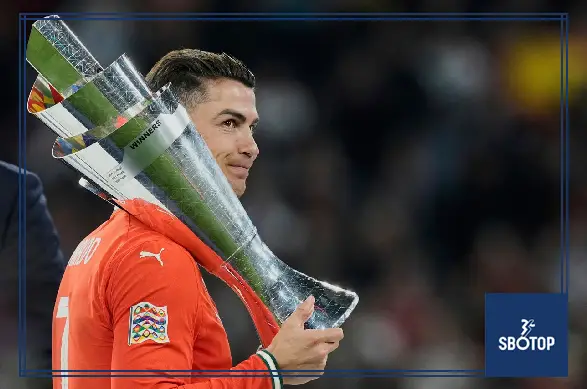
Ronaldo’s role in the 2019 Nations League victory was more direct in the closing stages. He scored all three Portugal goals in the semi-final against Switzerland, including two late in the match. Gonçalo Guedes then scored the winner against the Netherlands in the final. Portugal added another Nations League title in 2025, giving Ronaldo a third senior international trophy nine years after the first.
The records that kept moving
Ronaldo equalled Ali Daei’s men’s international record of 109 goals during Euro 2020 and passed it against the Republic of Ireland in a World Cup qualifier on 1 September 2021. By the time he retired, he had scored 37 more than Daei. He also scored at least once for Portugal in 23 consecutive calendar years, beginning in 2004. That run captures a dimension of his career that the final total alone can obscure. The goals came across a succession of qualifying campaigns, tournaments and changes of coach.
The appearances record followed. Ronaldo drew level with Kuwait’s Bader Al-Mutawa on 196 caps at the 2022 World Cup, then took the record outright against Liechtenstein in March 2023, marking the occasion with two goals. He became the first man to make 200 senior international appearances that June against Iceland and scored the winner in the 89th minute. He also finished with 14 goals at European Championship finals, the men’s tournament record.
Six World Cups and one enduring question
Ronaldo scored at every World Cup from 2006 through 2026, becoming the first man to find the net at six editions. His most prolific tournament was Russia 2018, where he scored four times. Three came in a 3–3 draw with Spain, capped by a late free kick that earned Portugal a point. It was the sort of performance that made the case for judging a player’s tournament impact through individual matches as well as the round his team eventually reached.
He scored three times at the 2026 finals in North America, taking his career World Cup total to 11. His final international goal was a penalty against Croatia in the round of 32. It was also his only goal in a World Cup knockout match. Portugal then lost 1–0 to eventual champions Spain in the round of 16, after which Ronaldo confirmed he had played at his last World Cup. He finished without winning the tournament, having come closest in his first appearance in 2006.
That record leaves room for different assessments. Scoring at six World Cups measures longevity and the ability to adapt to changing teams and roles. The distribution of the goals gives greater weight to the group stage, where ten of the 11 were scored. Those who prioritise contributions in the last rounds of the World Cup will assess the record differently from those who give more weight to sustained scoring, qualification and Portugal’s European titles.
A late selection dispute and a quiet final cap
Questions about Ronaldo’s place in the side had surfaced at the 2022 World Cup and intensified at Euro 2024, when he went without a goal as Portugal reached the quarter-finals. His three goals at the 2026 World Cup showed he could still make a direct contribution. Coaches also had to decide how to use him in games that demanded different things of a centre-forward, including when to start him and when to turn to other options.
The issue became public during the September 2026 international window. Ronaldo was left unused against Norway and subsequently departed the camp before the Denmark fixture. He said Jorge Jesus had broken promises to him, while Jesus denied making an agreement and had left open the possibility of a return. Ronaldo had already spoken of the difficulty of stepping away, and the public accounts establish a disagreement over his role. His farewell message framed the decision around passing the shirt on and thanking those who had accompanied him.
How Portugal’s next generation will inherit the shirt
Portugal now have to replace several things once supplied by a single player. One is a reliable scorer who could turn a tight qualifier with a late goal, as he did on his 200th appearance. Another is the authority of a captain who had been part of the senior side since before some of his eventual teammates were born. Those responsibilities can pass to different players. The next person to wear No. 7 will inherit the number, while the team will decide how to share the work that went with it.
Ronaldo’s final Portugal appearance against Wales was a Nations League match. His first brought him on in place of Figo, whose national appearance record he would eventually surpass. Between those two games, he became the reference point for a generation of Portuguese football and captained the team to its first major title. The debate over where he ranks will depend on how much weight people give to records, trophies and World Cup knockout games. Portugal’s history already contains his clearest legacy. A team that lost its first European final with Ronaldo in it won its first major trophy with him as captain.
Also Read: