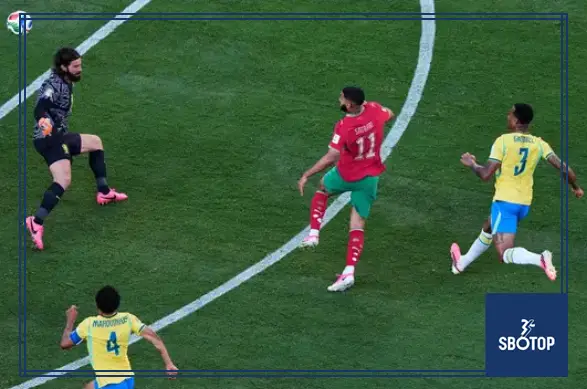
A surprising moment unfolded after Brazil’s 1-1 draw against Morocco in their opening Group C match at the 2026 FIFA World Cup in East Rutherford, New Jersey. What should have been a routine post-match press conference turned into a talking point—not because of football, but because of a language barrier involving Vinícius Júnior.
The Real Madrid star, who appeared as Brazil’s player representative, requested that a journalist’s question be asked in Spanish. However, the request was denied due to the absence of Spanish translation services in the press room.
The incident has since triggered debate about FIFA’s language policies at one of the most global sporting events in the world.
Vinícius Jr Faces Unexpected Language Barrier After Brazil Match
Following Brazil’s disappointing 1-1 draw against Morocco, Vinícius Júnior stepped into the media zone to address reporters. During the session, a journalist posed a question in English, prompting the Brazilian forward to request clarification in Spanish instead.
However, the moderator immediately responded that the request could not be fulfilled.
“Sorry, we do not have Spanish translation available. Questions must be in English or one of the other supported languages today. Thank you,” the moderator said, as reported by Sportbible.
The moment quickly spread across social media, with fans questioning why one of the world’s most widely spoken languages was not supported in a World Cup press conference.
Similar Situations Involving Hakimi and De Jong
Vinícius Jr was not the only player affected by strict language rules during media sessions at the tournament. Similar situations have already occurred involving other high-profile stars.
Notable cases include:
- Achraf Hakimi (Morocco) – A journalist attempted to ask questions in Spanish due to his Real Madrid background, but was stopped by officials.
- Frenkie de Jong (Netherlands) – A Spanish-language question was rejected, with only English, Dutch, and Japanese permitted.
- Multiple press conferences where moderators intervened to restrict language usage strictly.
These incidents have fueled discussions about consistency and flexibility in FIFA’s media guidelines.
FIFA’s Language Policy Explained
According to officials, the restrictions are not random but part of a structured translation system used during World Cup press conferences. FIFA only provides interpretation services for selected languages based on logistical planning and match requirements.
The primary working language remains English, with additional support depending on the teams involved and available interpreters.
Key reasons behind the policy:
- Limited interpreter availability for every language combination
- Pre-arranged media logistics for each match venue
- Focus on operational efficiency during packed tournament schedules
- Priority given to official FIFA working languages
While the system is designed for practicality, it has clearly created friction in multilingual situations.
Why the Controversy Is Growing
The issue has gained attention not just because of Vinícius Jr, but due to the global nature of the tournament itself. The 2026 World Cup is being hosted across the United States, Canada, and Mexico—making it the most linguistically diverse edition in history.
Spanish, in particular, plays a major role in global football communication. It is:
- One of the most widely spoken languages worldwide
- The second most common language in the United States
- The official language of multiple participating nations in Latin America
- A key language in global football media coverage
Given this context, many fans and analysts believe the lack of Spanish support in certain press settings feels inconsistent.
Media Access vs Tournament Logistics
The controversy highlights a growing tension between global accessibility and event logistics. On one hand, FIFA aims to standardize communication across venues. On the other, players and journalists operate in a highly international environment where multiple languages are essential.
The core debate centers around:
- Should FIFA expand language coverage in press conferences?
- Is English-only or limited-language policy still practical in 2026?
- How can media access remain inclusive in global tournaments?
- Should star players have more flexibility in communication preferences?
For many observers, the Vinícius Jr incident has become symbolic of a larger issue in modern football administration.
Social Media Reaction and Fan Debate
Unsurprisingly, the moment quickly gained traction online. Fans and pundits shared mixed reactions, with some defending FIFA’s structured approach and others criticizing the lack of flexibility.
Some argue that logistical limitations are understandable given the scale of the tournament. Others believe that a World Cup—by definition a global event—should be fully equipped to handle multilingual interaction, especially involving Spanish-speaking nations and players.
What Happens Next?
At this stage, FIFA has not issued a specific statement regarding the Vinícius Jr incident. However, similar discussions in the past suggest that language protocols are unlikely to change mid-tournament.
Still, the conversation may influence future editions of the World Cup, particularly as the demand for more inclusive media access continues to grow.
Conclusion: A Small Moment With a Big Message
What began as a simple translation request from Vinícius Júnior has evolved into a broader debate about communication, inclusivity, and global standards in football.
While Brazil’s draw against Morocco will be remembered for its on-field implications, the post-match press conference has added an unexpected subplot to the 2026 World Cup story.
In a tournament designed to unite nations through football, even small language barriers can spark big conversations.
ALSO READ :